Plug Power (PLUG) Stock Forecast: 2026–2030 Scenarios
Looking at the Plug Power stock forecast? We break down analyst targets, recent losses, and bull, base, and bear valuation scenarios through 2030.
On this page
Plug Power shares sit near the bottom of their 52-week range as the company continues to spend heavily to build out its green hydrogen network. If you own the stock or are thinking about buying the dip, you need to understand whether its revenue growth can outpace its persistent net losses.
Long-range stock forecasts are not guarantees or precise predictions. Instead, a proper plug power stock forecast looks at where the business stands today and maps out realistic operational scenarios over the coming years.
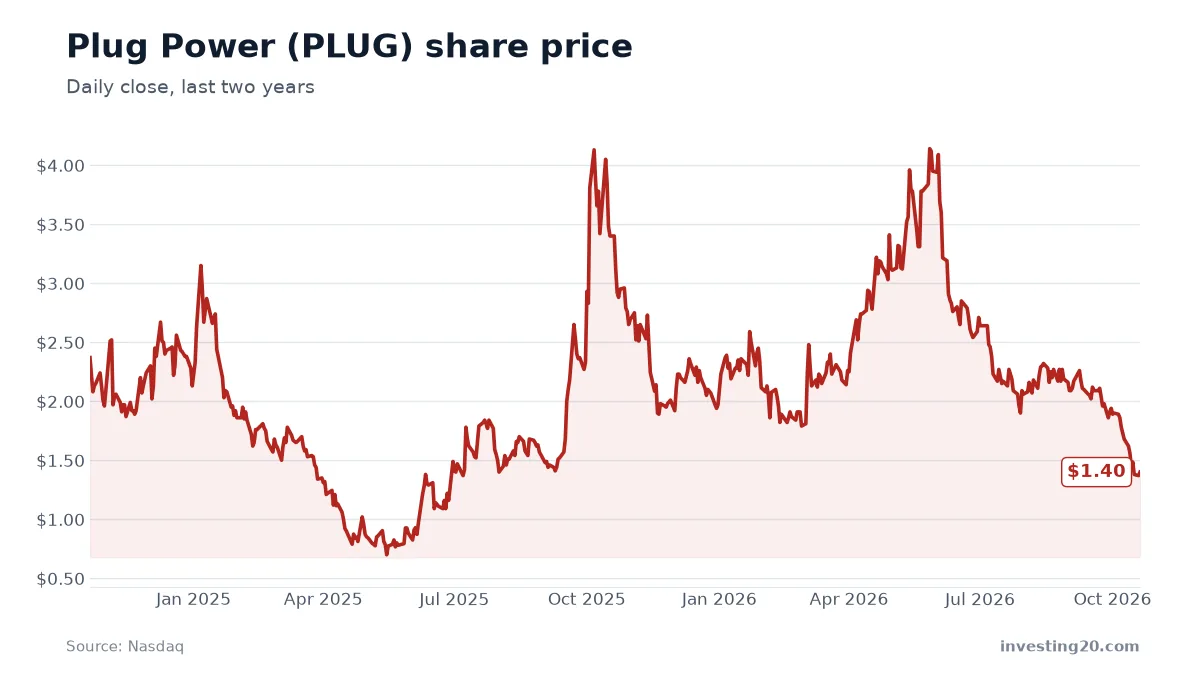
| Share price | $1.40 (Oct 20, 2026 2:21 PM ET) |
| Market value | about $2.0 billion |
| 52-week range | $1.35 – $4.33 |
| Revenue, last 12 months | about $744.1 million |
| Revenue growth, last fiscal year | 13% |
| Net income, last 12 months | a loss of about $1.6 billion |
| Price-to-sales | about 2.6× |
| Price-to-earnings | n/a (not profitable) |
| Analyst 12-month target | average $3.00 (range $1 – $7); 3 buy, 5 hold, 3 sell |
Market data from Nasdaq as of October 20, 2026. Check current figures before making any decision.
What Plug Power does and how it makes money
Headquartered in New York, Plug Power is an energy technology company trying to build an end-to-end green hydrogen ecosystem. It designs and manufactures electrolyzers to generate hydrogen from water, fuel cell systems to replace batteries and diesel engines, liquid hydrogen storage tanks, and specialized fueling stations.
The company generates revenue by selling this equipment and providing ongoing maintenance and hydrogen fuel deliveries. It is the world’s largest user of liquid hydrogen, operating an internal generation network that produces 40 tons of hydrogen per day. Globally, Plug has deployed more than 76,000 fuel cell systems and over 275 fueling stations across five continents.
Its commercial customers primarily use hydrogen fuel cells in material handling equipment like warehouse forklifts. High-volume distribution centers run around the clock, where fast hydrogen refueling offers productivity advantages over recharging standard electric batteries. Plug powers operations for major global companies, including Walmart, Amazon, Home Depot, BMW, and BP.
Where the business stands today
Plug Power generated $744.1 million in revenue over its last four reported quarters. That represents a partial rebound from fiscal 2024 revenue of $628.8 million, though it remains below the $891.3 million the company booked in fiscal 2023. Revenue for the latest full fiscal year (2025) stood at $709.9 million, reflecting annual growth of 12.9%.
Recent quarterly figures show steady top-line volume. Plug reported $177.06 million in revenue for the quarter ending September 30, 2025, and $225.22 million for the quarter ending December 31, 2025. In 2026, it posted $163.51 million for the quarter ending March 31, followed by $178.30 million for the quarter ending June 30.
Plug Power Annual Revenue Trend:
Fiscal 2023: $891.3 million
Fiscal 2024: $628.8 million
Fiscal 2025: $709.9 million
Last 4 Quarters: $744.1 million
Profitability remains the central challenge. The company recorded a net loss of $1.6 billion over the last four quarters, matching its $1.6 billion loss in fiscal 2025. While that marks an improvement over the $2.1 billion net loss in fiscal 2024, the business continues to burn significant cash to fund operations and manufacturing expansion. At the current share price of $1.40, the market value is roughly $2.0 billion, giving the stock a price-to-sales multiple of 2.6.
Much like capital-intensive clean technology firms such as Rivian Automotive or earlier-stage growth plays like Rocket Lab, scaling heavy infrastructure requires absorbing substantial losses before reaching unit-level break-even economics.
PLUG stock forecast for the next 12 months
Analyst sentiment on Wall Street reflects sharp division over the plug stock future. According to consensus data tracked by Nasdaq across 11 analysts, the stock carries 3 buy ratings, 5 hold ratings, and 3 sell ratings.
The average 12-month plug price target is $3.00, which sits 114.3% above the current $1.40 price. However, the wide spread between targets reveals deep uncertainty. The lowest plug stock price target is $0.75, while the highest target stands at $7.00.
For the stock to push toward the consensus target of $3.00, Plug Power would need to demonstrate visible progress on narrowing its losses. Analyst consensus forecasts project earnings per share (EPS) of -$0.25 for fiscal 2026, -$0.16 for fiscal 2027, and -$0.08 for fiscal 2028. Hitting or beating those targets requires higher margins on fuel delivery and lower per-unit manufacturing costs on its electrolyzers. Conversely, if gross margins stay deeply negative or cash burns accelerate, shares could easily test the street low of $0.75.
PLUG stock forecast for 2030: three scenarios
Looking further out requires a systematic framework rather than guessing. Our 2030 model starts with Plug’s trailing four-quarter revenue of $744.1 million. It applies different annual growth rates through 2030, assigns a price-to-sales multiple reflecting market sentiment, and factors in ongoing share dilution as the company issues equity to fund operations.
To put these numbers into context, consider the break-even math. Assuming our base-case valuation multiple (2.6 times sales) and share count (1.49 billion shares), Plug Power needs roughly $789.7 million of revenue in 2030 just to justify today’s $1.40 stock price.
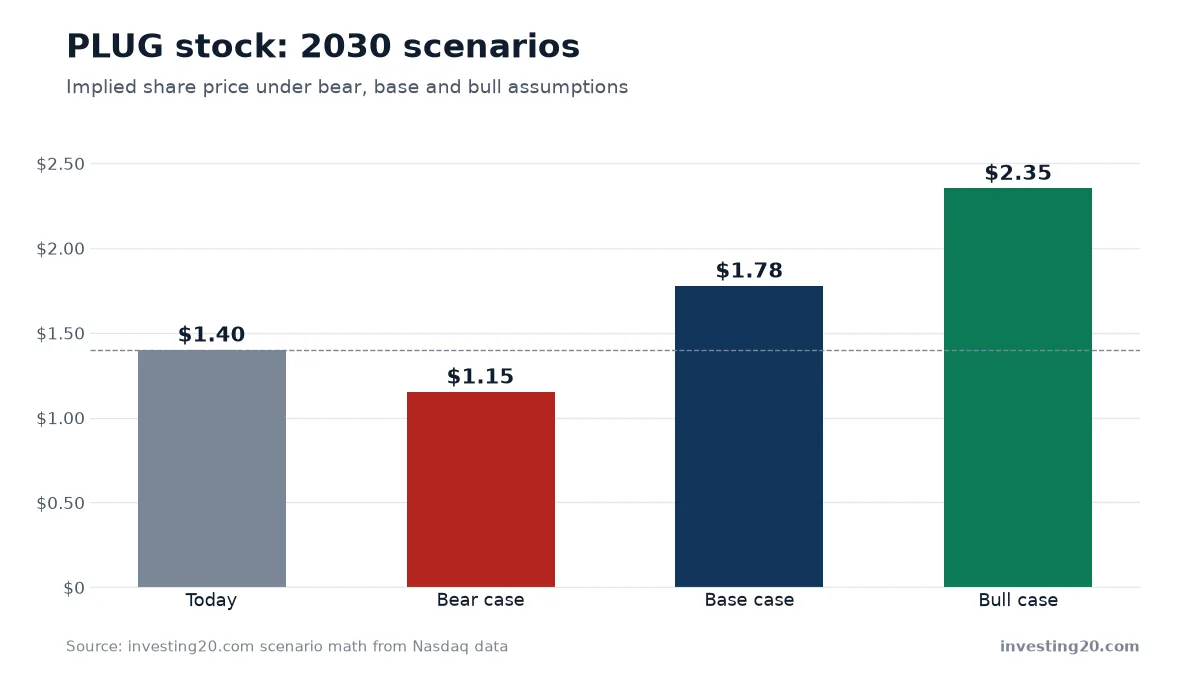
| Scenario | Revenue growth per year | 2030 revenue | Price-to-sales | Shares | Implied share price |
|---|---|---|---|---|---|
| Bear | 4% | $861.8 million | 2.1× | 1.58 billion | about $1.15 (-18%) |
| Base | 8% | $1.0 billion | 2.6× | 1.49 billion | about $1.78 (+27%) |
| Bull | 12% | $1.2 billion | 2.9× | 1.44 billion | about $2.35 (+68%) |
The bear case ($1.15)
In the bear case, hydrogen adoption slows, or industrial customers delay fleet conversions. Revenue grows at just 4% per year, reaching $861.8 million by 2030. Ongoing losses require heavy equity financing, expanding the share count to 1.58 billion. The valuation multiple compresses to 2.1 times sales, producing an implied share price of $1.15, an 18% decline from current levels.
The base case ($1.78)
In the base case, Plug’s revenue expands at 8% per year, lifting sales to $1.0 billion by 2030. The company keeps dilution moderate, ending with 1.49 billion shares outstanding. Holding its current price-to-sales valuation multiple steady at 2.6, the implied share price reaches $1.78, representing a 27% gain.
The bull case ($2.35)
In the bull case, demand for industrial decarbonization accelerates. Plug maintains its recent momentum, growing revenue at an average of 12% annually to hit $1.2 billion in 2030. Tighter cost controls reduce financing needs, limiting dilution to 1.44 billion shares. With stronger execution, the market awards a slightly higher multiple of 2.9 times sales, pointing to an implied share price of $2.35, or a 68% gain.
The takeaway across all three scenarios is that massive equity returns are not automatic. Because ongoing losses force share dilution, top-line revenue growth does not flow directly into share-price gains dollar for dollar.
Risks to weigh
Before making any investment decision based on a plug power prediction, consider these fundamental risks:
- Heavy ongoing losses: Plug lost $1.6 billion over the last four reported quarters, following a $2.1 billion loss in 2024. Sustained red ink limits financial flexibility.
- Ongoing share dilution: Because the company remains unprofitable, issuing new stock is a primary mechanism to raise capital. More shares outstanding reduces the ownership slice and upside per share.
- Execution on green hydrogen plants: Scaling hydrogen generation to 40 tons per day requires complex, costly industrial facilities. Cost overruns or delays directly pressure margins.
- Customer concentration: Plug relies heavily on a small group of large logistics operations like Walmart and Amazon. Any change in procurement plans from these anchor customers can swing quarterly numbers.
- Volatile price history: The stock traded as high as $4.14 in May 2026 and as low as $0.70 in May 2025. It remains down 40.9% from its October 2024 level of $2.37.
Evaluating risk-heavy turnarounds like Plug Power requires the same patience as looking at developing international plays like NIO.
What to watch next
If you are tracking the plug power stock prediction for upcoming quarters, focus on these metrics:
- Quarterly cash burn and gross margin: Watch whether fuel delivery gross margins move closer to positive territory as local hydrogen generation ramps up.
- Progress on EPS consensus targets: Track whether the company tracks toward analyst targets of -$0.25 per share in fiscal 2026 and -$0.16 in fiscal 2027.
- Share count trends: Monitor the weighted average shares outstanding in quarterly SEC filings to see the pace of dilution.
FAQ
What is the 12-month plug price target from Wall Street analysts?
According to Nasdaq consensus data from 11 analysts, the average 12-month plug stock price target is $3.00, with estimates ranging from a low of $0.75 to a high of $7.00.
Is Plug Power currently profitable?
No, Plug Power is not profitable. Over the last four reported quarters, the company reported a net loss of $1.6 billion on revenue of $744.1 million.
What is the long-term plug stock forecast for 2030?
In our 2030 scenario analysis, implied share prices range from $1.15 in the bear case (assuming 4% annual revenue growth) to $2.35 in the bull case (assuming 12% annual growth), with a base case around $1.78.
Market data and financials: Nasdaq. Scenario math: investing20.
This article is for information only and is not investment advice. Do your own research before investing.