Rocket Lab (RKLB) Stock Forecast 2026–2030: Long-Term Outlook
Rocket Lab trades near $51 with a $32B valuation. See analyst 12-month targets and 2026–2030 revenue, valuation, and share price scenarios.
On this page
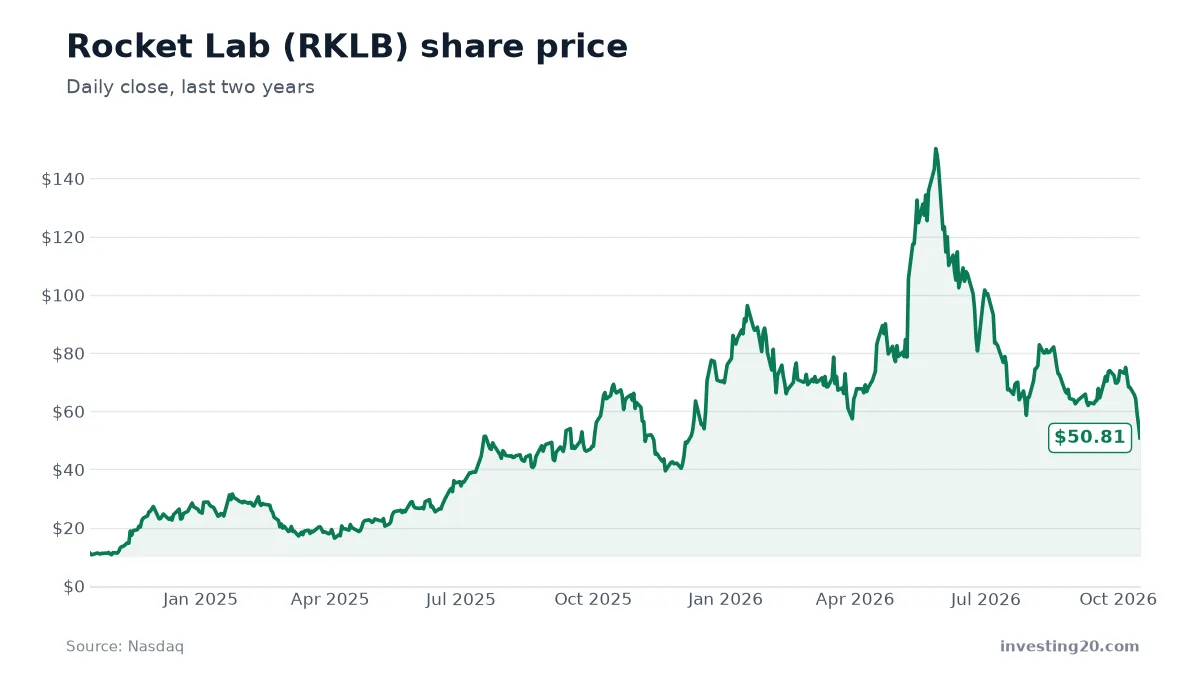
Rocket Lab (RKLB) has transformed from a niche launch startup into one of the most closely watched commercial space companies on the market. Between October 2024 and October 2026, the stock climbed 355.4%, pushing the company’s valuation to roughly $31.9 billion as revenue expanded rapidly across both launch services and satellite components.
Looking out several years requires a clear distinction between firm price predictions and structured scenarios. Markets do not move in straight lines, and multi-year projections are simply mathematical frameworks based on revenue growth rates, valuation multiples, and potential share dilution. Here is what the numbers look like today, what Wall Street expects over the next year, and how different growth scenarios could shape Rocket Lab’s valuation by 2030.
| Share price | $50.95 (Oct 16, 2026 6:09 PM ET) |
| Market value | about $31.9 billion |
| 52-week range | $37.57 – $151.00 |
| Revenue, last 12 months | about $769.1 million |
| Revenue growth, last fiscal year | 38% |
| Net income, last 12 months | a loss of about $165.5 million |
| Price-to-sales | about 41.5× |
| Price-to-earnings | n/a (not profitable) |
| Analyst 12-month target | average $99.65 (range $67 – $132); 16 buy, 3 hold, 0 sell |
Market data from Nasdaq as of October 16, 2026. Check current figures before making any decision.
The snapshot above summarizes Rocket Lab’s position as of October 16, 2026. While the business generates over $760 million in trailing annual revenue, it trades at an elevated valuation multiple of 41.5 times sales while continuing to report net losses.
What Rocket Lab does and how it makes money
Rocket Lab is an end-to-end space company founded in 2006 and headquartered in Long Beach, California. Rather than operating strictly as a rocket builder, the business delivers launch services, satellite manufacturing, spacecraft components, and on-orbit management solutions. This dual setup allows Rocket Lab to sell rides to orbit while also supplying the hardware and flight software that customers operate once in space.
The launch side of the business centers on the Electron small orbital launch vehicle. Since its first orbital mission in January 2018, Electron has become the second most frequently launched U.S. rocket on an annual basis. Rocket Lab also offers HASTE, a modified suborbital version of Electron built specifically for hypersonic test flights for government and defense customers. To address larger payloads, the company is developing Neutron, a medium-lift vehicle designed for commercial constellation deployment.
Rocket Lab’s customers include commercial satellite operators, civil space programs, and military agencies. By providing everything from solar panels and separation systems to dedicated launch operations, the company captures revenue at multiple points of a space mission rather than relying solely on launch cadences.
Where the business stands: revenue and losses
Rocket Lab’s top line has expanded quickly over the past three fiscal years. Full-year revenue stood at $244.6 million in 2023, climbed to $436.2 million in 2024, and reached $601.8 million in 2025, which marked 38.0% growth year over year. That momentum carried into 2026. Over the last four reported quarters, total revenue reached $769.1 million:
- Quarter ending September 30, 2025: $155.08 million
- Quarter ending December 31, 2025: $179.65 million
- Quarter ending March 31, 2026: $200.35 million
- Quarter ending June 30, 2026: $234.07 million
Despite top-line expansion, the business remains unprofitable. Rocket Lab posted net losses of $190.2 million in 2024 and $198.2 million in 2025. Over the four quarters ending June 30, 2026, cumulative net losses totaled $165.5 million. Developing launch vehicles like Neutron requires heavy capital spending, a pattern often seen when evaluating growth-stage hardware companies like those examined in our Tesla Stock Price Prediction review.
Recent quarterly earnings reports show mixed progress against analyst bottom-line estimates. For the quarter ending September 2025, Rocket Lab reported earnings per share (EPS) of -$0.01 against an expected -$0.09. The December 2025 quarter missed expectations with an EPS of -$0.10 versus the -$0.08 consensus. However, both the March 2026 and June 2026 quarters delivered slight beats, each reporting an EPS of -$0.06 against a projected -$0.07. Wall Street consensus expects net losses per share of -$0.20 for full-year 2026 and -$0.09 for full-year 2027.
RKLB stock forecast for the next 12 months
Wall Street analysts track Rocket Lab closely, and sentiment remains broadly constructive. According to Nasdaq data, 19 analysts cover the stock, with 16 rating it a buy, 3 rating it a hold, and zero assigning a sell rating.
The average 12-month price target is $99.65, representing a 95.6% gain from the October 16, 2026 share price of $50.95. The target range remains wide:
- High estimate: $132.00
- Average estimate: $99.65
- Low estimate: $67.00
Even the lowest analyst target of $67.00 sits roughly 31% above the current market price, though the stock has already seen substantial volatility over the past year, trading between $37.57 and a peak of $151.00.
For the stock to push toward that $99.65 average target over the coming year, Rocket Lab would need to keep quarterly revenue tracking above $230 million, hit milestones on its Neutron development timeline, and maintain a steady launch cadence for Electron. Any significant test anomalies or launch delays would make it difficult to defend high multiples, much like the operational shifts discussed in the Amazon Stock Price Prediction 2023, 2025, 2030, 2040 and 2050 overview.
RKLB stock forecast for 2030: three scenarios
Looking toward 2030 requires projecting revenue growth, estimating future share counts to account for dilution, and applying realistic valuation multiples. Today, Rocket Lab trades at a price-to-sales multiple of 41.5. As high-growth companies mature and sales bases expand, price-to-sales multiples almost always contract toward historical industry norms.
The scenarios below assume that revenue growth starts near recent levels and slows over time, while price-to-sales multiples compress to 5 in the bear case, 10 in the base case, and 18 in the bull case.
| Scenario | Revenue growth per year | 2030 revenue | Price-to-sales | Shares | Implied share price |
|---|---|---|---|---|---|
| Bear | 11% slowing to 5% | $1.1 billion | 5.0× | 705 million | about $7.47 (-85%) |
| Base | 23% slowing to 15% | $1.5 billion | 10.0× | 665 million | about $23.09 (-55%) |
| Bull | 34% slowing to 25% | $2.2 billion | 18.0× | 639 million | about $61.01 (+20%) |
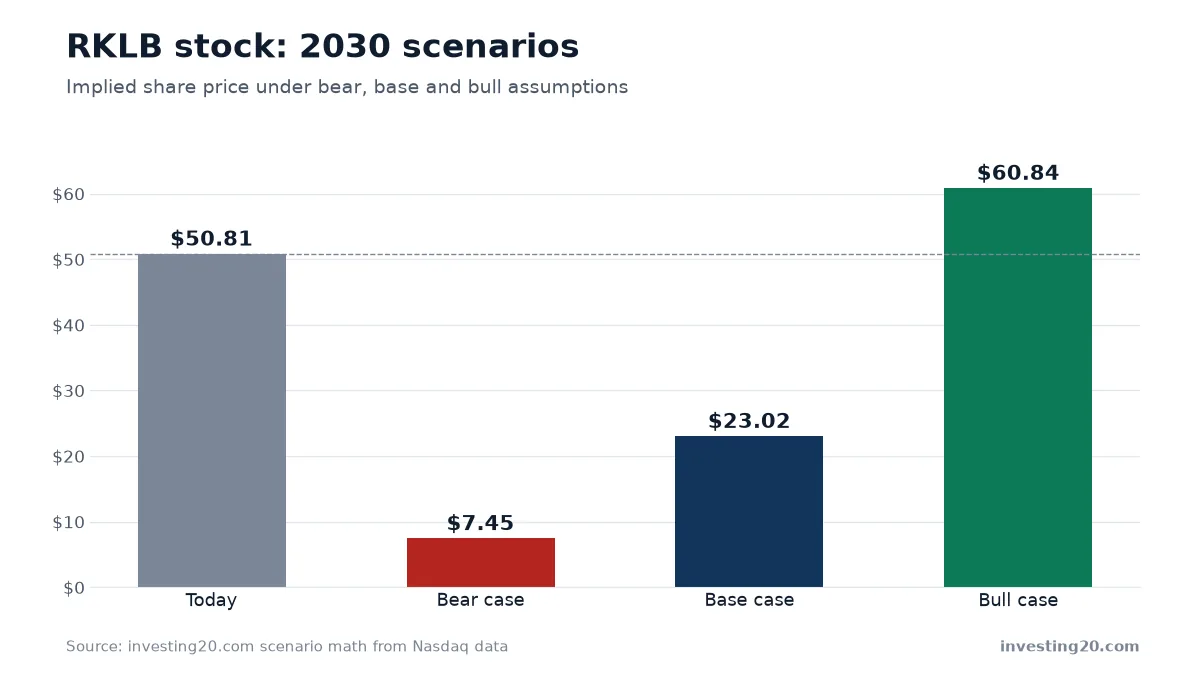
The table outlines how these assumptions translate into implied share prices by 2030:
In the bear case, annual revenue growth slows from 11% down to 5%, averaging around 8% annually. Rocket Lab reaches $1.1 billion in revenue by 2030. If the market values the business at 5.0 times sales and dilution expands the share count to 705 million, the implied share price drops to about $7.47, an 85% decline from today’s price.
In the base case, revenue grows at an average of roughly 19% per year, starting at 23% and slowing to 15%. This brings 2030 revenue to $1.5 billion. Applying a 10.0 price-to-sales multiple across 665 million shares yields an implied price of about $23.09, which sits 55% below the current market price.
In the bull case, Rocket Lab sustains faster expansion, averaging 30% revenue growth per year as sales climb from 34% growth down to 25%. Under this path, 2030 revenue reaches $2.2 billion. Valued at an 18.0 multiple with 639 million shares, the implied stock price reaches about $61.01, a 20% gain from current levels.
The central takeaway is valuation math: at a base-case multiple of 10 times sales and 665 million shares, Rocket Lab would need roughly $3.4 billion in annual revenue in 2030 just to support its current $50.95 share price. Today’s price already factors in years of strong operational execution.
Risks to weigh
Before making any investment decisions, investors need to weigh several company-specific and structural risks:
- Elevated valuation multiple: Trading at 41.5 times sales leaves little margin for error if top-line growth slows faster than expected.
- Ongoing net losses: Rocket Lab lost $165.5 million over the past four reported quarters, and analyst consensus points to continued net losses through at least 2027.
- Neutron execution risk: Developing and testing a larger, medium-lift launch vehicle involves significant capital expenses and potential technical delays.
- Share dilution: Continued losses and stock-based compensation can increase the total share count, reducing per-share upside over time.
- Flight failure exposure: Orbital launch operations inherently carry physical failure risks that can pause launch manifests and impact revenue for months.
Investors exploring high-multiple, volatile growth stories can compare these risks to digital asset equities covered in our MARA Price Prediction: 2023, 2025 and 2030 breakdown.
What to watch next
If you hold or are watching Rocket Lab, the most critical item over the next few quarters is the quarterly revenue run rate. Investors should track whether sales can stay comfortably above the $230 million mark reached in June 2026 and whether net losses narrow toward the -$0.09 EPS consensus projected for 2027.
Beyond headline earnings, keep an eye on hardware development milestones for the Neutron rocket and the frequency of Electron missions. Sustained launch cadences and backlog execution in satellite components will reveal whether Rocket Lab is tracking toward the bull-case revenue trajectory or heading closer to base-case reality.
FAQ
What is the 12-month price target for Rocket Lab (RKLB)?
According to Nasdaq consensus data as of October 2026, the average 12-month target is $99.65, with estimates ranging from a low of $67.00 to a high of $132.00 across 19 analysts.
Is Rocket Lab currently profitable?
No, Rocket Lab is not profitable. Over the four reported quarters ending June 30, 2026, the company posted a net loss of $165.5 million.
How fast is Rocket Lab growing its revenue?
Rocket Lab grew revenue by 38.0% in fiscal 2025 to reach $601.8 million, up from $436.2 million in 2024 and $244.6 million in 2023. Over the last four reported quarters through June 2026, revenue totaled $769.1 million.
What does Rocket Lab need to achieve to support its current stock price by 2030?
At a base-case valuation multiple of 10 times sales and an estimated 665 million shares, Rocket Lab would need roughly $3.4 billion in annual revenue in 2030 just to break even with its October 2026 price of $50.95.
Market data and financials: Nasdaq. Scenario math: investing20.
This article is for information only and is not investment advice. Do your own research before investing.