NIO Stock Forecast and Price Prediction 2026–2030: Bull, Base and Bear Cases
NIO stock forecast and price prediction for 2026 to 2030: record deliveries, thin profits, analyst targets, and bear, base and bull 2030 scenarios with the math shown.
On this page
- Key numbers at a glance
- Where the business stands in 2026
- Why the stock fell in 2026 while sales grew
- NIO stock forecast for 2026 and 2027
- NIO stock forecast for 2030: three scenarios
- NIO stock price prediction by year
- What about 2040 and 2050?
- How the earlier forecast held up
- Risks to weigh
- FAQ
- What to watch next
Updated October 17, 2026. This is the NIO stock forecast for NIO Inc., the Chinese electric-car maker behind the NIO, ONVO and FIREFLY brands. It covers where the business stands in 2026, what analysts expect next, and a NIO stock price prediction for each year to 2030 under three scenarios.
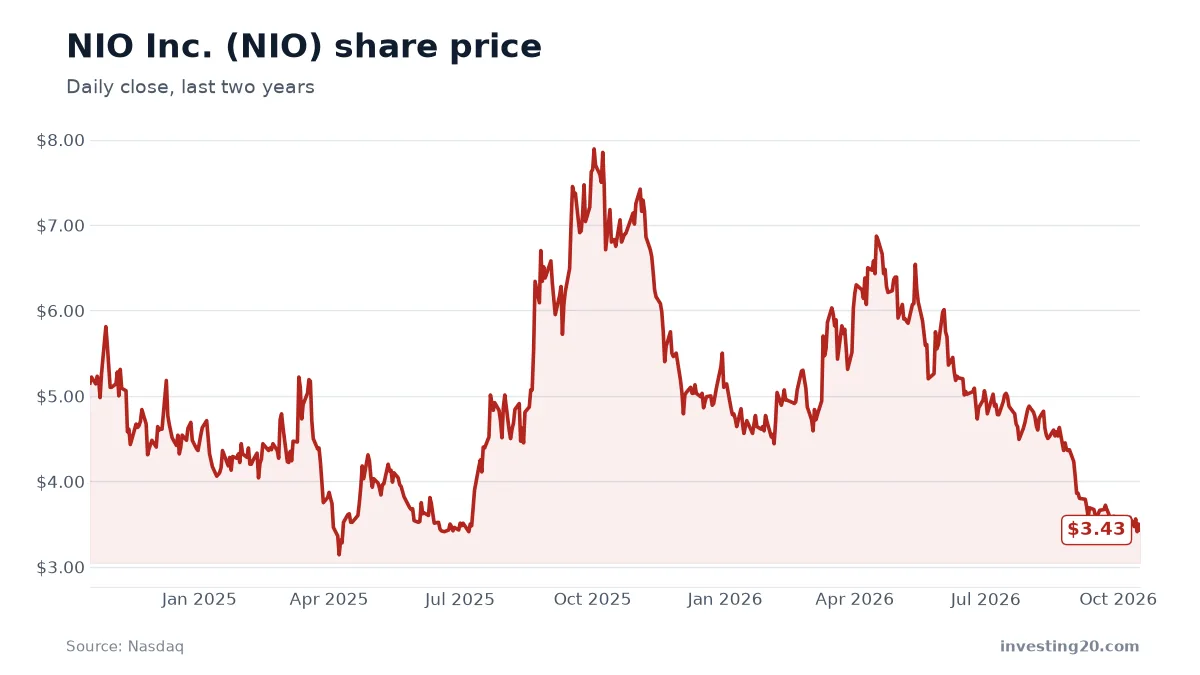
The short answer: using NIO’s current revenue pace and simple valuation math, the stock lands near $2.60 in a bear case, $8 in a base case and $23 in a bull case by 2030, against $3.43 today. Analysts’ 12-month targets average about $5.84. The outcome depends on whether NIO turns record sales into lasting profits without issuing many more shares.
Nothing here is a prediction you should trade on. The earlier version of this article forecast $400 to $450 by 2030; that was not defensible, and the section on how it held up explains why this version shows its math instead.
Key numbers at a glance
| Share price | $3.43 (close on October 16, 2026) |
| Market value | about $8.6 billion |
| Shares outstanding | about 2.5 billion |
| 52-week range | $3.36 – $7.54 |
| Change in 2026 | down about 33% (from $5.10 at the end of 2025) |
| Revenue, 2025 | RMB87.5 billion (about US$12.5 billion) |
| Cash reserves | RMB56.7 billion (US$8.4 billion), June 30, 2026 |
| Analyst 12-month targets | $4.00 – $8.80 (consensus about $5.84) |
Price, share and analyst data are from Nasdaq; financial results are from NIO’s investor relations site. Check them for current figures before you make any decision.
Where the business stands in 2026
NIO is selling more cars than ever and is close to breaking even, but it is not consistently profitable yet.
Full year 2025 (reported March 10, 2026):
- 326,028 vehicles delivered, up 46.9%
- Revenue of RMB87.5 billion, up 33.1%
- Net loss of RMB14.9 billion (US$2.1 billion), down 33.3% from 2024
- A first-ever quarterly net profit, RMB282.7 million, in the fourth quarter
Second quarter 2026 (reported September 1, 2026):
- Revenue of RMB32.1 billion, up 69.1% from a year earlier
- 107,658 vehicles delivered, up 49.4%, but short of the company’s guidance of 110,000 to 115,000
- Vehicle margin, the profit on each car before overheads, of 18.5%, up from 10.3% a year earlier
- An adjusted operating profit of RMB206.9 million but a net loss of about RMB528 million
- Positive operating cash flow for the fourth quarter in a row
Third-quarter deliveries came in at 109,178, inside NIO’s guidance. The mix is shifting, though. In September the NIO brand delivered 21,318 cars, up 55%, and the small FIREFLY brand set a monthly record of 7,327, while the mid-priced ONVO brand fell about 43% from a year earlier. Total September growth slowed to 7.7%, the weakest of the year. Management has said it is aiming for more than 40,000 deliveries a month in the fourth quarter.
Why the stock fell in 2026 while sales grew
The share price is down about a third this year, which looks odd next to a 69% jump in quarterly revenue. A few things explain it:
- Slowing growth. The second-quarter delivery miss and the 7.7% growth in September suggest demand is cooling, and ONVO’s slump undercuts the case for a second mass-market brand.
- Rising costs. Input costs per car rose in 2026, according to TIKR’s summary of NIO’s second-quarter call, and China’s price war leaves little room to pass them on.
- Thin, adjusted profits. The profits are on an adjusted basis; on standard accounting NIO still lost money in the second quarter.
- Dilution worries. On September 28, NIO agreed to sell a 30% stake in NIO Power, its battery-swapping and charging business, to a Geely subsidiary in exchange for Geely’s own battery-swap business and RMB640 million in cash. The deal values NIO Power at about RMB16 billion and still needs regulatory approval. It brings in a partner for the swap network, but investors read it as giving away part of one of NIO’s most distinctive assets.
JPMorgan downgraded the stock to neutral and cut its target to $4.50 from $7, citing slow demand, according to TIKR. The stock set a 52-week low of $3.36 in October.
NIO stock forecast for 2026 and 2027
Of the 11 analysts in Nasdaq’s consensus, six rate NIO a buy, four a hold and one a sell. Their 12-month targets run from $4.00 to $8.80, with a consensus of about $5.84, which is about 70% above the current price. Goldman Sachs has a $6.10 target.
Analysts expect NIO to lose about $0.13 per share in 2026, then earn about $0.05 in 2027 and $0.23 in 2028. That path is the core of the bull argument: if NIO earns money every year from 2027, the stock no longer has to be valued as a cash-burning startup.
The next test is the third-quarter report, which NIO usually releases in late November. The numbers to watch are the fourth-quarter delivery guidance against the 40,000-a-month goal, vehicle margin against the 18.5% of the second quarter, and whether net income turns positive.
NIO stock forecast for 2030: three scenarios
No one can forecast a share price four years out. What you can do is pick assumptions and see what they imply. NIO’s revenue in the first half of 2026 was about RMB57.7 billion; doubling that gives an annual pace of roughly RMB115 billion, or about US$17 billion. The table grows that figure to 2030, applies a price-to-sales multiple, and allows for more shares.
| Scenario | Revenue growth per year | 2030 revenue | Price-to-sales | Shares | Implied share price |
|---|---|---|---|---|---|
| Bear | 5% | $20.7 billion | 0.4× | 3.2 billion | about $2.60 |
| Base | 15% | $29.7 billion | 0.8× | 2.9 billion | about $8.20 |
| Bull | 25% | $41.5 billion | 1.5× | 2.7 billion | about $23 |
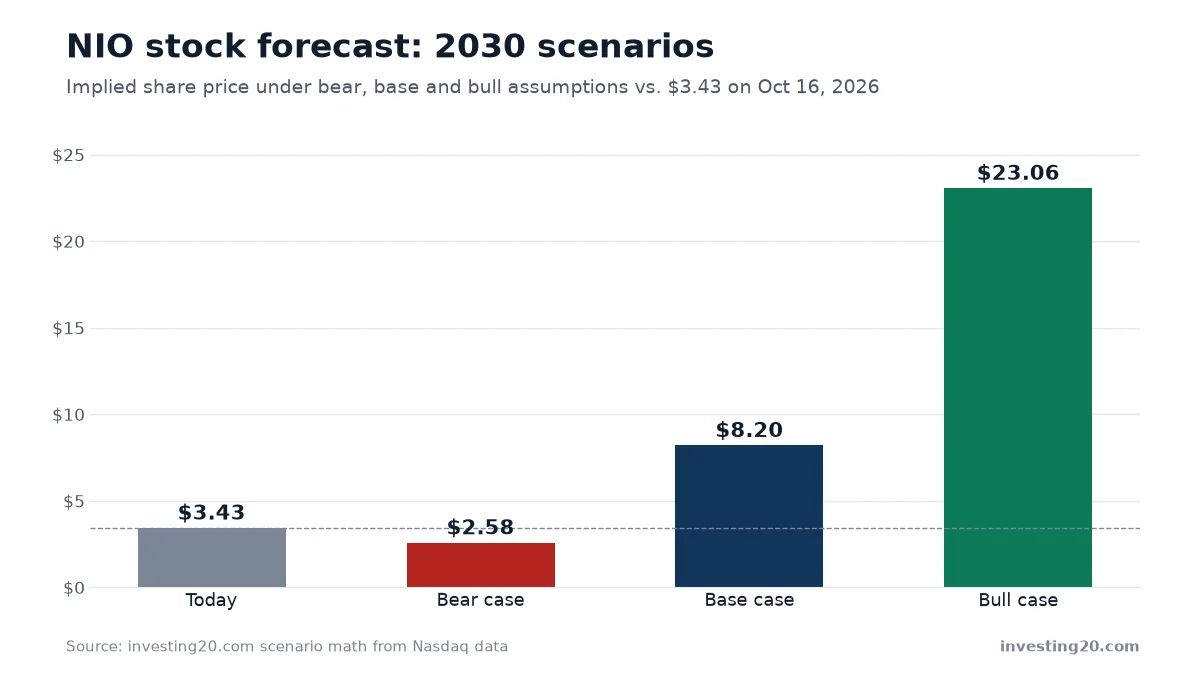
How to read it:
- Bear case. The price war keeps margins thin, growth stalls in the single digits and NIO raises more money by issuing shares. The market keeps valuing it at well under one times sales, a little below today’s roughly 0.5 times.
- Base case. Growth slows to 15% a year, which at the current average selling price of about RMB270,000 per car means roughly 750,000 deliveries in 2030. NIO becomes modestly profitable and the valuation moves up to 0.8 times sales, still below most established carmakers.
- Bull case. All three brands keep growing, battery swapping becomes an industry standard through partners such as Geely, and investors pay 1.5 times sales for a profitable, growing EV maker.
NIO stock price prediction by year
The same scenarios, year by year. Each year applies the scenario’s growth rate and moves the valuation and share count in even steps from today’s levels to the 2030 assumptions.
| Year-end | Bear | Base | Bull |
|---|---|---|---|
| 2027 | $3.20 | $4.35 | $6.28 |
| 2028 | $2.98 | $5.43 | $10.24 |
| 2029 | $2.77 | $6.71 | $15.68 |
| 2030 | $2.58 | $8.20 | $23.06 |
These are outputs of the stated assumptions, not forecasts of where the stock will trade. NIO’s real share price has moved far more than any smooth path; it fell from $62.84 in February 2021 to below $4 in 2026.
The takeaway is that the base case more than doubles the stock by 2030 without NIO doing anything spectacular, because the market currently values it at about half its annual sales. The risk is the bear case, where more shares and thin margins keep the price where it is.
What about 2040 and 2050?
The older version of this article was found by people searching for NIO price predictions for 2040 and 2050. There is no honest way to put a number on those years. Over 15 to 25 years the result depends on whether NIO survives China’s consolidation of EV makers, how many new shares it issues, and whether it grows outside China. If you want a sense of scale, our article on whether NIO stock can reach $1,000 works through the market value each price would require.
How the earlier forecast held up
The 2023 version of this article projected $16.70 to $34 for 2023, $32 to $64.67 for 2025 and $400 to $450 for 2030. NIO ended 2025 at $5.10 and trades at $3.43 today. The business grew, with yearly deliveries more than doubling between 2022 and 2025, but losses, share issuance and a lower valuation across Chinese EV stocks meant the share price did not follow. That gap is the reason this version uses scenarios with stated assumptions.
Risks to weigh
- Price war. Chinese EV makers keep cutting prices, which limits margins for everyone.
- Dilution. NIO has raised money by issuing shares several times, and the share count is now about 2.5 billion.
- Brand execution. ONVO’s 43% slump in September shows how quickly a brand can lose momentum.
- China and trade. Almost all sales are in China, and export markets face tariffs.
- Volatility. The stock traded between $3.36 and $7.54 in the past year.
FAQ
What is the NIO stock forecast for 2030?
Nobody can know. Using NIO’s current revenue pace and simple valuation math, a bear case lands near $2.60, a base case near $8 and a bull case near $23 per share by 2030, against $3.43 on October 16, 2026.
What is the NIO stock price prediction for 2026 and 2027?
Analysts’ 12-month price targets range from $4.00 to $8.80, with a consensus of about $5.84 according to Nasdaq in October 2026. In the base scenario in this article, the stock would be worth about $4.35 at the end of 2027.
Is NIO profitable?
Not on a full-year basis. NIO posted its first quarterly net profit in the fourth quarter of 2025, but it lost RMB14.9 billion for 2025 as a whole and had a net loss of about RMB528 million in the second quarter of 2026. Analysts expect a small profit per share in 2027.
Why is NIO stock down in 2026?
The shares fell about a third in 2026 even as revenue grew. Delivery growth slowed to 7.7% in September, the second-quarter delivery figure missed guidance, rising chip and raw material costs are squeezing margins, and investors worry about dilution, including the sale of a 30% stake in NIO Power to Geely.
How high can NIO stock go?
The bull case in this article reaches about $23 by 2030, which needs 25% yearly revenue growth and a valuation of 1.5 times sales. The stock’s all-time closing high was $62.84 in February 2021, when NIO had far fewer shares outstanding.
Is NIO stock a buy, sell or hold?
Of the 11 analysts in Nasdaq’s October 2026 consensus, six rate it a buy, four a hold and one a sell. JPMorgan cut its rating to neutral in 2026. This article is not investment advice.
What to watch next
NIO’s third-quarter report in late November is the next checkpoint: fourth-quarter delivery guidance, vehicle margin and net income will show whether 2027 profits look realistic. Monthly delivery numbers, published at the start of each month, are the quickest read on demand in between.
Related forecasts: Jumia (JMIA) stock forecast 2026–2030, Palantir (PLTR), Lucid and Rivian.
Disclaimer: This article is for information only and is not investment advice. The scenarios are illustrations based on stated assumptions, not predictions. Do your own research before investing.