Carnival Ltd. Common Shares (CCL) Stock Forecast 2026–2030
What analysts expect from Carnival Ltd. Common Shares (CCL) through 2030, including 12-month price targets, revenue trends, and three stock scenarios.
On this page
This article looks at Carnival Ltd. Common Shares (CCL) and what a CCL stock forecast might mean for investors through 2030. It covers what the company does, where the business stands financially, what analysts expect over the next 12 months, and three long-range scenarios for the stock. If you are searching for a carnival cruise line stock forecast or a carnival cruise lines stock forecast, the starting point is the underlying business.
These are scenarios, not predictions. Anyone searching for a ccl stock prediction should treat long-range estimates as scenarios rather than promises. A five-year outlook for a cruise line depends on travel demand, pricing, and investor sentiment, and nothing here is a recommendation to buy or sell.
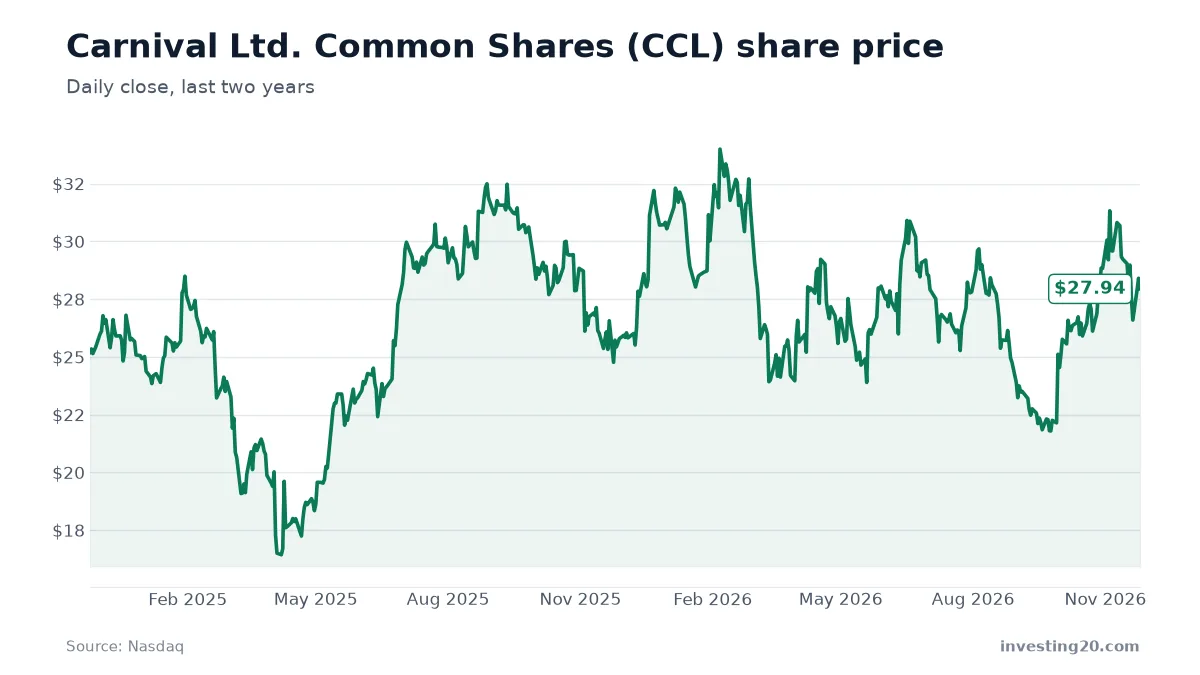
| Share price | $27.94 (Nov 25, 2026 5:48 PM ET) |
| Market value | about $37.6 billion |
| 52-week range | $21.45 – $34.03 |
| Revenue, last 12 months | about $27.6 billion |
| Revenue growth, last fiscal year | 6% |
| Net income, last 12 months | about $3.1 billion |
| Price-to-sales | about 1.4× |
| Price-to-earnings | about 12× |
| Analyst 12-month target | average $34.40 (range $29 – $42); 17 buy, 4 hold, 0 sell |
Market data from Nasdaq as of November 25, 2026. Check current figures before making any decision.
What Carnival Ltd. Common Shares does
Carnival Cruise Line is part of Carnival Corporation (NYSE: CCL), which Nasdaq describes as the world’s largest cruise company. Its ships call at more than 800 ports and destinations, and the company brands itself as America’s Cruise Line because it carries more Americans and serves more U.S. homeports than any other operator. It sails from 13 U.S. homeports and four in Australia, with seasonal departures from Europe, and hosts more than 95,000 guests on its ships every day. Carnival says it has carried more than 100 million guests in total since its founding in 1972 and employs more than 50,000 team members across 120 nationalities.
The business makes money by selling cruise vacations. Guests book sailings through a portfolio of cruise lines, and revenue comes from ticket sales and spending onboard. The company’s pitch has long been an affordable, fun travel option, which makes it sensitive to how much discretionary income households have for vacations.
Where the business stands
Revenue has climbed over the last few fiscal years. Carnival reported $21.6 billion for the year ending November 2023, $25.0 billion for 2024, and $26.6 billion for 2025, a 6.4% increase. Revenue over the last four reported quarters totals about $27.6 billion. The summer quarter ending August 2026 was the strongest at $8.44 billion, while the other recent quarters were $6.66 billion (May 2026), $6.17 billion (February 2026), and $6.33 billion (November 2025). The stock’s 52-week range is $21.45 to $34.03, and the last trade on November 25, 2026 was $27.94.
Profitability has improved along with revenue. Net income was $1.9 billion in fiscal 2024, $2.8 billion in fiscal 2025, and about $3.1 billion over the last four quarters. The stock trades at about 1.4 times sales and 12 times earnings, giving it a market value of roughly $37.6 billion. Price history shows the stock traded at $25.19 on November 25, 2024, reached a high of $33.99 on February 6, 2026, and hit a low of $16.43 on April 7, 2025. It is up 10.9% from a year ago.
The most recent earnings reports have beaten estimates. For the quarter ending August 2026, EPS came in at $1.43 versus a consensus of $1.36. The May 2026 quarter earned $0.41 versus $0.35 expected, February 2026 earned $0.20 versus $0.18, and November 2025 earned $0.34 versus $0.25. Analysts now model EPS of $2.26 for fiscal 2026, $2.56 for 2027, and $2.98 for 2028.
CCL stock forecast for the next 12 months
The Nasdaq analyst consensus puts the average 12-month price target for CCL at $34.40, with a low of $28.70 and a high of $42.00. The rating breakdown is 17 buy, 4 hold, and 0 sell, and the average target implies about 23.1% upside from the current price of $27.94. The average target also sits just above the 52-week high of $34.03, which means analysts are pricing in further gains from current levels.
For the stock to move toward the high end, Carnival would likely need to keep beating earnings estimates, hold revenue growth near its recent pace, and reassure investors that cruise demand can sustain higher prices. The ccl stock future over the next year will depend partly on whether the company can keep repeating those earnings beats. If bookings soften or costs rise, the low end near $28.70 looks more plausible. Remember that these are 12-month targets, not a five-year forecast, so they should not be compared directly with the 2030 scenarios below.
CCL stock forecast for 2030: three scenarios
Long-range forecasts are built on assumptions that will almost certainly change. The model here starts with revenue over the last four quarters ($27.6 billion), grows it at a set annual rate through 2030, applies a price-to-sales multiple, and divides by a share count that allows for dilution. Today’s price-to-sales is about 1.4, and the model does not assume that multiple lasts forever.
A useful reference point is the break-even logic: at the base-case multiple and share count, Carnival needs roughly $27.6 billion of revenue in 2030 for the shares to be worth today’s $27.94. In other words, today’s price already assumes about flat revenue from here.
| Scenario | Revenue growth per year | 2030 revenue | Price-to-sales | Shares | Implied share price |
|---|---|---|---|---|---|
| Bear | -0% | $27.4 billion | 1.1× | 1.40 billion | about $21.34 (-24%) |
| Base | 4% | $32.1 billion | 1.4× | 1.35 billion | about $32.48 (+16%) |
| Bull | 8% | $37.3 billion | 1.5× | 1.29 billion | about $43.27 (+55%) |
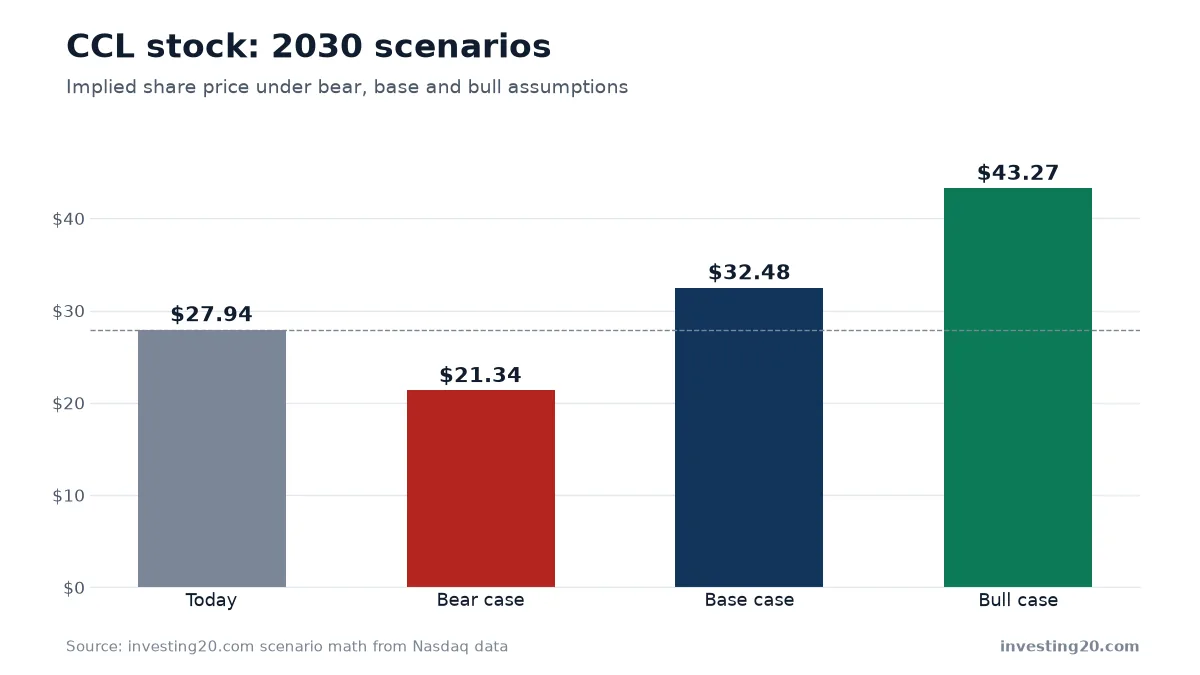
Bear case: revenue stays roughly flat, declining 0% a year to about $27.4 billion in 2030. With a lower price-to-sales of 1.1 and 1.40 billion shares, the implied price is about $21.34, or 24% below today’s level. This would look like weak consumer demand, pricing pressure, or a lower valuation for cruise stocks.
Base case: revenue grows about 4% a year to $32.1 billion in 2030. With a price-to-sales of 1.4 and 1.35 billion shares, the implied price is about $32.48, or 16% above today’s price. This assumes modest growth and a valuation multiple similar to today’s.
Bull case: revenue grows about 8% a year to $37.3 billion in 2030. With a price-to-sales of 1.5 and 1.29 billion shares, the implied price is about $43.27, or 55% above today’s price. That outcome requires sustained growth faster than the recent 6.4% pace and a higher multiple.
The main takeaway is the spread between outcomes. The base case offers modest upside, the bull case depends on above-trend growth, and the bear case implies losses even if revenue holds steady.
Risks to weigh
- Carnival sells discretionary vacations, so a weaker economy or tighter household budgets could reduce bookings and revenue growth.
- The business is seasonal, with summer quarters generating much more revenue than winter quarters, which can make short-term results lumpy.
- Share dilution matters: the scenarios assume different share counts, and issuing more shares would lower the per-share value.
- Valuation can compress. If investors assign a lower price-to-sales multiple to cruise stocks, the share price can fall even if revenue grows.
- Growth rates tend to fall as revenue gets larger, so sustaining an 8% annual pace through 2030 is harder than it sounds.
What to watch next
Watch Carnival’s quarterly revenue and EPS against consensus estimates, especially whether growth stays near the recent 6.4% rate. Also track changes to analyst price targets; the current average is $34.40, and any revisions to the fiscal 2026 through 2028 EPS forecasts matter too. Also watch whether the price-to-sales multiple stays near 1.4 or shifts toward the scenario assumptions. The gap between today’s $27.94 and the base-case 2030 implication of about $32.48 gives a sense of how much the long-term model is already priced in.
For context on how other large consumer-facing companies are being valued for the same period, see the Walt Disney Company (DIS) stock forecast and the Target (TGT) long-term outlook.
FAQ
What is the CCL stock forecast for 2030?
The scenario model implies about $21.34 in the bear case, $32.48 in the base case, and $43.27 in the bull case by 2030. These are scenarios, not predictions, and depend on revenue growth and valuation assumptions.
What is the average analyst price target for CCL?
The Nasdaq consensus average 12-month price target is $34.40, with a low of $28.70 and a high of $42.00. The ratings stand at 17 buy, 4 hold, and 0 sell as of November 25, 2026.
How has Carnival's revenue trended recently?
Revenue rose from $21.6 billion in fiscal 2023 to $25.0 billion in fiscal 2024 and $26.6 billion in fiscal 2025. Revenue over the last four quarters totals about $27.6 billion.
Does this article recommend buying or selling CCL stock?
No. It presents analyst targets and scenario math only, and none of it is a recommendation to buy or sell. Long-term outcomes depend on factors that can change before 2030.
Market data: Nasdaq. Financials: Nasdaq. Scenario math: investing20.
This article is for information only and is not investment advice. Do your own research before investing.