Advanced Micro Devices (AMD) Stock Forecast 2026–2030: Long-Term Outlook
An analysis of AMD's future stock price targets, financial growth, and potential 2030 valuation scenarios under bear, base, and bull conditions.
On this page
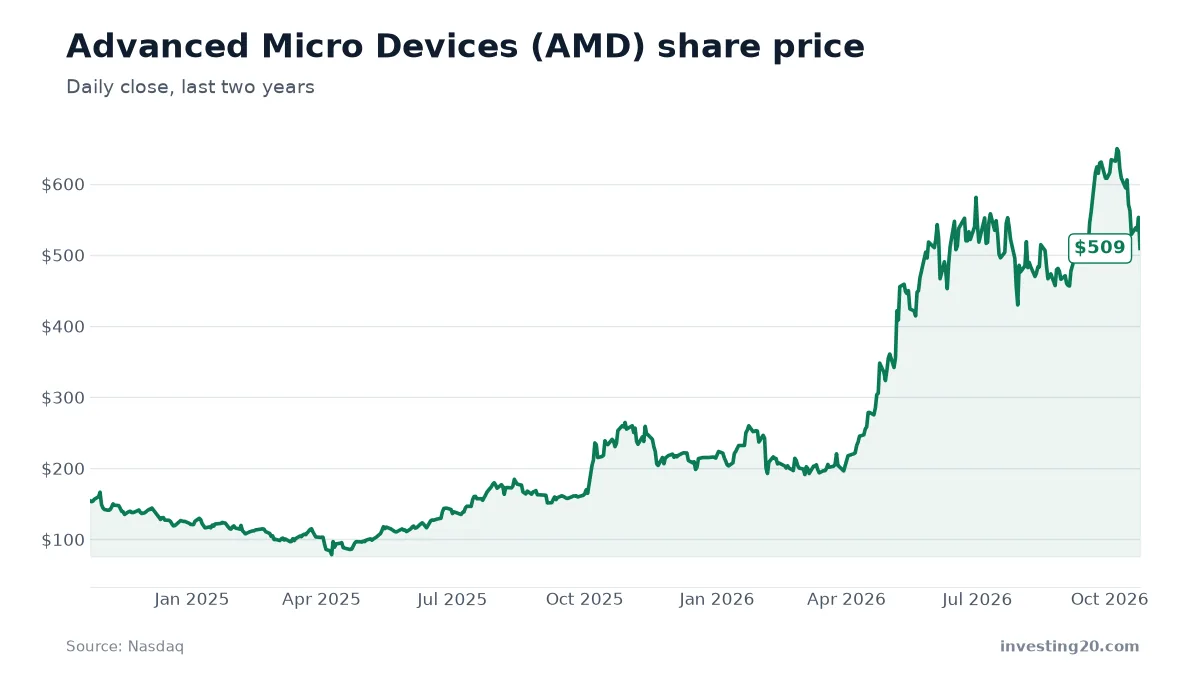
Advanced Micro Devices trades at $483.52 as of November 4, 2026, giving the semiconductor designer a market value of about $789.3 billion. This long-range outlook looks at the core drivers behind the business and models where the stock could land by 2030 under three distinct financial scenarios.
Single-point predictions over four to five years are rarely accurate, as hardware cycles, spending trends, and competitive dynamics shift quickly. Looking at a range of outcomes based on revenue growth rates, future profit margins, and valuation multiples offers a clearer picture of what today’s valuation is already pricing in.
| Share price | $483.52 (Nov 4, 2026 1:33 PM ET) |
| Market value | about $789.3 billion |
| 52-week range | $188.22 – $658.52 |
| Revenue, last 12 months | about $41.3 billion |
| Revenue growth, last fiscal year | 34% |
| Net income, last 12 months | about $6.4 billion |
| Price-to-sales | about 19.1× |
| Price-to-earnings | about 123× |
| Analyst 12-month target | average $640.96 (range $540 – $800); 26 buy, 6 hold, 0 sell |
Market data from Nasdaq as of November 4, 2026. Check current figures before making any decision.
What changed since our last update
Since our previous update on October 22, 2026, AMD’s stock price moved down 5.0% from $509.01 to $483.52. Over the same stretch, the average analyst 12-month target edged down from $663.28 to $640.96, while our long-term 2030 scenarios adjusted slightly to reflect the lower starting share count and entry price point. The short-term pullback brings the stock closer to our 2030 base-case revenue valuation benchmark, offering a slightly wider margin relative to top-end analyst targets.
What Advanced Micro Devices does
Advanced Micro Devices designs high-performance microprocessors, graphics chips, and custom silicon. Rather than manufacturing chips in its own factories, AMD operates as a fabless chipmaker, relying on semiconductor foundries to build its physical hardware.
The company earns revenue across four main markets:
- Data Center: Central processing units (CPUs), graphics processing units (GPUs), and networking gear built for cloud platforms, enterprise servers, and artificial intelligence models.
- Client: Ryzen desktop and laptop processors designed for personal computers, including new AI-enabled PCs.
- Gaming: Radeon graphics processing chips for desktop computers and custom processors powering major home video game consoles.
- Embedded: Dedicated processors and programmable chips for industrial automation, automotive technology, aerospace, and medical devices.
AMD sells its hardware directly to massive hyper-scale cloud providers, original equipment computer manufacturers, enterprise data center operators, and retail consumers globally.
Where the business stands
AMD generated $41.3 billion in revenue over the last four reported quarters, building on a multi-year growth trend. Full-year revenue reached $34.6 billion in fiscal year 2025, up 34.3% from $25.8 billion in 2024 and $22.7 billion in 2023.
AMD Annual Revenue Trend
2023: $22.7 billion
2024: $25.8 billion
2025: $34.6 billion
Last 12 Months: $41.3 billion
Profitability has expanded alongside top-line sales. AMD generated $6.4 billion in net income over the trailing twelve months, up from $4.3 billion in fiscal year 2025 and $1.6 billion in 2024.
Quarterly results throughout 2026 consistently exceeded consensus expectations set by Wall Street:
- Quarter ending September 2026: Earnings per share of $1.84 beat the $1.68 consensus estimate by 9.52%.
- Quarter ending June 2026: EPS of $1.44 beat the $1.35 estimate by 6.67%, with quarterly revenue hitting $11.54 billion.
- Quarter ending March 2026: EPS of $1.11 beat the $1.06 estimate by 4.72%.
- Quarter ending December 2025: EPS of $1.24 beat the $1.11 estimate by 11.71%.
Consensus analyst expectations point toward continued earnings momentum, calling for full-year EPS of $6.50 in fiscal 2026, $14.14 in fiscal 2027, and $20.49 in fiscal 2028. You can track similar growth trajectories across hardware infrastructure providers in our Super Micro Computer (SMCI) Stock Forecast 2026–2030 and our broader Tesla (TSLA) Stock Forecast 2026–2030.
AMD stock forecast for the next 12 months
Wall Street analysts hold a constructive near-term outlook on the stock. Among 32 analysts tracked by Nasdaq, 26 rate the stock a Buy, 6 rate it a Hold, and none recommend Selling.
The average 12-month amd price target stands at $640.96, which implies a 32.6% upside from the current $483.52 share price. Wall Street targets span a range:
- High target: $800.00 (+65.5% upside)
- Average target: $640.96 (+32.6% upside)
- Low target: $540.00 (+11.7% upside)
For AMD to reach or exceed the $640.96 average target over the next year, the company will likely need to maintain its recent string of quarterly earnings beats and show steady adoption of its data center GPUs. The shares currently trade at a price-to-earnings ratio of about 123 and a price-to-sales ratio of 19.1. Maintaining these elevated valuation multiples requires management to deliver high organic growth while protecting gross margins.
AMD stock forecast for 2030: three scenarios
To model an amd stock prediction for 2030, we evaluate three potential growth paths starting from trailing twelve-month revenue of $41.3 billion. Fast-growing technology businesses typically experience slowing percentage growth as their overall revenue base expands. Valuation multiples also tend to contract toward mature semiconductor averages over time.
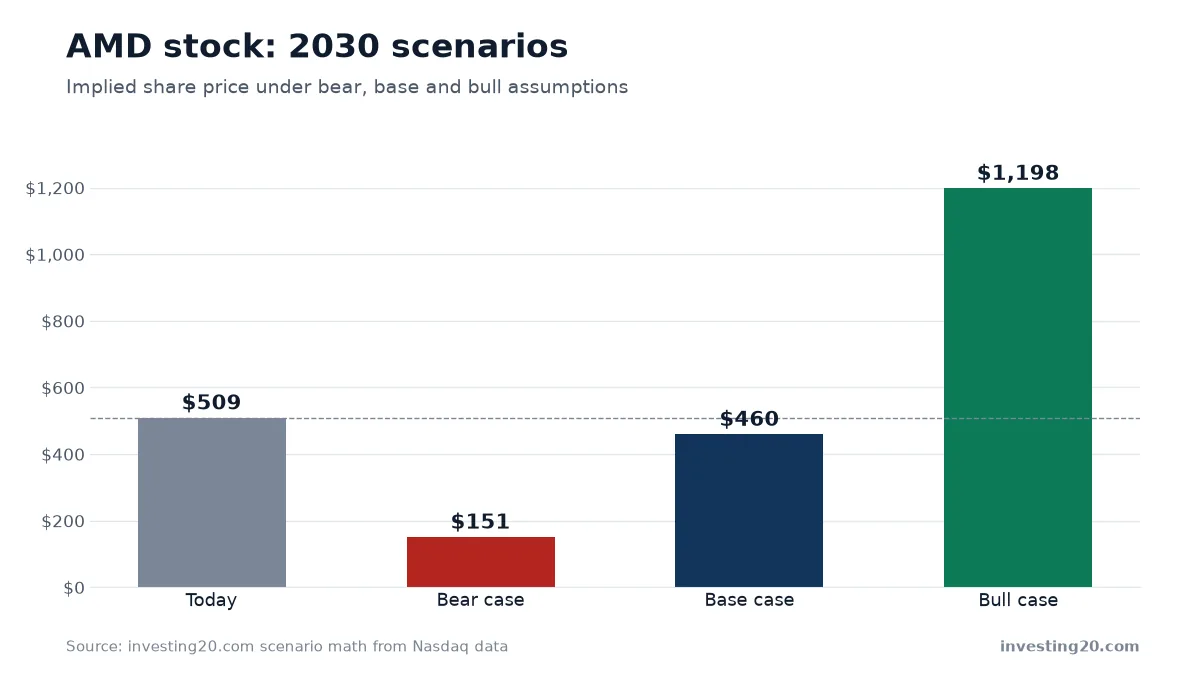
| Scenario | Revenue growth per year | 2030 revenue | Price-to-sales | Shares | Implied share price |
|---|---|---|---|---|---|
| Bear | 10% slowing to 5% | $55.4 billion | 5.0× | 1.84 billion | about $150.85 (-69%) |
| Base | 21% slowing to 15% | $79.5 billion | 10.0× | 1.73 billion | about $458.80 (-5%) |
| Bull | 31% slowing to 25% | $110.6 billion | 18.0× | 1.67 billion | about $1,195.90 (+147%) |
Bear case
In the bear case, competitive pressures intensify or capital spending on data center infrastructure slows significantly. Annual revenue growth deceleration drops from 10% to 5% per year, averaging roughly 8% annually. Under these conditions, 2030 revenue reaches $55.4 billion. Assuming the price-to-sales multiple compresses to 5.0 and stock compensation increases total shares to 1.84 billion, the amd share price target drops to $150.85, representing a 69% decline from today’s price.
Base case
The base case assumes strong but moderating growth. Revenue growth scales down gradually from 21% to 15% annually, averaging about 18% per year. Under this scenario, AMD produces $79.5 billion in 2030 revenue. Applying a 10.0 price-to-sales multiple on 1.73 billion shares yields an implied future stock price of $458.80, roughly 5% below current levels.
For the shares to maintain today’s $483.52 price point under base-case valuation multiples and share counts, AMD would need to generate approximately $83.8 billion in 2030 revenue. This indicates that today’s valuation already prices in roughly 19% steady annual top-line growth over the next four years.
Bull case
In the bull case, AMD captures substantial market share in data center AI processors, client chips, and server hardware. Top-line growth starts at 31% and gradually tapers to 25% annually (averaging 28% per year), pushing 2030 revenue to $110.6 billion. If the market rewards this growth with an 18.0 price-to-sales ratio on 1.67 billion shares, the implied amd stock price prediction rises to $1,195.90, delivering a 147% gain.
Investors interested in how tech valuations compare over multi-year horizons can read our long-term analysis on the Advanced Micro Devices (AMD) Stock Forecast.
Risks to weigh
Before making investment decisions regarding AMD, consider these key operational and market risks:
- Customer Concentration and Capital Expenditure Cycles: A significant portion of data center chip sales comes from a small group of hyper-scale cloud providers. If these customers slow their capital spending, revenue growth could drop quickly.
- Manufacturing Dependencies: AMD relies entirely on third-party foundries like TSMC to manufacture its chip designs. Supply chain disruptions, yield issues, or geopolitical events affecting overseas foundries present direct risk to output.
- Intense Competition: AMD faces direct competition from dominant players like Nvidia in high-end data center GPUs and Intel in legacy server and PC CPUs.
- Valuation Multiples: Trading at a price-to-earnings ratio above 120 and a price-to-sales ratio above 19 leaves little room for earnings misses or operational delays.
What to watch next
If you are tracking AMD for your portfolio, focus on these specific metrics in coming quarters:
- Data Center GPU Revenue: Watch whether data center sales continue to represent a growing share of overall quarterly revenue, validating market adoption against rival products.
- Gross Profit Margins: Monitor whether rising production costs or competitive pricing pressure weigh on overall profitability.
- Forward Guidance Updates: Look at management’s quarterly revenue and EPS projections to judge if the company remains on pace to meet the consensus FY 2026 earnings target of $6.50 per share.
FAQ
What is the 12-month AMD stock price target?
According to consensus data from Nasdaq, analysts set an average 12-month AMD stock price target of $640.96. The forecasts range from a low of $540.00 to a high of $800.00, with 26 analysts rating the stock a buy and 6 rating it a hold.
What is the AMD stock price prediction for 2030?
Long-term scenario modeling suggests an implied AMD share price target of about $458.80 in a base case, $1,195.90 in a bull case, and $150.85 in a bear case. These outcomes depend heavily on revenue growth trajectories and valuation multiples through 2030.
What does the amd stock future look like for earnings growth?
Analyst estimates project AMD's annual earnings per share to increase from $6.50 in fiscal year 2026 to $14.14 in 2027 and $20.49 in 2028, reflecting expanded demand for hardware in data centers and AI hardware deployments.
Market data and financials: Nasdaq. Scenario math: investing20.
This article is for information only and is not investment advice. Do your own research before investing.