Meta Platforms (META) Stock Forecast 2026–2030
Meta Platforms (META) stock forecast through 2030: Wall Street 12-month price targets, revenue trends, and long-term scenarios modeling META stock future.
On this page
- What Meta Platforms does and how it makes money
- Where the business stands today
- META stock forecast for the next 12 months
- META stock forecast for 2030: three long-term scenarios
- The bear case: $602.07 (-7%)
- The base case: $1,000.48 (+55%)
- The bull case: $1,315.44 (+104%)
- Risks to weigh
- What to watch next
- FAQ
Meta Platforms is generating massive profits while pouring billions into artificial intelligence, leaving investors curious about where the shares could trade over the rest of the decade. This guide breaks down the numbers behind the business, reviews 12-month analyst targets, and maps out potential 2030 valuation cases.
Before looking ahead, remember that every long-range meta stock forecast represents an illustrative scenario rather than a guaranteed outcome. Businesses face regulatory shifts, competitive pressure, and changing consumer habits, so treat these models as useful yardsticks for thinking about valuation rather than absolute predictions.
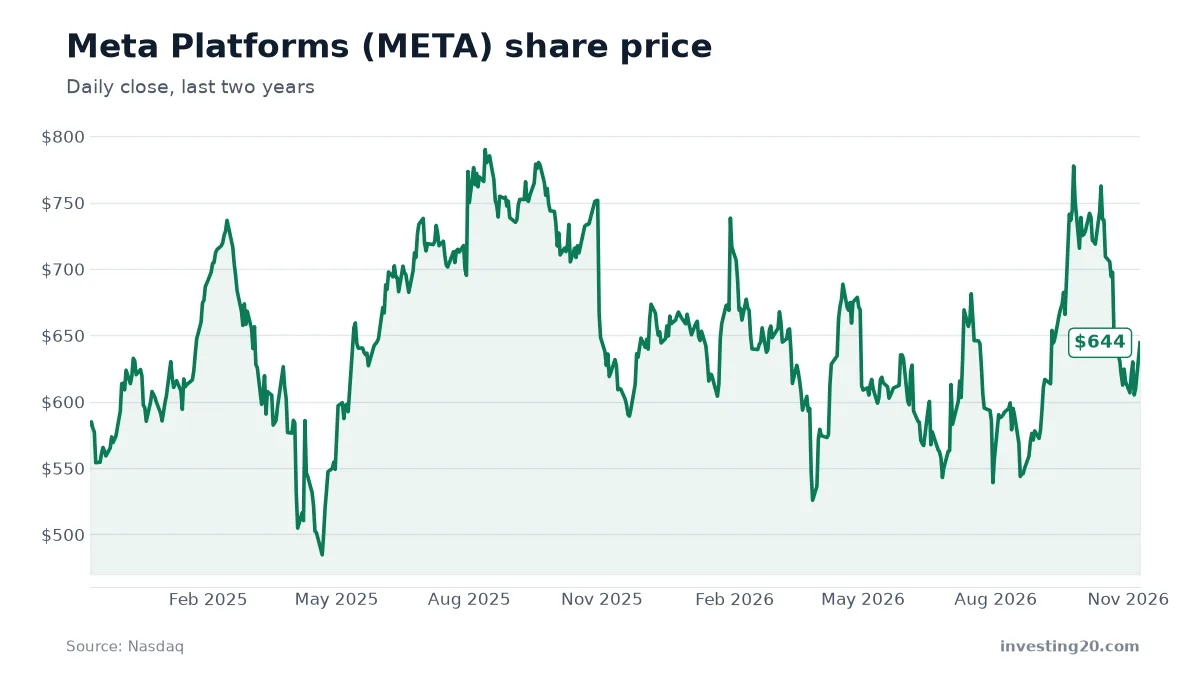
| Share price | $644.39 (Nov 9, 2026 6:10 PM ET) |
| Market value | about $1.6 trillion |
| 52-week range | $520.26 – $779.82 |
| Revenue, last 12 months | about $241.6 billion |
| Revenue growth, last fiscal year | 22% |
| Net income, last 12 months | about $75.2 billion |
| Price-to-sales | about 6.8× |
| Price-to-earnings | about 22× |
| Analyst 12-month target | average $859.32 (range $580 – $1,000); 37 buy, 6 hold, 0 sell |
Market data from Nasdaq as of November 9, 2026. Check current figures before making any decision.
The table above summarizes the core valuation metrics for Meta Platforms as of November 9, 2026. Trading around $644.39, the company holds a market value of roughly $1.6 trillion and trades at about 21.8 times its net income over the last four reported quarters.
What Meta Platforms does and how it makes money
Meta operates some of the most widely used digital services in history. The business traces back to the launch of Facebook in 2004, which changed how people interact online. Today, the company’s core family of apps includes Facebook, Instagram, Messenger, and WhatsApp, connecting billions of daily users worldwide.
The primary engine of Meta’s business is digital advertising. Marketers pay Meta to deliver targeted advertisements across its apps, using the company’s detailed user engagement data and artificial intelligence algorithms to optimize campaigns.
Beyond its legacy social feeds, Meta has shifted focus toward building immersive technologies and AI-driven experiences. The company is developing hardware and software platforms that support artificial intelligence and virtual experiences, aiming to create deeper digital connections.
Where the business stands today
Meta has delivered strong top-line expansion over recent fiscal periods. Annual revenue climbed from $134.9 billion in 2023 to $164.5 billion in 2024, reaching $201.0 billion in fiscal 2025. That represented a 22.2% annual growth rate in 2025. Over the last four reported quarters, revenue totaled $241.6 billion.
Profitability remains substantial, though quarterly bottom-line performance has seen some volatility:
- Quarter ending September 30, 2026: Revenue reached $64.60 billion. Meta reported earnings per share (EPS) of $7.40, beating consensus estimates of $6.52 by 13.5%.
- Quarter ending June 30, 2026: Revenue came in at $60.80 billion, but EPS of $6.18 missed the consensus estimate of $7.10 by 12.96%.
- Quarter ending March 31, 2026: Revenue hit $56.31 billion, with EPS of $7.31 topping the $6.71 estimate by 8.94%.
- Quarter ending December 31, 2025: Revenue was $59.89 billion, generating an EPS of $8.88 compared to an $8.21 estimate (an 8.16% positive surprise).
Over the last four quarters, Meta earned $75.2 billion in net income, up from $60.5 billion in fiscal 2025 and $62.4 billion in fiscal 2024. For comparison with other major tech firms balancing large infrastructure spending with bottom-line profits, see our Apple (AAPL) Stock Forecast 2026–2030 and our Tesla (TSLA) Stock Forecast 2026–2030.
META stock forecast for the next 12 months
Wall Street analysts track Meta closely, and consensus expectations call for steady earnings expansion. According to Nasdaq consensus estimates, analysts project EPS of $29.01 for fiscal 2026, rising to $33.91 in 2027 and $39.44 in 2028.
Nasdaq consensus data covering 43 analysts shows an overwhelmingly positive stance:
- 37 analysts rate the stock a Buy
- 6 analysts rate it a Hold
- 0 analysts rate it a Sell
The average 12-month meta price target sits at $859.32, which sits about 33.4% above the November 9, 2026 share price of $644.39. Individual targets range from a low estimate of $580.00 to a high of $1,000.00.
For the average meta price target to materialize within the next year, Meta would need to sustain its advertising revenue growth while proving that capital spending on AI infrastructure is yielding higher ad pricing and improved engagement.
META stock forecast for 2030: three long-term scenarios
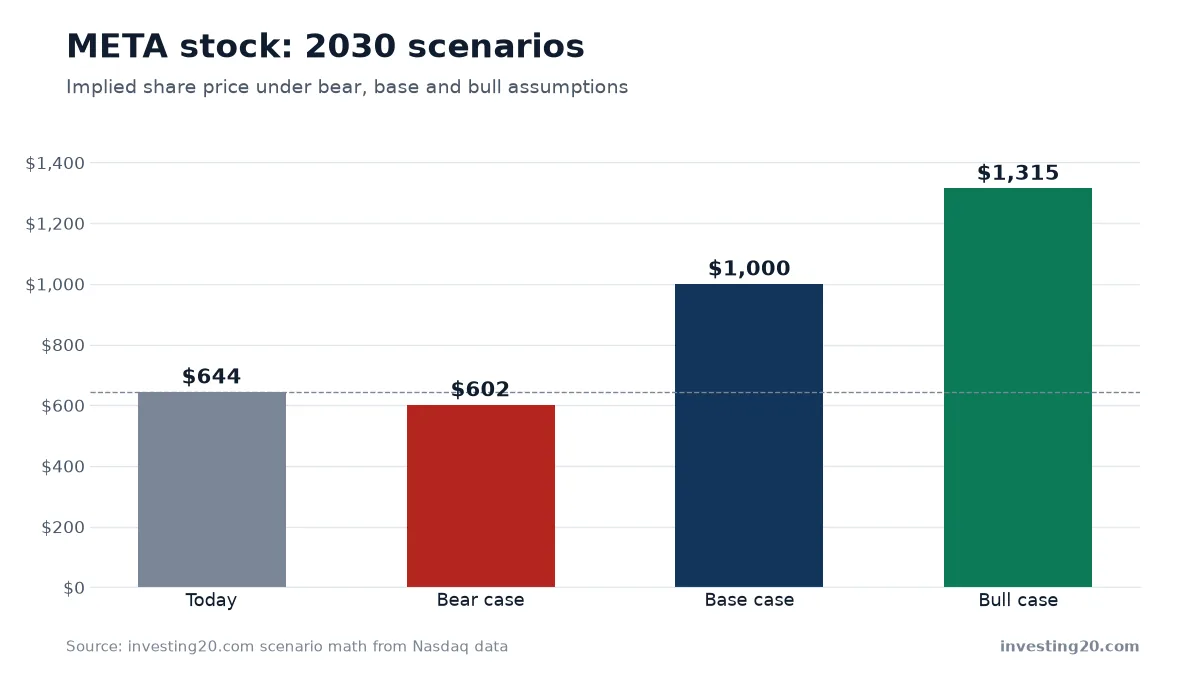
To think about the meta stock future over a multi-year horizon, Investing 2.0 uses a model that starts from trailing twelve-month revenue ($241.6 billion), applies an annual revenue growth rate through 2030, assigns a price-to-sales multiple, and divides by a projected share count.
Because growth naturally slows as companies reach massive scale, these scenarios dial down expansion rates from the 22.2% seen in fiscal 2025. At Meta’s base-case multiple (6.8 times sales) and projected share count, the company needs roughly $256.4 billion in annual revenue by 2030 just to justify today’s $644.39 share price.
| Scenario | Revenue growth per year | 2030 revenue | Price-to-sales | Shares | Implied share price |
|---|---|---|---|---|---|
| Bear | 9% | $344.8 billion | 5.0× | 2.86 billion | about $602.07 (-7%) |
| Base | 13% | $398.1 billion | 6.8× | 2.70 billion | about $1,000.48 (+55%) |
| Bull | 17% | $457.4 billion | 7.5× | 2.60 billion | about $1,315.44 (+104%) |
The bear case: $602.07 (-7%)
In this scenario, annual revenue growth slows to an average of 9% per year, bringing 2030 revenue to $344.8 billion. Multiple contraction takes the price-to-sales ratio down to 5.0, reflecting maturing ad markets and elevated operational expenses. Dilution lifts the share count to 2.86 billion shares. Under these conditions, the implied share price dips 7% below current levels to $602.07.
The base case: $1,000.48 (+55%)
The base case models steady execution, with top-line sales growing at an average rate of 13% annually to reach $398.1 billion in 2030. Assuming Meta maintains its current price-to-sales multiple of 6.8 and share repurchases keep dilution modest at 2.70 billion shares, the meta stock prediction points to about $1,000.48 per share.
The bull case: $1,315.44 (+104%)
The optimistic case assumes artificial intelligence monetization accelerates ad pricing and opens fresh commercial formats. Revenue grows at 17% annually to reach $457.4 billion in 2030. The market awards the stock a price-to-sales ratio of 7.5, with share count managed down to 2.60 billion. This meta stock price prediction yields an implied share price of $1,315.44, more than doubling current levels. Similar high-growth scenarios can be examined in our Super Micro Computer (SMCI) Stock Forecast 2026–2030.
The main takeaway from this modeling is that Meta does not need excessive valuation multiple expansion to deliver solid gains. Because it already generates substantial cash flow, achieving modest double-digit revenue growth while avoiding steep multiple compression could offer positive long-term returns.
Risks to weigh
Before making any investment decisions, consider the key operational and market risks facing Meta:
- Heavy capital spending: Meta is investing tens of billions into data centers and custom AI silicon. If these expenditures fail to yield improved operating margins, returns on invested capital will decline.
- Earnings consistency: While Meta beat earnings estimates soundly in September 2026, it missed consensus expectations by nearly 13% in June 2026, highlighting that profitability can fluctuate between quarters.
- Ad market sensitivity: Digital advertising budgets contract quickly during economic slowdowns, which could dampen top-line sales growth.
- Regulatory and antitrust pressure: Meta routinely encounters regulatory scrutiny in Europe and the United States regarding privacy practices, app store fees, and platform dominance.
- Competition: Video engagement and social attention face ongoing competition from rival streaming, social, and search applications.
What to watch next
The clearest indicator of Meta’s direction will be its upcoming quarterly earnings reports. Track whether digital ad revenue continues to grow in the double digits and watch how management guides full-year capital expenditures.
Investors should also watch operating margins to ensure hardware and AI investments are not consuming too much cash flow. Finally, monitor whether Meta uses its free cash flow for ongoing share buybacks, which help keep the total share count in check and support long-term earnings per share.
FAQ
What is the 12-month META price target?
According to Nasdaq analyst data as of November 9, 2026, the average 12-month META price target is $859.32, with a high estimate of $1,000.00 and a low of $580.00.
What does the meta stock forecast project for 2030?
Investing 2.0 scenario modeling outlines three potential paths by 2030: a bear case of roughly $602.07 (-7%), a base case of $1,000.48 (+55%), and a bull case reaching $1,315.44 (+104%).
What are Wall Street ratings on META stock?
Nasdaq consensus data shows 43 analyst ratings: 37 rate Meta Platforms as a buy, 6 rate it as a hold, and none recommend selling.
Market data: Nasdaq. Financials: Nasdaq. Scenario math: investing20.
This article is for information only and is not investment advice. Do your own research before investing.