AST SpaceMobile (ASTS) Stock Forecast: 2026 to 2030 Outlook
AST SpaceMobile stock forecast for 2026 to 2030. Learn how satellite broadband execution, heavy losses, and valuation multiples shape ASTS share price scenarios.
On this page
AST SpaceMobile (ASTS) wants to turn ordinary smartphones into satellite-connected devices anywhere on Earth. If the technology works at scale, the addressable market is enormous, but turning high-flying space engineering into sustainable cash flow is rarely a smooth ride.
This forecast walks through where AST SpaceMobile stands today, what Wall Street analysts expect over the next 12 months, and three mathematical scenarios for where the stock could trade by 2030. Long-range forecasts are not certain predictions. They are scenario models designed to show what kind of business performance today’s valuation already prices in.
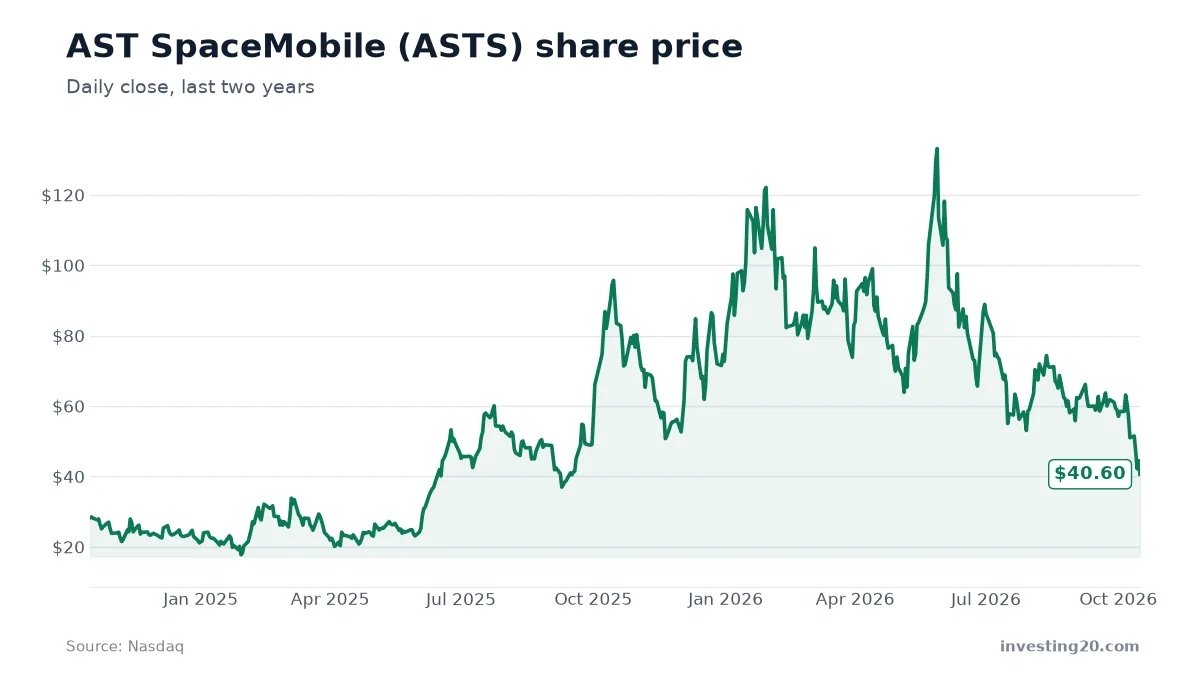
| Share price | $40.60 (Oct 16, 2026 6:12 PM ET) |
| Market value | about $15.8 billion |
| 52-week range | $39.87 – $133.86 |
| Revenue, last 12 months | about $115.3 million |
| Revenue growth, last fiscal year | 1,505% |
| Net income, last 12 months | a loss of about $618.8 million |
| Price-to-sales | about 137.2× |
| Price-to-earnings | n/a (not profitable) |
| Analyst 12-month target | average $80.10 (range $51 – $115); 5 buy, 6 hold, 0 sell |
Market data from Nasdaq as of October 16, 2026. Check current figures before making any decision.
What does AST SpaceMobile actually do?
AST SpaceMobile is building what it describes as the first and only global cellular broadband network in space that connects directly with standard, unmodified mobile devices. Unlike satellite internet services that require specialized ground terminals, satellite dishes, or custom phones, AST SpaceMobile relies on its patent portfolio to broadcast directly to ordinary phones carried by standard subscribers.
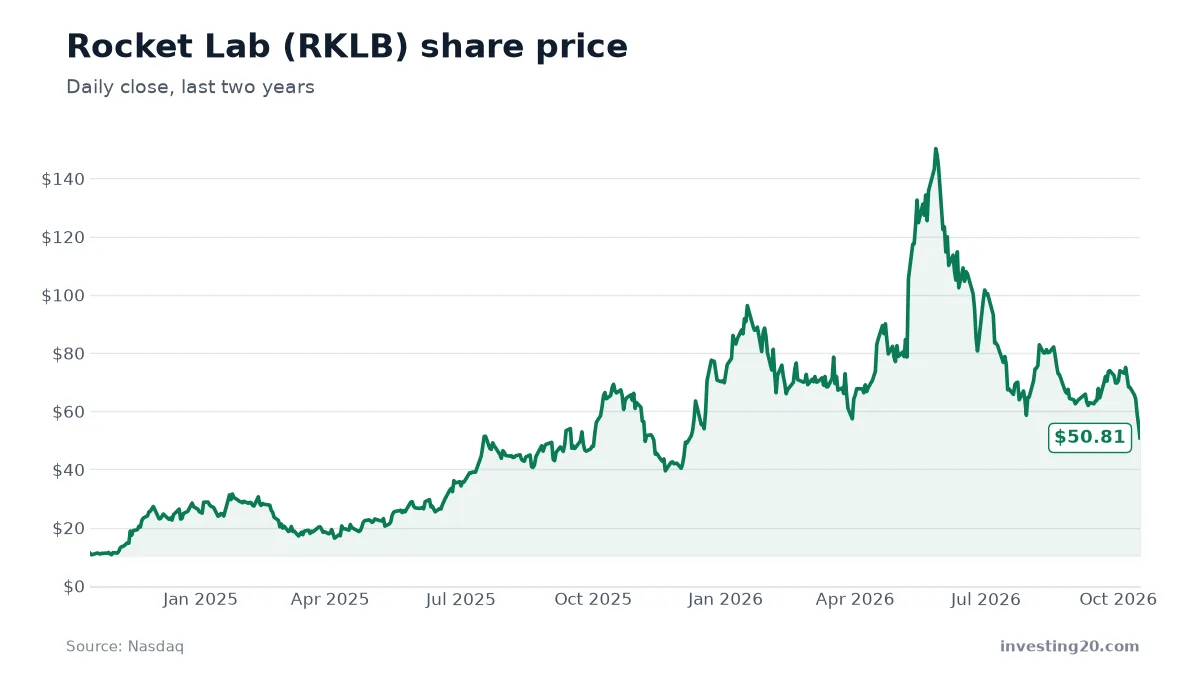
The business model targets both commercial mobile network operators and government clients. Rather than competing directly with wireless carriers for end users, AST SpaceMobile partners with existing carriers so they can offer coverage in dead zones to their five billion collective subscribers. The company earns revenue as these network relationships commercialize and as government agencies contract for space-based communications. Much like other capital-intensive space operators covered in our Rocket Lab (RKLB) stock forecast, scaling space hardware requires huge upfront capital before network services produce steady cash.
Where the business stands today
AST SpaceMobile generated $115.3 million in revenue over its last four reported quarters. That represents a dramatic leap from earlier years: full-year revenue stood at $4.4 million in 2024 and grew by 1,505.2% to reach $70.9 million for the fiscal year ending December 31, 2025. Quarter by quarter, the top line has shown rapid but uneven progress, reporting $14.74 million in the third quarter of 2025, $54.30 million in the fourth quarter of 2025, $14.73 million in the first quarter of 2026, and $31.52 million for the quarter ending June 30, 2026.
Despite top-line gains, the company remains deeply in the red. Over the last four reported quarters, AST SpaceMobile posted a net loss of $618.8 million. That follows full-year net losses of $300.1 million in 2024 and $341.9 million in 2025.
Recent earnings reports have repeatedly lagged Wall Street expectations:
- For the quarter ending September 2025, AST SpaceMobile reported an EPS loss of -$0.45 versus an expected -$0.18.
- For the quarter ending December 2025, EPS came in at -$0.26 versus an expected -$0.18.
- For the quarter ending March 2026, EPS landed at -$0.66 against a consensus target of -$0.23.
- For the quarter ending June 2026, reported EPS was -$0.44 compared to an estimated -$0.28.
Consensus forecasts collected by Nasdaq show analysts expect an EPS loss of -$1.92 for the full year ending December 2026, followed by a loss of -$1.18 in 2027. Wall Street does not expect the company to cross into positive territory until fiscal year 2028, when two analysts project a consensus EPS of $0.52.
What do analysts expect over the next 12 months?
Wall Street sentiment on AST SpaceMobile remains generally constructive, though split. Across 11 analysts covering the stock on Nasdaq, five rate the shares a buy and six rate it a hold, with zero sell ratings.
The consensus 12-month price target averages $80.10, which sits roughly 97.3% above the October 16, 2026 closing price of $40.60. Individual price targets display wide disagreement: the low target sits at $50.80, while the street-high target reaches $115.00.
For the stock to hit those targets in the next year, AST SpaceMobile will likely need to keep scaling quarterly revenue while narrowing its operating losses. With the stock trading well below its 52-week peak of $133.86 (it hit a high of $133.09 on May 28, 2026) and close to its 52-week low of $39.87, short-term momentum depends heavily on whether upcoming quarters show closing gaps between reported earnings and consensus projections. Similar valuation gaps between current market prices and long-range potential have surfaced across early-stage technology stories, from electric vehicle makers in our Tesla stock price prediction to crypto infrastructure names in our MARA price prediction.
ASTS stock forecast for 2030: three scenarios
Looking out toward 2030 requires understanding AST SpaceMobile’s current valuation multiple. At a share price of $40.60, the company carries a market value of about $15.8 billion, giving it a price-to-sales ratio of 137.2 based on trailing 12-month revenue of $115.3 million. High multiples can persist while revenue is small, but as companies mature, valuation multiples inevitably compress toward normal market averages.
To map where ASTS could trade in 2030, our scenario model starts with trailing revenue of $115.3 million, projects growth that gradually slows over time, assumes conservative valuation multiples (ranging from 5 to 18 times sales), and factors in shareholder dilution from ongoing share issuance.
| Scenario | Revenue growth per year | 2030 revenue | Price-to-sales | Shares | Implied share price |
|---|---|---|---|---|---|
| Bear | 50% slowing to 5% | $294.2 million | 5.0× | 439 million | about $3.35 (-92%) |
| Base | 100% slowing to 15% | $652.5 million | 10.0× | 414 million | about $15.77 (-61%) |
| Bull | 200% slowing to 25% | $1.9 billion | 18.0× | 398 million | about $86.73 (+114%) |
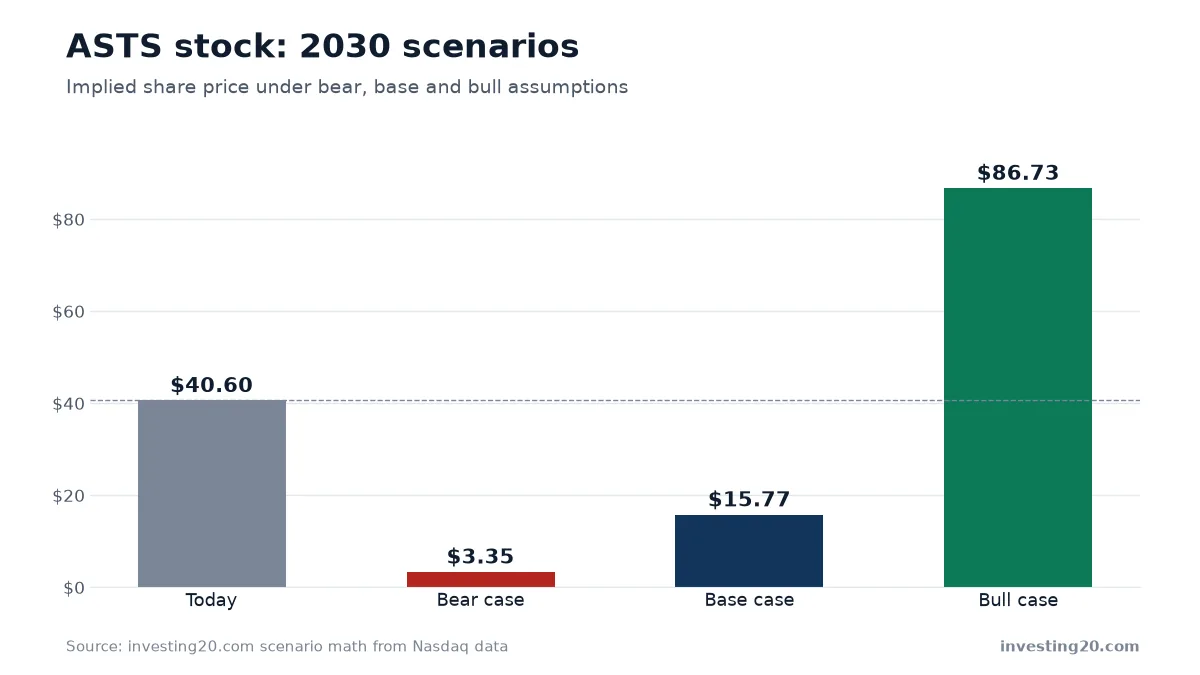
In the bear case, AST SpaceMobile’s top-line growth slows from 50% down to 5% annually, averaging roughly 26% per year to yield $294.2 million in 2030 revenue. If growth stalls and the price-to-sales multiple drops to 5.0 across an expanded share base of 439 million shares, the implied stock price falls to $3.35, a decline of about 92% from today’s level.
In the base case, annual growth decelerates from 100% down to 15%, averaging around 54% per year. That brings 2030 revenue to $652.5 million. Applying a 10.0 price-to-sales multiple across 414 million shares yields an implied price of $15.77, representing a 61% drawdown from the current price.
In the bull case, commercial adoption accelerates with revenue expanding at 200% initially before easing to 25%, averaging roughly 102% annually. Under this trajectory, 2030 revenue reaches $1.9 billion. At a premium 18.0 price-to-sales multiple and 398 million shares, the implied price reaches $86.73, delivering a 114% gain.
The primary takeaway from this scenario analysis is break-even math. At a base-case multiple of 10.0 and 414 million shares, AST SpaceMobile must generate roughly $1.7 billion in revenue by 2030 just for the stock to justify its current $40.60 price tag. Today’s market price already assumes a massive, multi-year surge in commercial operations.
Risks to weigh before investing
- Extreme valuation multiple: A price-to-sales multiple of 137.2 leaves minimal room for execution missteps. Any slowdown in top-line growth can cause sharp multiple contraction.
- Deep operating losses: Generating a net loss of $618.8 million over the last four reported quarters means the company is burning substantial capital to fund its satellite deployment.
- Dilution pressure: Building and deploying an orbital broadband constellation requires ongoing funding. Expanding share counts dilute existing investors and reduce per-share value over time.
- Consistent earnings misses: The company has reported wider-than-expected losses per share in each of the last four quarters, including misses of -57.14% in June 2026 and -186.96% in March 2026.
- Extended path to profitability: Analyst consensus does not project positive annual EPS until fiscal year 2028, leaving the business exposed to financing conditions for several more years.
What to watch next
The single most important milestone for AST SpaceMobile is top-line progress relative to bottom-line burn. Over the next few quarters, track whether revenue continues to advance toward the hundreds of millions and whether net losses begin to plateau.
You will also want to monitor the gap between Wall Street estimates and actual EPS results to see if the company can halt its pattern of quarterly earnings misses. Finally, keep an eye on total shares outstanding: any major capital raises that dilute the share count will directly shift the revenue required to sustain future share price gains.
FAQ
What is the 12-month analyst target for AST SpaceMobile stock?
According to Nasdaq consensus data as of October 16, 2026, the average 12-month price target is $80.10, with a low of $50.80 and a high of $115.00 across 11 analysts.
Is AST SpaceMobile currently profitable?
No, AST SpaceMobile is unprofitable. Over the last four reported quarters, the company recorded a net loss of $618.8 million on $115.3 million in revenue.
When does Wall Street expect AST SpaceMobile to turn a profit?
Analyst consensus forecasts project negative earnings through 2027, with earnings per share turning positive at $0.52 for the fiscal year ending December 2028 based on estimates from two analysts.
Market data and financials: Nasdaq. Scenario math: investing20.
This article is for information only and is not investment advice. Do your own research before investing.