Gitcoin (GTC) Price Prediction 2026–2030: Can It Reach $1,000?
Realistic Gitcoin (GTC) price targets for 2026 to 2030 based on market share math. Find out what it takes to hit $1,000 and the risks ahead.
On this page
Gitcoin (GTC) is an established governance token in the Ethereum ecosystem, but its price has struggled since the 2021 bull run. This guide looks at realistic scenarios for GTC from 2026 through 2030, testing the math behind aggressive price targets like $1,000 and assessing where the token could realistically trade.
Long-range crypto price predictions are structured scenario exercises, not guaranteed forecasts. Digital assets carry massive volatility, and smaller governance tokens can lose most of their value or fail to recover after prolonged market downturns. The earlier version of this guide was titled Gitcoin Price Prediction 2023, 2025, 2030: Will GTC reach $1000?, and as you will see below, targets beyond 2030 are simply too far out to model honestly.
| Price | $0.228 (October 17, 2026) |
| Market value | about $20.0 million (#838 by market value) |
| Trading volume, 24 hours | about $33.9 million |
| Coins in circulation | 87.49 million (87% of the 100 million total) |
| Change, last 12 months | +7% |
| All-time high | $22.37 on November 26, 2021 (-99%) |
| Whole crypto market | about $2.7 trillion; Gitcoin is 0.00% of it |
Market data from CoinGecko as of October 17, 2026. Crypto prices move fast; check current figures before making any decision.
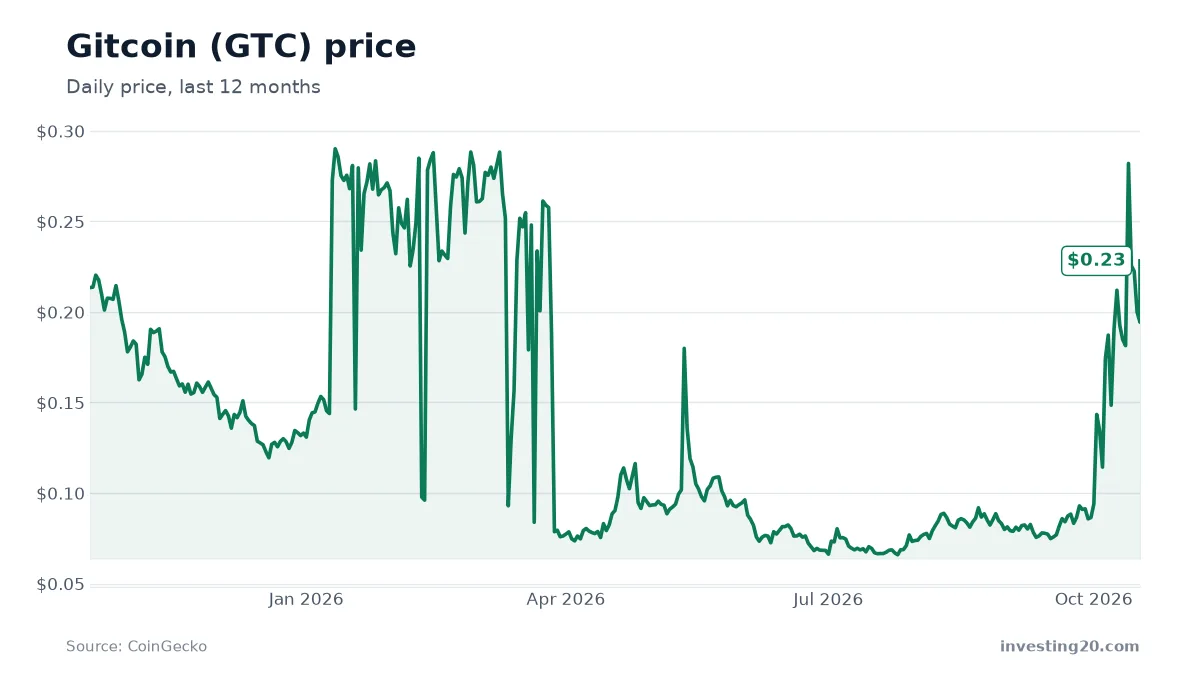
In the past 24 hours, the price of Gitcoin increased by 11.07%. However, over the past 7 days, despite the recent increase, Gitcoin experienced a decline of 9.48%.
This week, Gitcoin is showing signs of a potential reversal. Take a look at the technical analysis before reading a trend into it.
| Period | Change (USD) |
|---|---|
| Today | +11.07% |
| 7 days | -9.48% |
| 14 days | -7.33% |
| 30 days | +129.45% |
| 60 days | +187.11% |
| 200 days | +186.93% |
| 1 year | +28.14% |
Updated October 31, 2026 · Data provided by CoinGecko
The table above outlines where Gitcoin stands on October 17, 2026. With a market value of about $20.0 million and an overall crypto market footprint of just 0.001%, GTC is a small-cap token where even modest shifts in liquidity can trigger sharp price moves.
What Gitcoin is and what the coin is used for
Gitcoin is a decentralized platform built to fund developers and creators working on open source software. Instead of relying purely on corporate sponsorships or venture capital, open source projects can receive community grants and collective funding through Gitcoin’s infrastructure.
The GTC token functions primarily as a governance asset within this ecosystem. Holding GTC gives users voting power over the Gitcoin decentralized autonomous organization (DAO). Community members use the token to vote on treasury spending, platform upgrades, grant allocations, and structural changes to funding rounds.
Gitcoin fits into both the Ethereum and Near Protocol ecosystems, and it sits in Paradigm’s investment portfolio. Because GTC is a governance coin rather than an asset that captures direct platform fee revenue, its market value largely depends on community participation, DAO treasury strength, and speculative sentiment surrounding public goods funding. Similar token models exist across decentralized networks; you can compare its setup to broader infrastructure assets like Loopring or Internet Computer.
Where the price stands today
Gitcoin trades at $0.228 as of October 17, 2026. That gives the project a total market capitalization of around $20.0 million, placing it at rank #838 across the broader crypto market.
Trading interest can flare up rapidly, evidenced by a 24-hour trading volume of $33.9 million, which exceeds the entire market capitalization of the token. Over the past 30 days, GTC experienced a steep run-up of +197.0%, though its 12-month gain stands at a modest +7.3%.
The longer-term picture reveals significant structural damage from the last cycle. Gitcoin hit an all-time high of $22.37 on November 26, 2021. At today’s price, GTC is still down 99% from that record level. Reclaiming past peaks is rare for governance tokens once the broader speculative narrative shifts elsewhere.
Can Gitcoin reach $1,000?
A common question among retail traders looking at past rallies is whether GTC could ever hit a massive round number like $1,000. To answer that honestly, you have to look at the market capitalization required to support each price tier.
| Price | Market value needed | Times today’s value | Share of today’s whole crypto market | Compared with Bitcoin today |
|---|---|---|---|---|
| $0.50 | $43.7 million | 2.2× | 0.0% | 0.00× Bitcoin |
| $2.00 | $175.0 million | 8.8× | 0.0% | 0.00× Bitcoin |
| $5.00 | $437.5 million | 21.9× | 0.0% | 0.00× Bitcoin |
| $22.37 (all-time high) | $2.0 billion | 98.0× | 0.1% | 0.00× Bitcoin |
| $50.00 | $4.4 billion | 219.1× | 0.2% | 0.00× Bitcoin |
| $1,000 | $87.5 billion | 4,381.5× | 3.2% | 0.05× Bitcoin |
Market value needed = price × today’s 87.49 million coins in circulation; more coins in circulation would raise every figure.
The table above details the market capitalizations needed at various milestones based on the 87.49 million coins circulating today.
A target of $0.50 requires a market value of $43.7 million, roughly 2.2 times today’s size. That is a manageable bar if broader market sentiment lifts small-cap altcoins. Pushing to $2.00 requires $175.0 million (8.8 times today’s level), while a move to $5.00 calls for $437.5 million (21.9 times today’s valuation).
Returning to its all-time high of $22.37 demands a market cap of $2.0 billion, a 98-fold expansion from today. While $2.0 billion is roughly 0.1% of the total crypto market, GTC has not held that kind of market share in years. A push to $50.00 requires $4.4 billion, which would make it 219 times larger than it is now.
When you test the $1,000 question, the math breaks down completely. For GTC to trade at $1,000, its market value would need to reach $87.5 billion. That is 4,381.5 times its current market valuation.
To put $87.5 billion in perspective, that represents 3.2% of the entire $2.7 trillion crypto market today. It also equals 0.05 times the size of Bitcoin, which sits at a $1.6 trillion valuation. Expecting a specialized open source governance token to command over $87 billion with no direct cash flow or burn mechanism is not realistic. Examining extreme price targets in other altcoins, such as the math behind whether XRP can reach $500 or whether Amp can hit $0.50, reveals a similar supply reality.
Gitcoin price prediction for 2030: three scenarios
Because crypto tokens have no earnings or traditional dividend streams, long-term projections work best by modeling overall crypto market expansion, the token’s relative market share, and scheduled coin dilution.
Today, Gitcoin accounts for 0.001% of the $2.7 trillion digital asset market. Over time, most secondary altcoins bleed relative share to Bitcoin and dominant Layer 1 networks. Also, 12.51 million of the 100 million maximum supply have yet to enter circulation. These unreleased tokens dilute existing holders as they become available.
| Scenario | Whole crypto market in 2030 | GTC share of it | Coins in circulation | Implied price |
|---|---|---|---|---|
| Bear | $2.2 trillion (-5% a year) | 0.00% | 100 million | about $0.0651 (-71%) |
| Base | $4.0 trillion (+10% a year) | 0.00% | 93.75 million | about $0.249 (+9%) |
| Bull | $6.7 trillion (+25% a year) | 0.00% | 90.62 million | about $0.807 (+254%) |
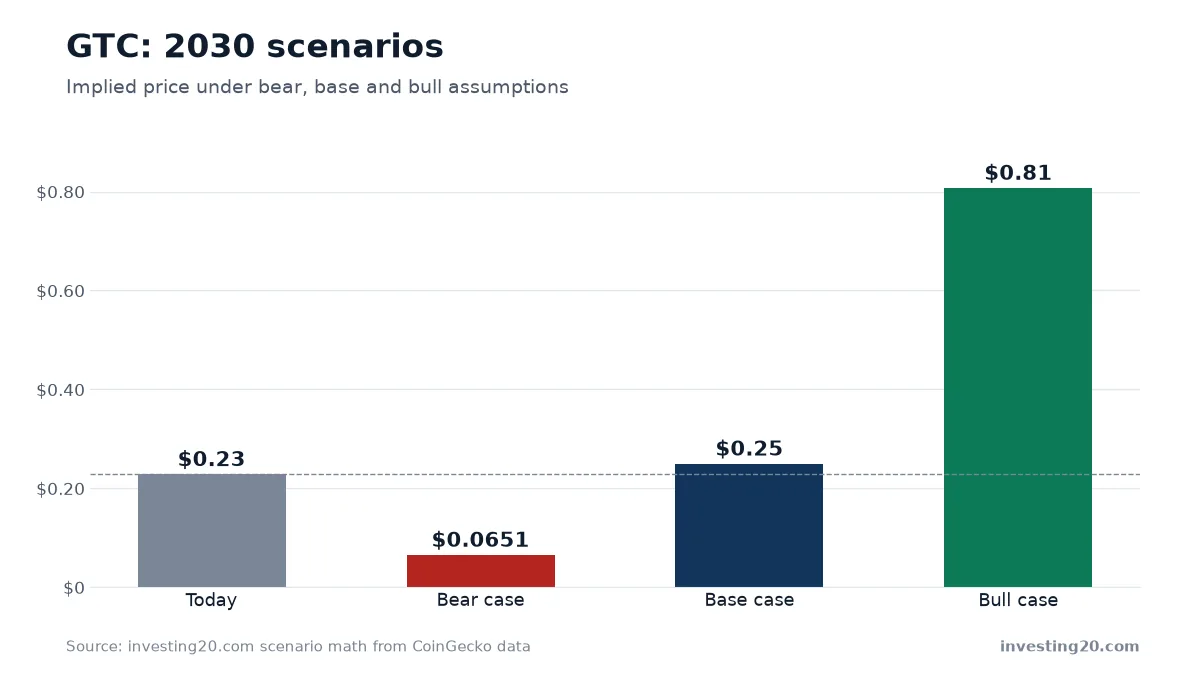
The bear case assumes the broader crypto market contracts by 5% annually, falling to $2.2 trillion by 2030. In this environment, GTC’s market share slips to 40% of its current level (rounding down to 0.000% of the market), and all remaining tokens become available to hit the 100 million cap. Under those conditions, the implied price drops to $0.0651, representing a 71% loss from today’s $0.228.
The base case models steady industry growth, with the crypto market rising 10% per year to reach $4.0 trillion in 2030. Gitcoin retains 80% of its current relative share, and half of the remaining uncirculated coins become available, bringing circulating supply to 93.75 million. The resulting price target is $0.249, a mild 9% gain from current levels.
The bull case models an aggressive expansion, where the crypto market surges 25% annually to reach $6.7 trillion by 2030. Gitcoin captures attention and expands its market share by 50% relative to today, while only a quarter of the locked supply becomes available (90.62 million coins). This scenario yields an implied price of about $0.807, a 254% gain.
The core takeaway from this model is clear: even in a roaring bull market where crypto nearly triples in size, GTC struggles to cross $1.00 unless it dramatically expands its utility and outpaces the broader sector.
Risks to weigh
Before making any investment decisions involving GTC, consider these structural risks:
- Governance discount: GTC is primarily a governance token. Without native fee-burning mechanics or direct dividend yields, there is little financial incentive for long-term holders beyond DAO voting rights.
- Future supply dilution: About 12.51 million tokens are not yet in circulation. As these tokens enter the market, they create persistent selling pressure that can weigh down price appreciation.
- Severe low-cap volatility: With a $20.0 million market cap and 24-hour volume running well above that figure, the token is subject to severe short-term speculative swings and liquidity pinches.
- Market share decay: As major institutional capital flows primarily into top-tier assets like Bitcoin and Ethereum, micro-cap tokens risk losing relevance and market share over multi-year cycles.
What to watch next
If you are tracking Gitcoin over the coming quarters, monitor how actively the DAO uses GTC for high-stakes governance decisions. Changes to platform grant distribution models or any proposal to add direct utility to the token could shift speculative interest.
Pay close attention to circulating supply metrics on tracking platforms. The pace at which the remaining 12.51 million tokens enter the market will tell you how much supply dilution current holders face. Finally, watch broader developer activity across the Ethereum open source ecosystem, as sustained platform relevance is the foundation of GTC’s long-term survival.
FAQ
Can Gitcoin (GTC) reach $1,000?
It is mathematically unlikely. Reaching $1,000 per coin would require a market value of roughly $87.5 billion at current circulation, which is over 4,300 times its valuation on October 17, 2026.
What is Gitcoin's all-time high?
Gitcoin reached an all-time high of $22.37 on November 26, 2021. As of October 17, 2026, the price sits around $0.228, which is down 99% from that peak.
What could Gitcoin be worth by 2030?
Based on scenario modeling using crypto market growth and market share, GTC could trade near $0.0651 in a bear case, $0.249 in a base case, or $0.807 in a strong bull run.
Market data: CoinGecko. Scenario math: investing20.
This article is for information only and is not investment advice. Do your own research before investing.