Strategy Inc (MSTR) Stock Forecast 2026–2030: Long-Term Scenarios
Looking at Strategy Inc (MSTR) stock forecast for 2026 to 2030. See Wall Street targets, business fundamentals, and valuation scenarios to 2030.
On this page
Strategy Inc (MSTR) trades less like a standard enterprise software provider and more like an active financial vehicle tied to the price of digital assets. If you hold shares or want to understand where the business is headed, evaluating any long-range MSTR stock forecast requires separating the operational software company from its treasury portfolio.
Long-term price targets five years out are not guaranteed predictions. Instead, they serve as structured scenarios designed to test what current valuations imply about future operational growth, dilution, and balance sheet performance.
| Share price | $96.50 (Nov 17, 2026) |
| Market value | about $38.1 billion |
| 52-week range | $81.81 – $213.83 |
| Revenue, last 12 months | about $495.1 million |
| Revenue growth, last fiscal year | 3% |
| Net income, last 12 months | a loss of about $13.7 billion |
| Price-to-sales | about 77.1× |
| Price-to-earnings | n/a (not profitable) |
| Analyst 12-month target | average $227.75 (range $175 – $350); 12 buy, 0 hold, 1 sell |
Market data from Nasdaq as of November 18, 2026. Check current figures before making any decision.
What Strategy Inc does: products, software, and treasury assets
Strategy Inc describes itself as the world’s first and largest Bitcoin Treasury Company. The company designs and issues novel fixed-income instruments and capital structures intended to give investors varying degrees of economic exposure to bitcoin. That active treasury strategy sits directly alongside its traditional corporate operational assets.
Outside its balance-sheet activities, the firm is an established developer in the enterprise analytics software market. It builds AI-powered business intelligence platforms under its vision of Intelligence Everywhere, selling tools to corporate clients to help them organize, visualize, and query large datasets.
The software business makes money primarily through software licensing, subscriptions, and ongoing technical support agreements. However, investor attention remains heavily centered on its bitcoin-focused capital management, which routinely overshadows quarterly software performance.
Where the business stands: software trends and volatile earnings
Strategy Inc generated $495.1 million in revenue over the last four reported quarters. That top-line figure has remained roughly flat over several years: the business booked $496.3 million in 2023, $463.5 million in 2024, and $477.2 million in 2025. That represents fiscal 2025 revenue growth of 3.0%.
Quarterly revenue throughout 2026 shows a steady baseline for the software unit:
- Quarter ending December 31, 2025: $122.99 million
- Quarter ending March 31, 2026: $124.30 million
- Quarter ending June 30, 2026: $122.37 million
- Quarter ending September 30, 2026: $125.43 million
The bottom line tells a far more dramatic story. Strategy Inc posted a total net loss of $13.7 billion across the last four quarters, after reporting full-year losses of $1.2 billion in 2024 and $3.8 billion in 2025. Because treasury holdings directly affect reported results, quarterly earnings per share (EPS) swing violently against consensus expectations.
In the quarter ending September 2026, the company posted an EPS of $44.75 against an expected $21.50, delivering a 108.14% surprise. Yet the preceding three quarters saw steep misses: EPS was -$24.45 in June 2026 (against an expected $52.04), -$38.25 in March 2026 (against an expected -$3.41), and -$42.93 in December 2025 (against an expected $46.02).
For fiscal year 2026, five analysts track a consensus EPS forecast of -$13.01. That projection rebounds to $29.73 in 2027 before dropping to -$1.78 in 2028 under a single analyst estimate. This volatility is common among firms undergoing corporate transitions or asset-heavy bets, as seen in other specialized tech trajectories like SoundHound AI, Inc (SOUN) Stock Forecast: 2026–2030 Scenarios or Hut 8 Corp. (HUT) Stock Forecast 2026–2030.
MSTR stock forecast for the next 12 months: what analysts expect
Wall Street analysts remain broadly optimistic on the company’s near-term trajectory. According to Nasdaq consensus data, the average 12-month analyst price target stands at $227.75, which sits 136.0% above the November 17, 2026 closing price of $96.50.
Targets range from a low of $175.00 to a high of $350.00. The rating breakdown includes:
- 12 Buy ratings
- 0 Hold ratings
- 1 Sell rating
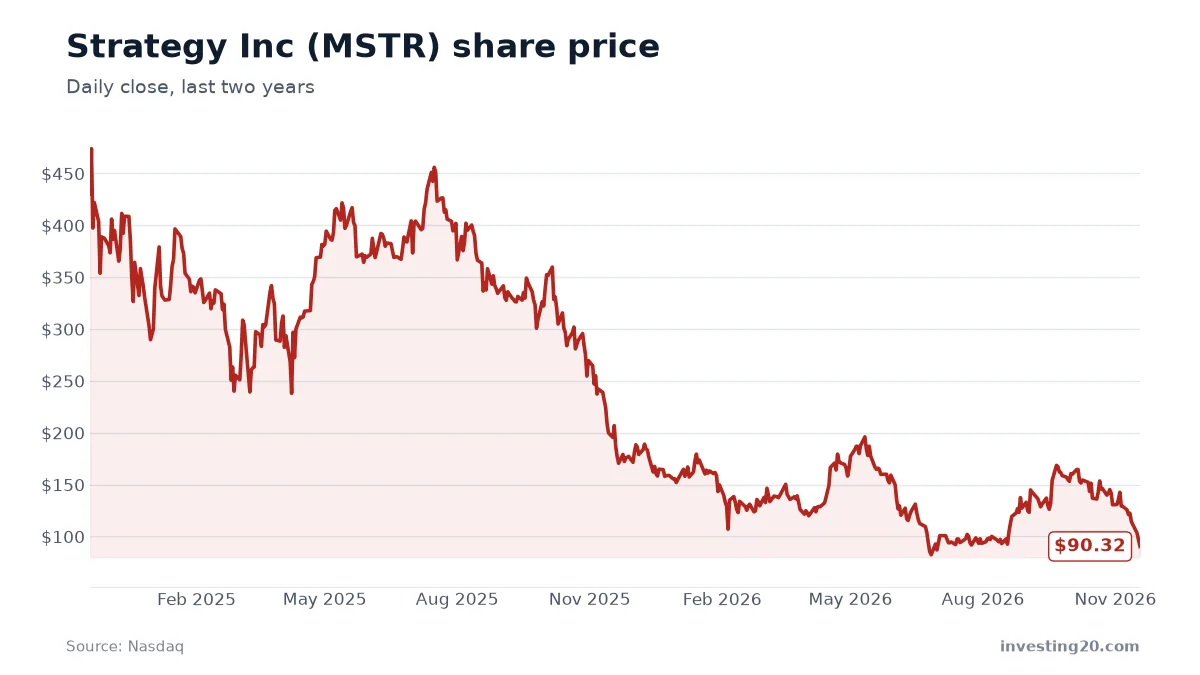
For this microstrategy stock prediction to materialize over the coming year, the market would need to assign a much higher net asset value to Strategy Inc’s balance sheet holdings or see renewed demand for its structured debt instruments. The stock traded as high as $473.83 on November 20, 2024, before falling roughly 79% to recent levels near $90.32. Hitting the average target of $227.75 would require reclaiming the upper boundary of its current 52-week range of $81.81 to $213.83.
MSTR price prediction for 2030: three revenue scenarios
Valuing Strategy Inc through 2030 using standard operating business metrics highlights a major gap between the software business and the current market capitalization. Today, the stock trades at a price-to-sales multiple of roughly 77.1 on $495.1 million in trailing revenue.
To model 2030 outcomes, we look at revenue growth, apply typical mature software multiples, and account for potential dilution. The bear case caps price-to-sales at 5.0, the base case at 10.0, and the bull case at 18.0.
| Scenario | Revenue growth per year | 2030 revenue | Price-to-sales | Shares | Implied share price |
|---|---|---|---|---|---|
| Bear | -1% | $475.6 million | 5.0× | 411 million | about $5.78 (-94%) |
| Base | 3% | $557.2 million | 10.0× | 395 million | about $14.10 (-85%) |
| Bull | 7% | $649.0 million | 18.0× | 380 million | about $30.76 (-68%) |
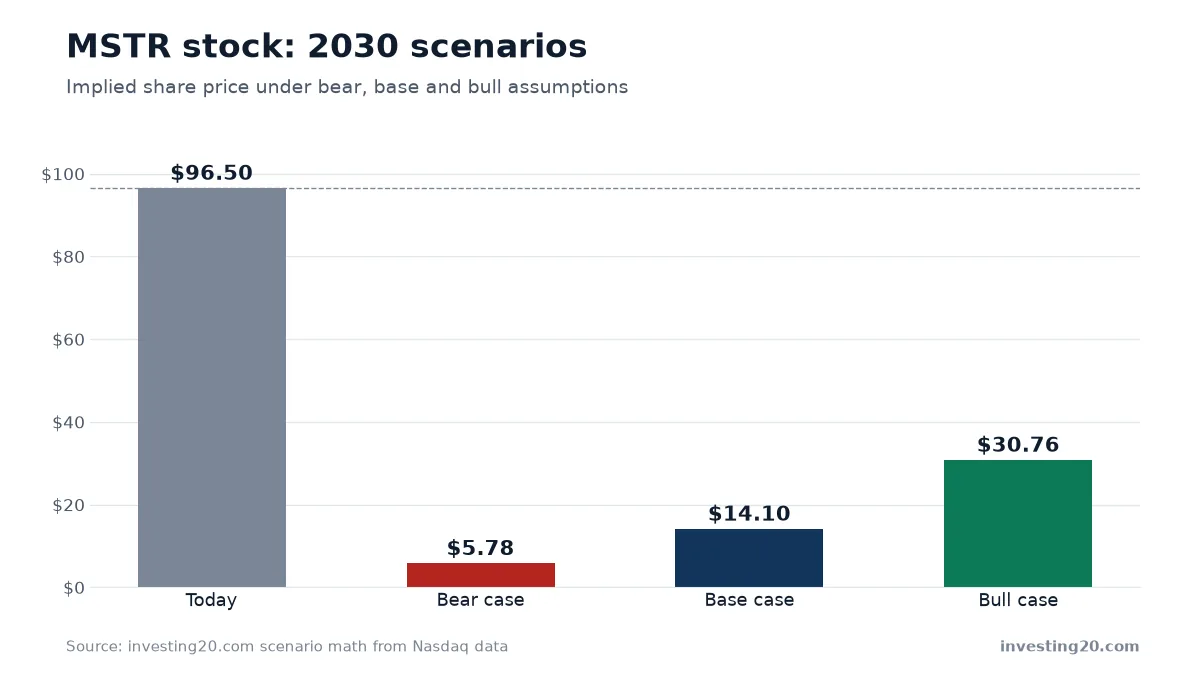
In the bear case, software revenue contracts by 1% per year to $475.6 million by 2030. If the price-to-sales ratio normalizes to 5.0 and the share count rises to 411 million, the implied share price falls to $5.78, down 94% from today’s $96.50.
In the base case, revenue grows at an average pace of 3% annually, matching its recent fiscal year rate, reaching $557.2 million. At a 10.0 sales multiple and 395 million shares, the implied price settles at $14.10, an 85% drop from current levels.
In the bull case, software sales accelerate by 7% per year to $649.0 million. If the market continues to reward the company with an elevated multiple of 18.0 across 380 million shares, the stock reaches $30.76, which is still 68% below the current market price.
The main takeaway from this modeling is what today’s valuation demands. At the base-case multiple of 10.0 and 395 million shares, Strategy Inc would need about $3.8 billion in annual software revenue by 2030 just to support today’s $96.50 share price on operations alone. When you buy MSTR today, you are not buying software growth; you are buying the net asset value and premium of its digital asset strategy. Similar valuation disconnects often appear in other momentum-driven software or hardware names, such as Super Micro Computer (SMCI) Stock Forecast 2026–2030.
Risks to weigh
Investors should review several specific risks when evaluating this business:
- Treasury asset dependency: The company’s bottom line is tied to external asset markets. Prolonged drawdowns in digital asset values create massive non-cash accounting losses, such as the $13.7 billion trailing net loss.
- Stagnant core growth: Software revenue has hovered near the $470 million to $495 million mark since 2023. The underlying enterprise analytics business is not currently expanding at the pace of modern cloud peers.
- Dilution and debt structure: Issuing fixed-income notes and new shares to fund capital management strategies increases the risk of equity dilution over time.
- Premium compression: If investor appetite for structured crypto exposure shifts toward direct spot funds or alternative vehicles like Robinhood Markets (HOOD) Stock Forecast: 2026–2030 Scenarios, the premium MSTR commands over its baseline balance sheet could shrink.
What to watch next
Keep an eye on the company’s next earnings reports to see if the AI analytics offerings can deliver sustained top-line software acceleration beyond the low single digits. More importantly, watch the terms and structure of any new fixed-income instruments management issues to support its treasury. Tracking how closely the stock’s market value mirrors its underlying asset base will tell you whether the market continues to price MSTR at an operational premium.
FAQ
What is the 12-month MSTR stock forecast?
Wall Street analysts tracked by Nasdaq have an average 12-month price target of $227.75 for Strategy Inc, with estimates ranging from a low of $175.00 to a high of $350.00. The consensus includes 12 buy ratings and 1 sell rating.
What is the long-term MicroStrategy stock prediction for 2030?
Based on traditional sales multiples and revenue modeling, long-term 2030 scenarios show implied stock prices ranging from $5.78 in a bear case to $30.76 in a bull case. These models illustrate how heavily the stock's current price relies on its balance sheet holdings rather than operating software revenue.
Why does Strategy Inc report large quarterly net losses?
Strategy Inc operates as a Bitcoin Treasury Company, meaning accounting rules cause swings in the value of its digital asset holdings to flow directly through net income. Over the last four reported quarters, this dynamic contributed to a combined net loss of $13.7 billion.
Market data: Nasdaq. Financials: Nasdaq. Scenario math: investing20.
This article is for information only and is not investment advice. Do your own research before investing.