Delta Air Lines (DAL) Stock Forecast 2026–2030: Valuation & Outlook
Examine Delta Air Lines (DAL) stock predictions for 2026–2030 with detailed bear, base, and bull scenarios based on revenue, earnings, and valuation.
On this page
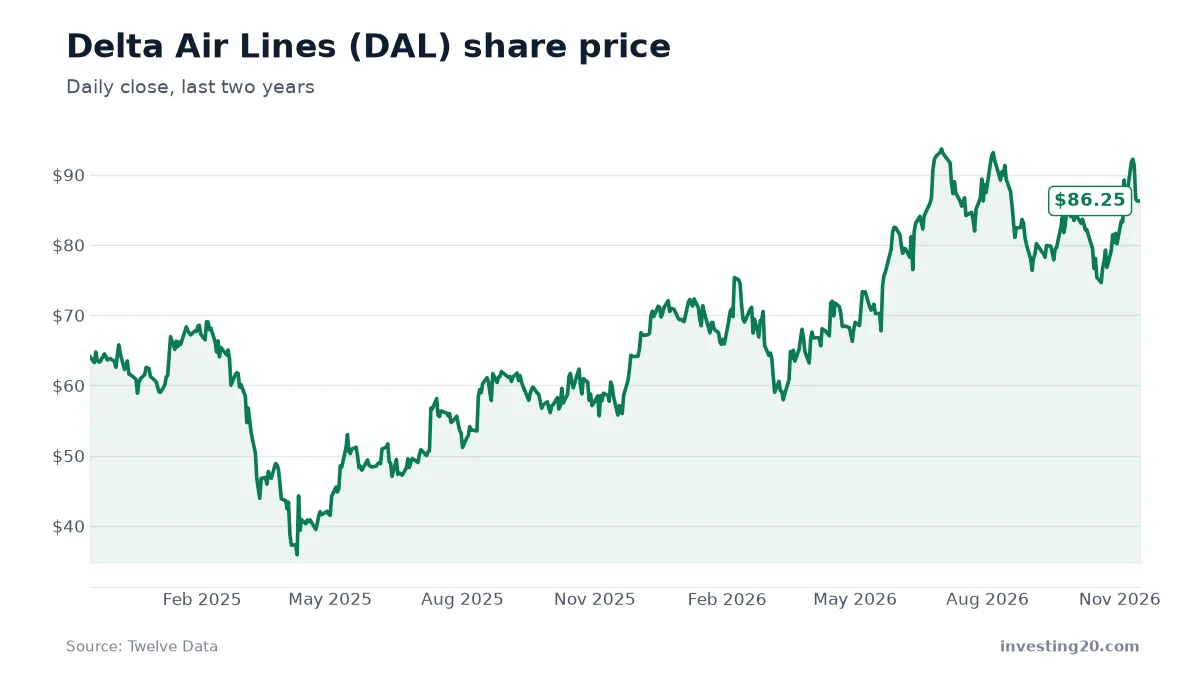
Delta Air Lines stock trades around $86.25 following two solid years of business recovery and expansion. This Delta Air Lines (DAL) stock forecast examines where the carrier’s business stands today and projects financial scenarios through 2030 using concrete revenue and valuation math.
Long-range stock forecasts are not absolute price predictions or guarantees. Instead, they are scenario models designed to map out realistic boundaries based on financial targets, valuation multiples, and operational trends over time.
| Share price | $86.25 (2026-11-13) |
| Market value | about $56.7 billion |
| 52-week range | $55.27 – $95.68 |
| Revenue, last 12 months | about $71.8 billion |
| Revenue growth, year over year | 14% |
| Net income, last 12 months | about $3.3 billion |
| Price-to-sales | about 0.8× |
| Price-to-earnings | about 17× |
Market data from Twelve Data as of November 15, 2026. Revenue and net income from the company’s SEC filings. Check current figures before making any decision.
What Delta Air Lines does
Delta Air Lines operates as a major global carrier in the scheduled air transportation industry. The company earns revenue primarily by selling passenger seats across domestic and international routes, carrying cargo, and operating its loyalty program alongside strategic airline partners.
Delta serves individual leisure travelers, business clients, and commercial freight shippers. The business generates cash through direct ticket sales, premium seat upgrades, baggage fees, corporate travel contracts, and credit card partnerships that reward passenger loyalty.
Where the business stands today
Delta’s financial performance shows steady revenue expansion across recent fiscal periods. For the fiscal year ending December 31, 2023, Delta reported $58.0 billion in revenue. That figure expanded to $61.6 billion in 2024 and reached $63.4 billion for the fiscal year ending December 31, 2025.
Over the trailing four reported quarters ending September 30, 2026, Delta generated $71.8 billion in total revenue. That represents a 14.1% increase compared to the prior four-quarter stretch. Quarterly revenue during this period came in at $16.00 billion for the quarter ending December 31, 2025; $15.85 billion for March 31, 2026; $19.76 billion for June 30, 2026; and $20.19 billion for September 30, 2026.
Net income over the latest four reported quarters stands at $3.3 billion, compared to $5.0 billion in fiscal year 2025 and $3.5 billion in fiscal year 2024. Shares trade at a price-to-earnings ratio of 17.2 and a price-to-sales ratio of 0.8 based on a market valuation of $56.7 billion.
Looking back, the stock traded at $64.07 on November 15, 2024, marking a 34.6% gain over two years to the current $86.25 level on November 13, 2026. Over the past 52 weeks, the share price has ranged between a low of $55.27 and a high of $95.68. Looking further back, shares hit a low of $35.88 on April 8, 2025, before rallying to a peak of $93.66 on June 30, 2026.
Similar multi-year operational shifts can be seen in other large enterprise forecasts, such as our Apple (AAPL) Stock Forecast 2026–2030 or our Tesla (TSLA) Stock Forecast 2026–2030.
DAL stock forecast for the next 12 months
Over the next 12 months, the direction of Delta stock will depend heavily on whether the airline can maintain its recent top-line momentum while managing volatile operating expenses like jet fuel and labor. The company posted strong quarterly revenue of $20.19 billion in the quarter ending September 30, 2026, showing that travel demand remained solid through the summer peak.
Investors evaluating a short-term delta airline stock forecast should monitor quarterly capacity utilization, passenger yields, and operating margins. To sustain current stock levels or build toward previous 52-week highs near $95.68, Delta will need to consistently match or exceed its recent 14.1% revenue growth rate without letting fuel cost swings erode net profitability.
Because short-term macro sentiment can shift quickly, watching corporate travel bookings and consumer travel budgets will provide clear signals on whether revenue trends can hold through upcoming quarters.
DAL stock forecast for 2030: three scenarios
To project a multi-year delta stock forecast through 2030, we start from the current trailing four-quarter revenue of $71.8 billion. We project annual growth rates out to 2030, apply valuation multiples, and factor in potential changes in share count.
Today’s valuation of $86.25 per share already assumes Delta will generate roughly $76.2 billion in annual revenue by 2030 under base-case valuation multiples. Here is how three specific financial paths look.
| Scenario | Revenue growth per year | 2030 revenue | Price-to-sales | Shares | Implied share price |
|---|---|---|---|---|---|
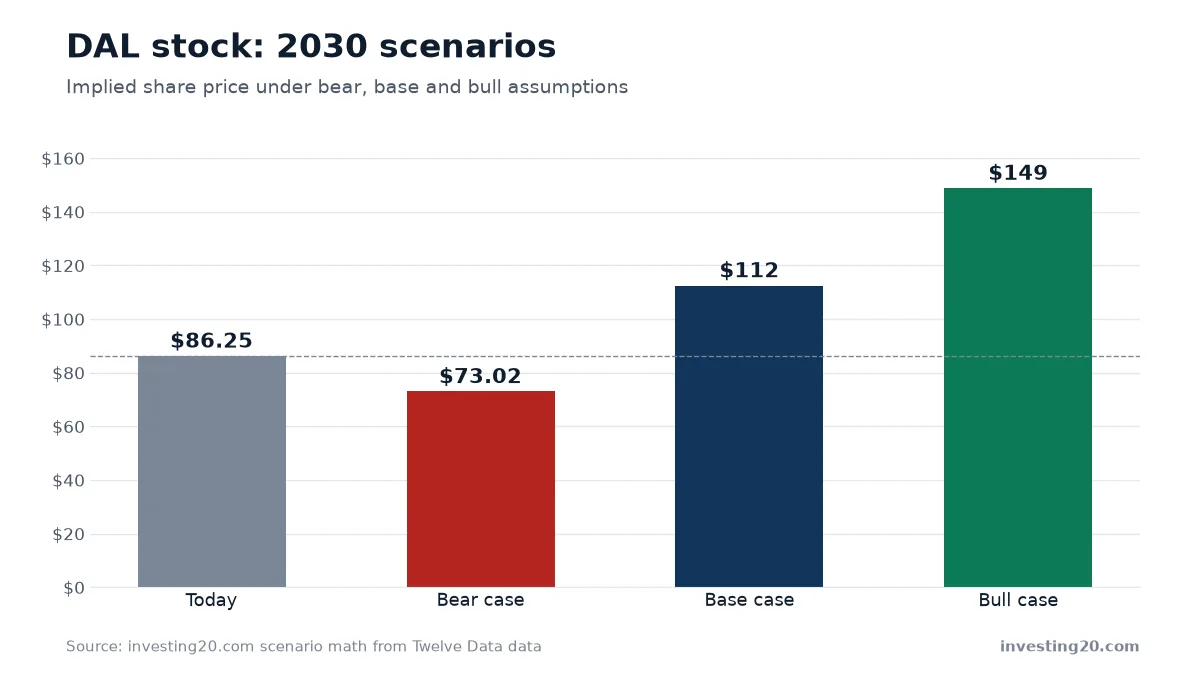
| Bear | 4% | $85.5 billion | 0.6× | 740 million | about $73.02 (-15%) |
| Base | 8% | $99.4 billion | 0.8× | 698 million | about $112.49 (+30%) |
| Bull | 12% | $114.9 billion | 0.9× | 671 million | about $148.80 (+73%) |
Bear case scenario
In the bear case, annual revenue growth slows to an average of 4% per year, bringing 2030 total revenue to $85.5 billion. If macroeconomic headwinds compress valuation multiples, the price-to-sales ratio could decline to 0.6. Assuming share dilution increases the share count to 740 million, the implied share price drops to about $73.02, representing a 15% decline from today’s price.
Base case scenario
In the base case, Delta maintains steady operational execution with revenue growing by an average of 8% per year to reach $99.4 billion by 2030. Assuming the price-to-sales ratio remains stable at today’s 0.8 level and share dilution brings the count to 698 million, the implied share price reaches approximately $112.49. That represents a 30% gain over the current stock price.
Bull case scenario
In the bull case, strong international and premium passenger demand drives revenue growth of 12% annually, pushing 2030 revenue to $114.9 billion. If investor confidence elevates the price-to-sales ratio slightly to 0.9 and share count dilution is contained to 671 million, the implied stock price reaches about $148.80, a 73% increase from current levels.
For investors who analyze scenario models across different market sectors, comparing cyclical transport stocks with retail trading platforms in our Robinhood Markets (HOOD) Stock Forecast provides useful context on how market multiples vary across industries.
Risks to weigh
- Fuel price volatility: Sharp increases in global crude oil or jet fuel prices can instantly squeeze airline profit margins.
- Economic downturns: Discretionary consumer spending and corporate travel budgets shrink during recessions, hitting booking volumes.
- Capital expenditure requirements: Fleet upgrades and aircraft maintenance require substantial ongoing cash outlays.
- Share dilution: Any issuance of new shares to raise capital or fund fleet expansion dilutes existing equity holders.
- Operational disruptions: Extreme weather events, air traffic control delays, or geopolitical tensions can disrupt flight networks and reduce revenue.
What to watch next
When following any delta airlines stock predictions or updating your own dal stock prediction, keep a close eye on Delta’s quarterly earnings filings to check if trailing revenue stays on track toward $76.2 billion and beyond. Watch net profit margins, jet fuel expense trends, and management’s commentary on premium seat demand. Tracking these fundamentals will show whether the stock is tracking closer to its bear, base, or bull path over the coming years.
FAQ
What is the delta airlines stock forecast for 2030?
Under a base-case scenario assuming 8% annual revenue growth to $99.4 billion and a price-to-sales ratio of 0.8, Delta Air Lines stock points to an implied price around $112.49 by 2030. The bull case points to $148.80 while the bear case indicates $73.02.
What revenue does Delta Air Lines generate today?
Delta generated $71.8 billion in revenue over the four reported quarters ending September 30, 2026, representing a 14.1% increase compared to the prior four quarters.
What are the main risks for a delta stock forecast?
Key risks include rising jet fuel costs, macroeconomic slowdowns that curb travel demand, share dilution, and operational interruptions across international networks.
Market data: Twelve Data. Financials: SEC filings. Scenario math: investing20.
This article is for information only and is not investment advice. Do your own research before investing.