Meta Q3 Earnings: Revenue Beat and $140B AI Spending Shift
Meta beat Q3 revenue estimates and raised capex for AI infrastructure. Here is what the numbers, Muse AI agent, and legal costs mean for tech investors.
On this page
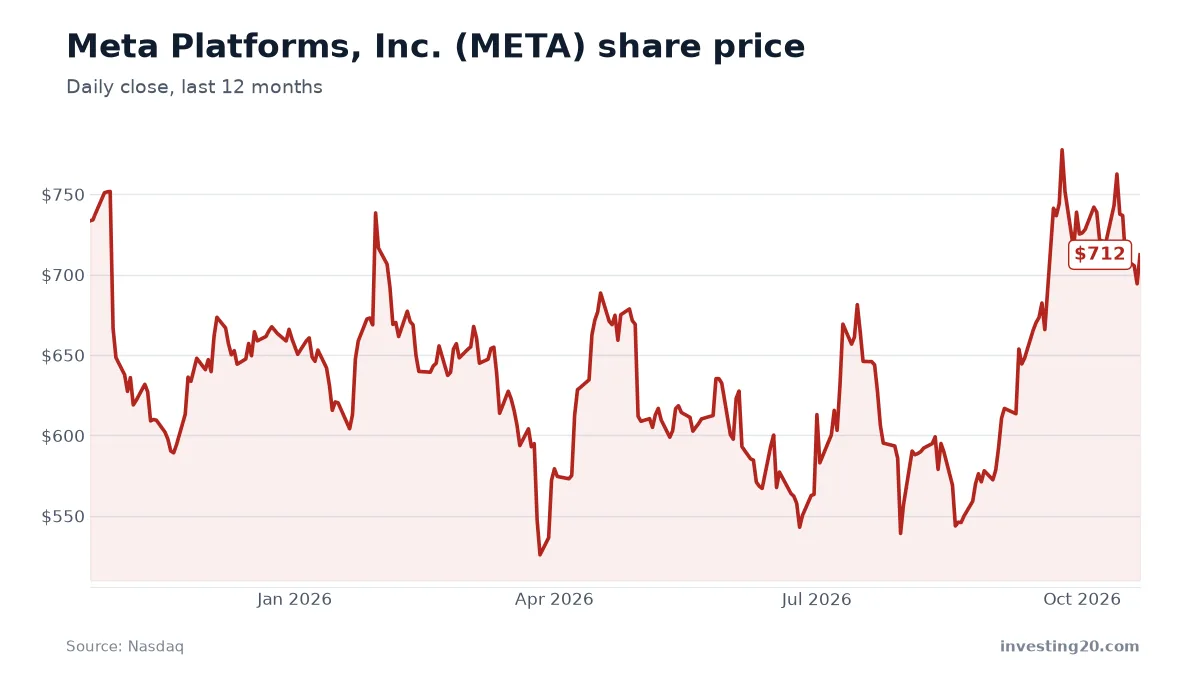
Meta reported third-quarter revenue of $64.6 billion on Wednesday, topping Wall Street expectations of $63.3 billion and pushing its stock up roughly 2.5% to 5% in extended trading. The social media giant also issued strong fourth-quarter guidance, projecting revenue between $73 billion and $76 billion, beating consensus estimates of $73.73 billion.
If you hold broad index funds or individual tech shares, Meta’s results are a valuable pulse check on the entire sector. The big story isn’t just advertising sales: it’s Mark Zuckerberg’s willingness to spend upwards of $140 billion this year alone on artificial intelligence infrastructure, even as massive legal settlements drag down short-term profits.
Meta Q3 earnings by the numbers
Meta’s core advertising engine is firing on all cylinders, but heavy spending and legal hits created a stark contrast between top-line growth and bottom-line cash flow. Revenue for the quarter rose 26% year-over-year, while daily active users across Facebook, Instagram, Messenger, and WhatsApp reached 3.64 billion.
Here is how the key financial metrics stacked up for the quarter ending September 30, 2026:
| Financial Metric | Q3 2026 Actual | Wall Street Expectation / Prior Period |
|---|---|---|
| Revenue | $64.6 billion | $63.3 billion expected (Up 26% YoY) |
| Q4 Revenue Guidance (Midpoint) | $74.5 billion | $73.73 billion expected |
| Net Income | $9.9 billion | $2.7 billion in Q3 2025 |
| Capital Expenditures (Capex) | $34.9 billion | $31.0 billion in Q2 2026 |
| Free Cash Flow | -$2.1 billion | $784 million in Q2 2026 |
| Full-Year Capex Range | $135B to $145B | $130B to $145B (previous guidance) |
The headline net income figure of $9.9 billion ($3.83 per share) includes a massive $10 billion legal charge related to a settlement with state attorneys general over youth safety and mental health. Without that single charge, operating income would have reached $22.9 billion ($7.40 per share) instead of the reported $13.0 billion.
Meanwhile, the company’s hardware and virtual reality arm, Reality Labs, recorded $443 million in revenue alongside an operating loss of $4.13 billion.
Why investors are forgiving negative free cash flow
Under normal circumstances, a company reporting negative free cash flow of $2.1 billion after generating positive cash flow in prior quarters would prompt a selloff. In this case, Wall Street gave Meta a pass because management showed concrete evidence that its AI investments are starting to pull in real users.
In September, Meta launched its Muse personal assistant, followed by the rollout of its Muse Wonder frontier model. CEO Mark Zuckerberg noted during the earnings call that over 10 million people across the U.S. and Canada set up Muse agents in its first six weeks. About a quarter of those users engage with the assistant daily, and more than 25% of active users are using the tool for online shopping with an average purchase value over $200.
Unlike historical feature rollouts where Meta waited until reaching one billion users before turning on monetization, Zuckerberg indicated the company plans to monetize Muse much faster. High operational compute costs mean Meta is already offering $20 and $100 monthly subscription tiers for power users, alongside plans to build custom agent networks for small businesses.
According to research notes from Baird Equity Research, investors are increasingly comfortable with Meta’s elevated capex because AI infrastructure directly upgrades the company’s core ad-targeting engine while opening new monetization paths. That represents a noticeable shift from earlier market panics, such as the broader market pullbacks detailed in our analysis of the AI tech stock selloff and debt fears.
Capital expenditures: The $1.2 trillion Big Tech arms race
Meta narrowed its full-year 2026 capex forecast to between $135 billion and $145 billion, locking in spending near the high end of its previous target. To put that in perspective, research firm Visible Alpha estimates that total tech industry infrastructure spending will hit $790 billion in 2026 and surge to $1.2 trillion in 2027.
Investors often wonder why Meta spends heavily on custom data centers when it doesn’t operate a public cloud platform like Microsoft, Google, or Amazon. The answer lies in scale: Meta runs its own models locally across billions of app users, meaning every efficiency gain in ad placement or retail transaction routing drops straight to its bottom line.
While hardware vendors and specialized server providers have seen wildly swinging valuations—similar to the volatility discussed in our Super Micro Computer stock forecast—Meta is using its core cash flow to build proprietary computing assets that reduce long-term reliance on third parties.
Legal headwinds and a new stock structure
While Meta’s operating core looks stable, legal overhangs remain a major risk factor. Hours before the earnings announcement, a New Mexico state judge ordered Meta to pay a $25 billion penalty in a long-running data privacy case stemming from the 2018 Cambridge Analytica scandal. Meta’s chief legal officer C.J. Mahoney stated the company intends to appeal the ruling, which includes a 15% annual interest penalty until resolved.
To maintain funding flexibility amidst rising capex and legal liabilities, Meta announced a new corporate share structure. Starting in January 2027, the company will issue a non-voting Class C common stock via a stock dividend, effectively creating a two-for-one stock split.
The company also executed a Founder Alignment Agreement with Mark Zuckerberg, securing his commitment to stay at Meta for eight years while addressing potential personal tax liabilities linked to California’s proposed Proposition 40 wealth tax. This structure allows Meta to use Class C shares for acquisitions and employee stock compensation without diluting founder control.
What this means for your portfolio
Meta’s earnings report highlights three important takeaways for everyday investors managing long-term brokerage accounts or 401(k) allocations:
- Mega-cap tech is eating the AI market: The massive capital requirements ($135B+ per year) favor mega-cap giants with high-margin cash engines. Smaller enterprise AI players may face stiffer competition as Meta expands Muse into corporate environments. If you hold concentrated positions in high-multiple software stocks, review our Palantir stock forecast to understand how enterprise AI pricing power is shifting.
- Volatile margins are the new normal: Legal settlements and infrastructure spending will cause quarterly earnings per share to jump around. Pay attention to top-line ad growth and active user trends rather than short-term net income swings caused by legal reserves.
- Stock splits don’t change business value: Meta’s upcoming Class C dividend in January 2027 doubles your share count while halving the price per share, leaving your overall ownership value unchanged.
What to watch next
If you hold Meta or broader tech index funds, keep these specific catalysts on your radar over the coming quarters:
- Monetization rates for Muse: Watch whether Meta successfully converts free personal assistant users into $20 and $100 monthly subscribers, and whether ad spending on Muse shopping recommendations ramps up in Q4.
- 2027 Capex guidance: Management will provide full-year 2027 capex expectations during the next earnings cycle. Wall Street expects industry-wide AI spending to keep accelerating, so any sharp cut or unexpected increase will move the stock.
- Appeals court updates: Track progress on Meta’s appeal of the $25 billion New Mexico court penalty, as well as final payout schedules for its $18 billion multi-state youth safety settlement.
FAQ
Did Meta beat expectations in its Q3 earnings report?
Yes, Meta reported third-quarter revenue of $64.6 billion, up 26% year-over-year and above Wall Street targets of $63.3 billion. Operating earnings were impacted by a $10 billion legal settlement, but baseline business demand remained strong.
How much is Meta spending on AI infrastructure?
Meta narrowed its full-year capital expenditure guidance to between $135 billion and $145 billion. In the third quarter alone, the company spent $34.9 billion on capital expenditures, mostly to build out data centers and computing power for AI models.
What is Meta's new Class C stock split?
Meta announced a new class of non-voting Class C common stock that will be distributed to existing shareholders via a stock dividend in January 2027. This effectively functions as a two-for-one stock split to help finance ongoing growth and equity compensation.
Sources: Meta reports third-quarter revenue beat and issues strong guidance (CNBC); Meta’s stock rises as investors glimpse an opportunity that could dwarf the ad business (MarketWatch); Meta’s revenue surges to $64.6 billion, but billions in settlements and skyrocketing AI spending turn screws on profit, free cash flow (Fortune); Meta ordered to pay $25 billion penalty in New Mexico Cambridge Analytica case (CNBC).
Market data: Nasdaq
This article is for information only and is not investment advice. Do your own research before investing.