Palantir (PLTR) Stock Forecast 2026–2030: Bull, Base and Bear Cases
PLTR stock forecast for 2026, 2027 and 2030: Palantir’s latest results and guidance, what analysts expect, and bull, base and bear scenarios with the math shown.
On this page
Updated October 3, 2026. This is a refreshed PLTR stock forecast for Palantir Technologies. It covers where the business stands today, what analysts expect for 2026 and 2027, and what the share price could look like by 2030 under three scenarios.
Nothing here is a prediction you should trade on. Long-range stock forecasts are guesses, so this article shows its assumptions and lets you change them.
Key numbers at a glance
| Share price | $188.75 (close on October 2, 2026) |
| Market value | about $454 billion |
| 52-week range | $106.37 – $207.52 |
| Revenue, last 12 months | about $6.2 billion |
| Net income, last 12 months | about $3.0 billion |
| Price-to-earnings | about 161 trailing, about 100 forward |
| Analyst 12-month targets | $80 – $255, average about $195 |
| Next earnings report | November 2, 2026 |
Price and valuation data are from StockAnalysis and MarketBeat. Check them for current figures before you make any decision.
What is Palantir Technologies?
Palantir is a software company founded in 2003 by Peter Thiel, Alex Karp, Joe Lonsdale, Stephen Cohen and Nathan Gettings. It builds platforms that let large organizations pull their data together and act on it. It went public through a direct listing in September 2020, joined the S&P 500 in 2024, and its shares now trade on the Nasdaq.
It sells four main products:
- Gotham, used mostly by defense and intelligence agencies
- Foundry, the equivalent for commercial companies
- Apollo, which deploys and updates software across different environments
- AIP, the Artificial Intelligence Platform launched in 2023, which connects large language models to a customer’s own data and operations
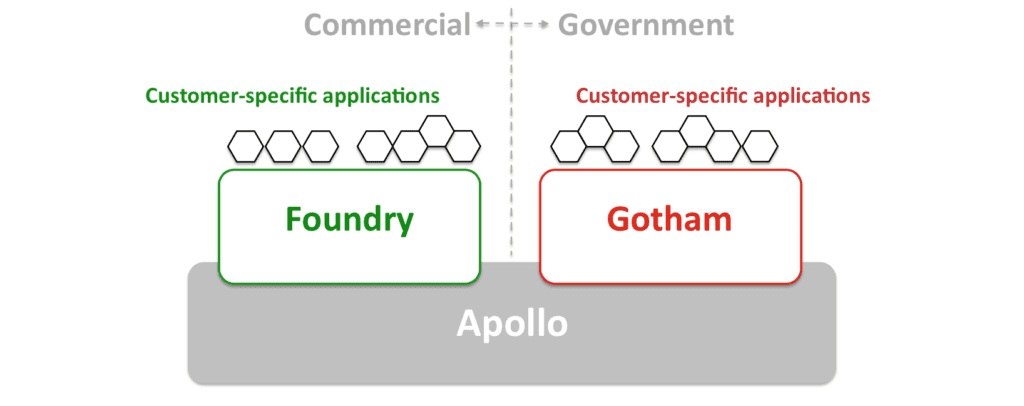
AIP is the product behind the growth of the last three years. It turned Palantir from a company known for government contracts into one whose US commercial business is nearly as large as its US government business.
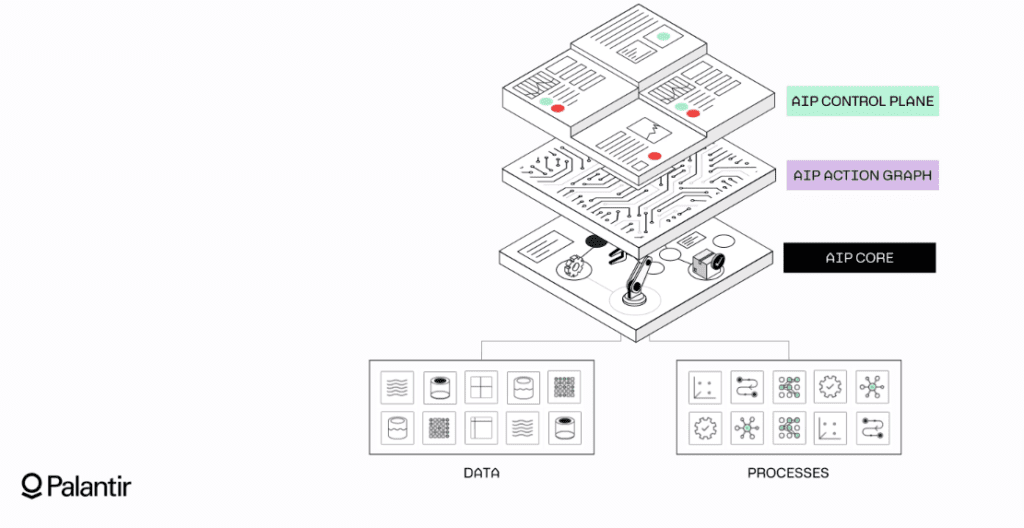
Credit: Palantir
Where the business stands in 2026
Palantir is growing faster now than it was three years ago, at a much larger size, and it is highly profitable.
Second quarter 2026 (reported August 3, 2026):
- Total revenue up 93% year over year
- US commercial revenue of $764 million, up 149%
- US government revenue of $809 million, up 90%
- Total US revenue of $1.573 billion, up 115%
Guidance for full year 2026, raised with that report:
- Revenue of $8.150 billion to $8.158 billion, about 82% growth
- US commercial revenue above $3.424 billion, at least 134% growth
- Adjusted income from operations of $4.889 billion to $4.897 billion
- Adjusted free cash flow of $4.5 billion to $4.7 billion
That guidance implies revenue of roughly $4.5 billion in 2025. When this article was first written in 2023, the forecast for 2025 revenue was about $3.2 billion.
PLTR stock forecast for 2026 and 2027
The business is not the question for the next year. The valuation is.
MarketBeat tracks 36 analysts: 23 rate the stock a buy or strong buy, 10 a hold and 3 a sell. The average 12-month target is about $195, within a few percent of the current price. Recent targets include $250 from UBS and DA Davidson, $225 from Rosenblatt and $215 from Needham. The lowest target on record is $80.
Two points stand out:
- The average target is roughly the current price. As a group, analysts think the stock already reflects the strong results.
- The range is unusually wide. A spread from $80 to $255 shows real disagreement about what multiple a company growing this fast deserves.
For the stock to move well above the analyst average in 2027, Palantir likely has to keep beating and raising its own guidance, as it did in August. A quarter of slower growth would test a valuation of about 160 times trailing earnings.
PLTR stock forecast for 2030: three scenarios
No one can forecast a share price four years out. What you can do is pick assumptions and see what they imply. The table below starts from the midpoint of 2026 revenue guidance, $8.154 billion, and applies a yearly growth rate for 2027 through 2030, a price-to-sales multiple, and a share count that allows for some dilution from stock-based pay.
| Scenario | Revenue growth per year | 2030 revenue | Price-to-sales | Shares | Implied share price |
|---|---|---|---|---|---|
| Bear | 15% | $14.3 billion | 10× | 2.60 billion | about $55 |
| Base | 30% | $23.3 billion | 20× | 2.55 billion | about $180 |
| Bull | 45% | $36.0 billion | 30× | 2.50 billion | about $430 |
How to read it:
- Bear case. AI spending cools, growth drops to the mid-teens, and the market values Palantir like a mature software company. Revenue still grows 75% from 2026 and the share price falls by about 70%.
- Base case. Growth slows from 82% to an average of 30% a year, still exceptional at this size, and the multiple compresses to 20 times sales. Revenue nearly triples and the share price ends close to where it is today.
- Bull case. Growth stays near 45% a year and investors keep paying a premium multiple. The share price more than doubles.
The base case is the main takeaway. Palantir trades at roughly 55 times this year’s expected revenue, so several years of fast growth are already in the price. The stock can do well from here, but the business has to keep outrunning very high expectations.
How the earlier forecast held up
The earlier version of this article projected $8.70 to $15 for 2023, $16.93 to $25.67 for 2025, and “$80+” by 2030, with $100 arriving around 2035. Palantir passed $100 in early 2025 and trades near $189 in October 2026. The forecast was far too low because it did not anticipate how quickly AIP would grow the commercial business. That miss is the reason this update uses scenarios with stated assumptions instead of single price targets.
Risks to weigh
- Valuation. At about 160 times trailing earnings, even good results can disappoint.
- Government dependence. US government revenue is still about half of US revenue, and budgets and contract awards can shift.
- Concentration in the US. The fastest growth is at home; results outside the US have historically been slower.
- Dilution. Stock-based compensation adds to the share count over time.
- Competition. Microsoft, Snowflake, Databricks and others are all selling AI and data platforms to the same customers.
FAQ
What is the PLTR stock forecast for 2026 and 2027?
Wall Street’s average 12-month price target for Palantir is about $195, with individual targets from $80 to $255, against a share price of $188.75 on October 2, 2026. The average sits close to the current price, which means analysts as a group see the stock as fairly valued after its run.
What could Palantir stock be worth in 2030?
Nobody can know. Using simple revenue-and-valuation math, a bear case lands near $55, a base case near $180 and a bull case near $430 per share by 2030. The base case is close to today’s price because the current valuation already assumes years of fast growth.
Did PLTR hit $100?
Yes. Palantir crossed $100 per share in early 2025, years ahead of what the earlier version of this article expected, and traded between $106.37 and $207.52 over the 12 months to October 2026.
Is Palantir profitable?
Yes. Palantir earned about $3.0 billion of net income over the last 12 months on revenue of about $6.2 billion, and it expects $4.5 billion to $4.7 billion of adjusted free cash flow in 2026.
Is PLTR overvalued?
It is expensive by any standard measure: about 160 times trailing earnings and roughly 55 times this year’s expected revenue. Whether that is too expensive depends on how long growth above 50% a year can continue. This article is not investment advice.
Final thoughts
Palantir has delivered results that few expected when this article was first written: revenue growth above 80%, large profits and a US commercial business that was a small part of the company a few years ago. The debate now is about price. The scenario math shows that a strong outcome is already assumed, so the stock’s path from here depends on whether the company can keep exceeding it.
Related forecasts: NVIDIA, Jumia (JMIA), Amazon, SoFi and NIO.
Disclaimer: This article is for information only and is not investment advice. The scenarios are illustrations based on stated assumptions, not predictions. Do your own research before investing.