Rivian Automotive (RIVN) Stock Forecast 2026–2030: Long-Term Outlook
A long-term Rivian Automotive (RIVN) stock forecast for 2026 to 2030. Explore Wall Street targets, financials, and 2030 revenue and valuation scenarios.
On this page
- What changed since our last update
- What does Rivian Automotive do?
- Where the business stands today
- What do analysts expect for RIVN stock over the next 12 months?
- Rivian stock forecast for 2030: three scenarios
- The bear case: production bottlenecks and multiple compression
- The base case: steady expansion and stable valuation
- The bull case: strong adoption and operational gains
- Risks to weigh
- What to watch next
- FAQ
Rivian Automotive (RIVN) sits at an interesting crossroads for electric vehicle investors: revenue is climbing steadily, net losses are shrinking, but the business continues to spend heavily to scale production. This forecast looks at where Rivian’s business stands as of November 1, 2026, what Wall Street analysts expect over the next 12 months, and how different revenue outcomes could shape the share price by 2030.
Long-range stock forecasts are not certain predictions. Instead, treat them as structured scenarios that show what kind of execution, sales volume, and valuation multiples the current stock price already reflects.
| Share price | $12.16 (Oct 30, 2026) |
| Market value | about $17.6 billion |
| 52-week range | $11.38 – $22.69 |
| Revenue, last 12 months | about $6.5 billion |
| Revenue growth, last fiscal year | 8% |
| Net income, last 12 months | a loss of about $3.0 billion |
| Price-to-sales | about 2.7× |
| Price-to-earnings | n/a (not profitable) |
| Analyst 12-month target | average $17.00 (range $10 – $22); 7 buy, 6 hold, 4 sell |
Market data from Nasdaq as of November 1, 2026. Check current figures before making any decision.
What changed since our last update
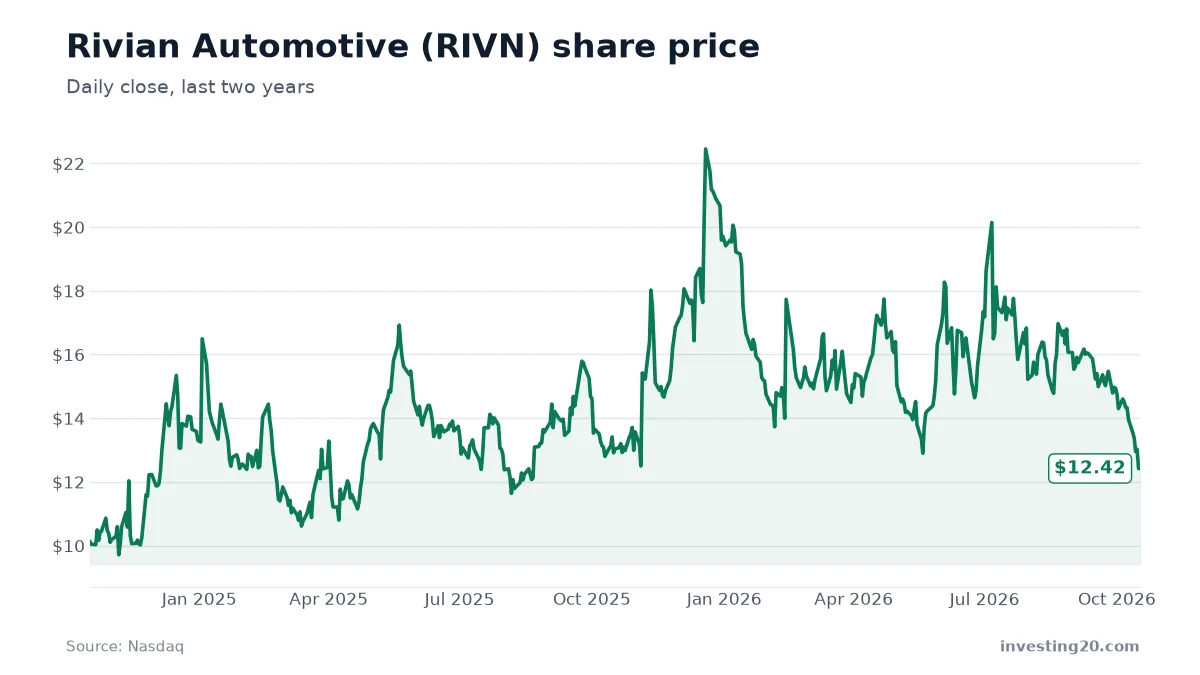
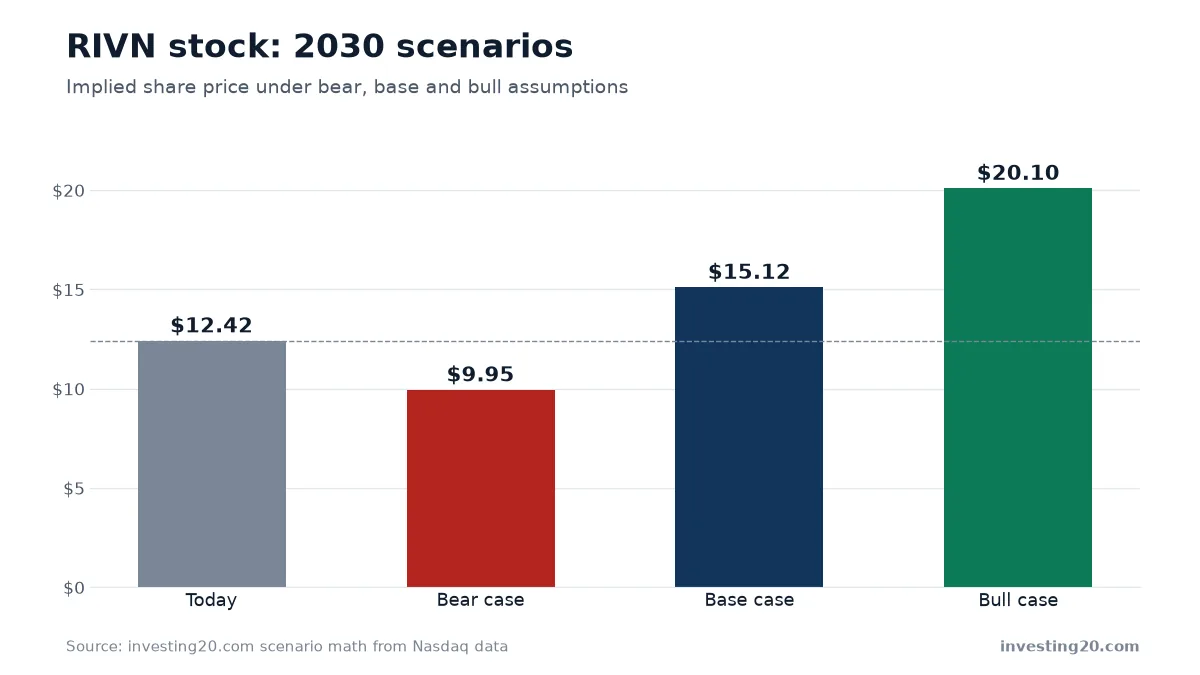
Rivian shares traded at $12.16 as of October 30, 2026, down 2.1% from $12.42 in our October 17 update. Over that same period, the average 12-month analyst target adjusted slightly from $17.47 to $17.00. Because of slight adjustments in projected share dilution across the industry model, our implied 2030 scenario prices also shifted slightly: the bear case moved from $9.95 to $9.74, the base case from $15.12 to $14.80, and the bull case from $20.10 to $19.68.
What does Rivian Automotive do?
Rivian is an American automotive technology company that designs, develops, and manufactures electric vehicles. Its lineup focuses on category-defining consumer vehicles, like adventure-oriented pickup trucks and SUVs, alongside commercial delivery vans.
The company builds its vehicles in the United States and sells directly to both consumer and commercial buyers rather than relying on franchised dealerships. Rivian focuses on vertical integration: it develops its own electrical architecture, propulsion hardware, battery systems, and end-to-end software stack. In addition to physical vehicle sales, Rivian generates revenue through value-added services, including software upgrades, fleet management tools, autonomous driving platforms, charging infrastructure, and vehicle servicing.
Much like other pure-play EV makers featured in our Tesla (TSLA) stock forecast and NIO stock forecast, Rivian aims to capture software margins on top of standard manufacturing sales as its customer base grows.
Where the business stands today
Rivian’s top line has shown steady expansion over the past three fiscal years. Full-year revenue stood at $4.4 billion in 2023, grew to $5.0 billion in 2024, and reached $5.4 billion in 2025 (an 8.4% annual growth rate). Over the trailing twelve months, top-line sales accelerated to $6.5 billion, helped by strong sequential gains in 2026:
- Quarter ending December 31, 2025: $1.29 billion
- Quarter ending March 31, 2026: $1.38 billion
- Quarter ending June 30, 2026: $1.66 billion
- Quarter ending September 30, 2026: $2.15 billion
At the same time, Rivian remains unprofitable, but its bottom line is moving in the right direction. Net losses dropped from -$4.7 billion in fiscal 2024 to -$3.6 billion in fiscal 2025. Over the last four reported quarters, total net losses stood at -$3.0 billion.
Recent quarterly earnings have consistently beaten consensus expectations. On October 29, 2026, Rivian reported a third-quarter earnings per share (EPS) loss of -$0.62, outperforming the -$0.84 estimate by 26.19%. In the June 2026 quarter, EPS came in at -$0.64 against an expected -$0.83. The March 2026 quarter beat by 5.33% ($-0.71 vs. -$0.75), and the December 2025 quarter beat by 20.48% ($-0.66 vs. -$0.83).
Consensus forecasts from Wall Street project losses will continue to narrow over the coming years: five analysts project an average EPS of -$2.92 for full-year 2026, six analysts expect -$2.46 in 2027, and four analysts estimate -$1.93 in 2028.
What do analysts expect for RIVN stock over the next 12 months?
Wall Street sentiment on Rivian is moderately positive but divided. Out of 17 analysts covering the stock according to Nasdaq consensus data, 7 recommend a Buy, 6 say Hold, and 4 suggest Sell.
The consensus 12-month price target averages $17.00. That would represent a 39.8% gain from the October 30 closing price of $12.16. Individual expectations show wide divergence: the lowest price target is $10.00 (a 17.8% decline), while the highest price target is $22.00 (an 80.9% gain).
For the stock to push toward the top end of that range, Rivian would likely need to maintain its revenue momentum above $2 billion per quarter while showing that gross margins are expanding fast enough to hit the projected -$2.46 EPS consensus for 2027. If delivery timelines slip or quarterly cash burn spikes, shares could retest the 52-week low of $11.38 or drift toward the analysts’ $10.00 floor.
Rivian stock forecast for 2030: three scenarios
To assess where Rivian might trade by 2030, we model three scenarios starting from its trailing twelve-month revenue of $6.5 billion. For fast-growing businesses, sales growth tends to taper over time as volume increases. In our model, we apply conservative price-to-sales multiples and factor in potential share dilution from future capital raises or stock-based compensation.
Today, Rivian trades at a price-to-sales ratio of 2.7 with a market capitalization of $17.6 billion. To break even with today’s $12.16 share price by 2030 (assuming our base-case share count and a 2.7 multiple), Rivian would simply need to maintain annual revenue around $6.5 billion.
| Scenario | Revenue growth per year | 2030 revenue | Price-to-sales | Shares | Implied share price |
|---|---|---|---|---|---|
| Bear | 1% | $6.8 billion | 2.2× | 1.51 billion | about $9.74 (-20%) |
| Base | 5% | $7.9 billion | 2.7× | 1.45 billion | about $14.80 (+22%) |
| Bull | 9% | $9.2 billion | 3.0× | 1.39 billion | about $19.68 (+62%) |
The bear case: production bottlenecks and multiple compression
In the bear scenario, production bottlenecks or softer consumer appetite limit annual revenue growth to an average of 1% through 2030, taking annual sales to $6.8 billion. Ongoing losses force Rivian to issue additional equity, expanding the diluted share count to 1.51 billion. With market sentiment cooling, the valuation multiple slips to 2.2 times sales. Under these conditions, the implied 2030 share price is $9.74, roughly 20% below current levels.
The base case: steady expansion and stable valuation
Our base scenario assumes Rivian delivers moderate annual sales growth of 5%, lifting total revenue to $7.9 billion in 2030. Dilution is kept in check, with share count increasing to 1.45 billion. Assuming the price-to-sales ratio holds steady at 2.7, the implied share price lands at $14.80, representing a 22% total gain from today.
The bull case: strong adoption and operational gains
In the bull scenario, commercial fleet deliveries and new consumer platforms lift revenue growth to an average of 9% per year, pushing 2030 revenue to $9.2 billion. Better operating cash flow minimizes equity financing, keeping the share count at 1.39 billion. A higher valuation multiple of 3.0 times sales brings the implied share price to $19.68, which is 62% above today’s price. For another perspective on long-term EV trajectories, you can review our companion piece on the Rivian Automotive (RIVN) stock forecast 2026–2030.
The main takeaway from these scenarios is that Rivian does not require double-digit explosive growth to justify its current price. Even modest single-digit growth combined with controlled share dilution can support prices in the mid-teens, while significant downside would likely require revenue growth to stall almost entirely.
Risks to weigh
Before making any investment decisions, consider the key risks Rivian faces:
- Ongoing cash burn: Rivian lost $3.0 billion over the past twelve months. Until the company achieves positive free cash flow, the threat of additional share dilution remains real.
- Capital intensity: Developing and manufacturing commercial and consumer vehicles requires billions in capital expenditures for tooling, factories, and parts inventory.
- Intense EV competition: Legacy automakers and established electric vehicle manufacturers continue to roll out competing electric trucks, SUVs, and commercial vans, which could pressure pricing and vehicle margins.
- Macroeconomic sensitivity: High interest rates increase monthly financing costs for car buyers, which can dampen demand for premium consumer vehicles.
What to watch next
The clearest sign of Rivian’s progress will be its upcoming quarterly earnings reports. Watch whether quarterly revenue can hold above the $2 billion run rate set in the September 2026 quarter, and monitor whether net losses continue to beat analyst expectations. Investors should also track consensus EPS revisions for fiscal 2027 to verify that the path to profitability remains on schedule.
FAQ
Is Rivian profitable today?
No, Rivian is not yet profitable. Over the last four reported quarters, the company recorded a net loss of $3.0 billion, though annual net losses have narrowed from $4.7 billion in 2024 to $3.6 billion in 2025.
What is the 12-month analyst target for RIVN stock?
According to Nasdaq consensus data as of November 1, 2026, the average 12-month price target is $17.00, ranging from a low of $10.00 to a high of $22.00, across 17 analyst ratings.
What revenue does Rivian need to support its current share price?
Under our base-case assumptions of a 2.7 price-to-sales multiple and 1.45 billion diluted shares, Rivian needs about $6.5 billion in annual revenue by 2030 to justify today's $12.16 share price.
Market data and financials: Nasdaq. Scenario math: investing20.
This article is for information only and is not investment advice. Do your own research before investing.