Tesla (TSLA) Stock Forecast 2026–2030: Long-Term Outlook
Tesla stock forecast through 2030 with bull, base, and bear scenarios based on revenue growth, valuation multiples, and Wall Street analyst targets.
On this page
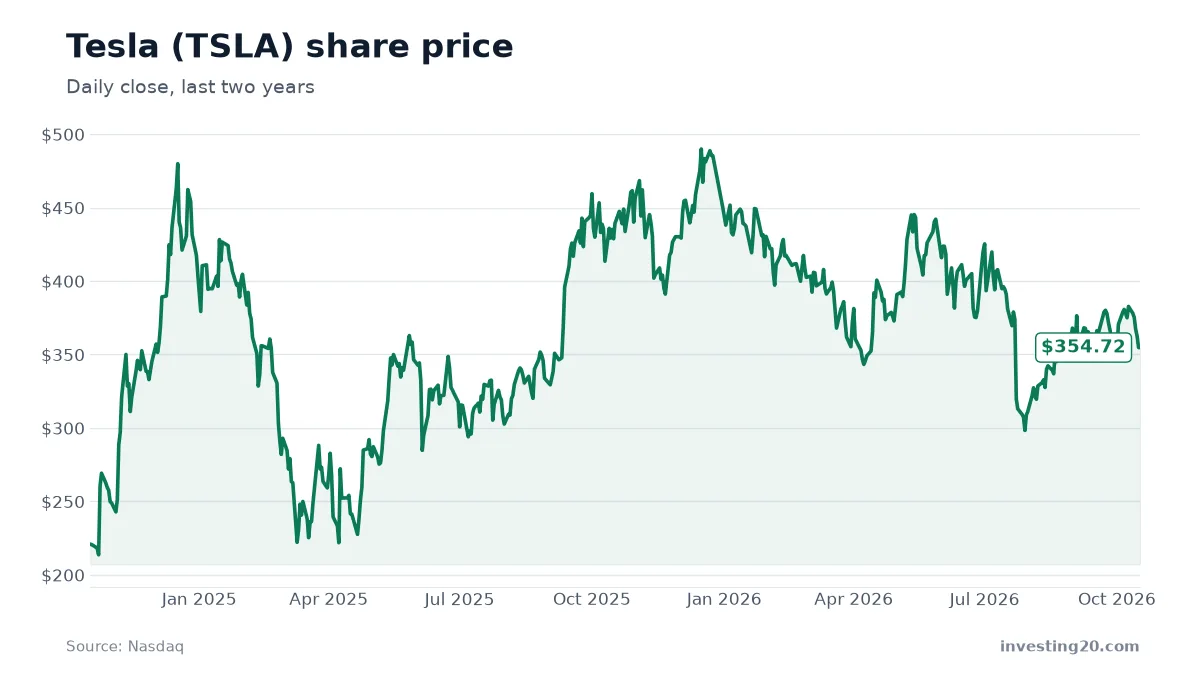
Tesla (TSLA) sits at an interesting crossroads for individual investors, trading at $382.66 with a market value of roughly $1.5 trillion despite slowing top-line growth. This forecast examines where Tesla stock could trade between 2026 and 2030 by looking at Wall Street expectations, recent financial results, and three mathematical valuation models.
Long-term projections are not guaranteed predictions or price promises. Instead, they are structured scenarios that illustrate what must happen to Tesla’s sales volume, profit margins, and valuation multiples to justify different share price levels by 2030.
| Share price | $382.66 (Oct 22, 2026 11:51 AM ET) |
| Market value | about $1.5 trillion |
| 52-week range | $297.38 – $498.83 |
| Revenue, last 12 months | about $103.6 billion |
| Revenue growth, last fiscal year | -3% |
| Net income, last 12 months | about $3.8 billion |
| Price-to-sales | about 14.6× |
| Price-to-earnings | about 398× |
| Analyst 12-month target | average $409.71 (range $25 – $550); 13 buy, 11 hold, 2 sell |
Market data from Nasdaq as of October 22, 2026. Check current figures before making any decision.
What changed since our last update
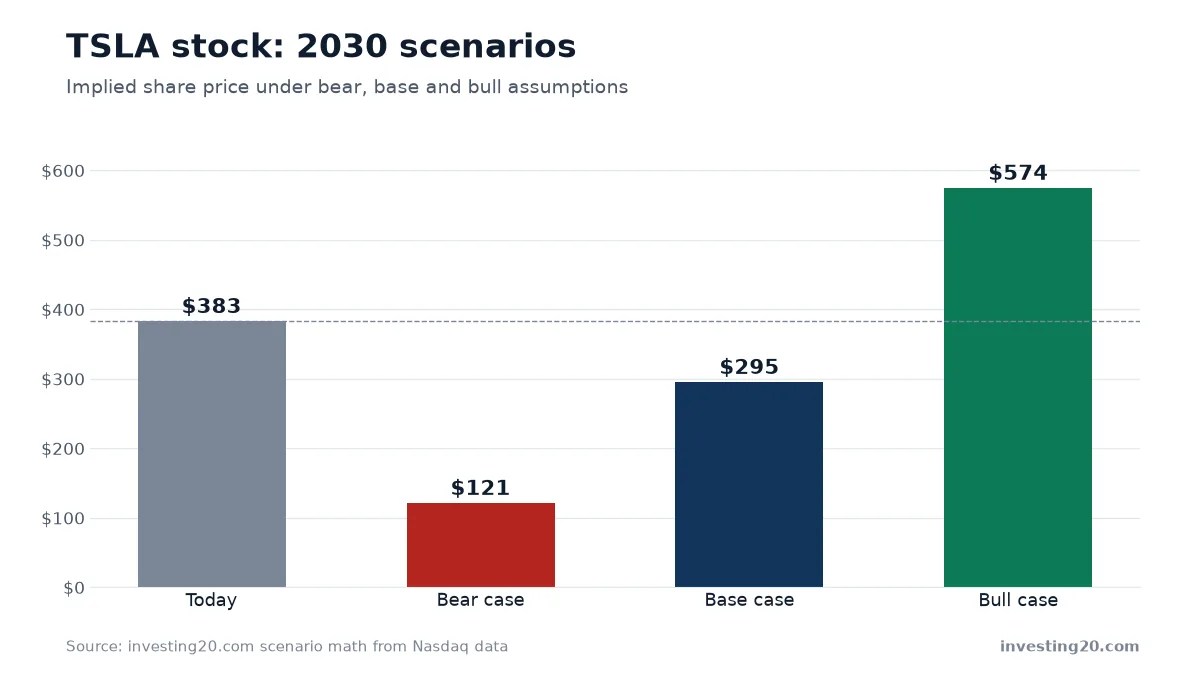
Tesla shares rose 7.9% over the past week, climbing from $354.72 on October 17, 2026, to $382.66 on October 22, 2026. Wall Street analysts nudged their average 12-month price target up slightly from $404.87 to $409.71. Because the current share price climbed while long-term fundamentals remained steady, the upside in our 2030 bull-case scenario shifted to $574.38 (up from $532.44 previously), while our base and bear scenario targets remained essentially flat at $295.05 and $121.00.
What does Tesla actually do to make money?
Tesla is a vertically integrated clean energy and automotive business. While most people know the company for its consumer cars, it generates revenue across two distinct operational areas: electric vehicles and stationary energy systems.
In automotive, Tesla manufactures and sells electric cars, including luxury and midsize sedans and crossover SUVs. The company has publicly shared plans to expand its lineup toward more affordable sedans, compact SUVs, a light pickup truck, a commercial semi truck, and a high-performance sports car. In 2021, global vehicle deliveries were slightly above 936,000 units, establishing the production scale the business relies on today.
Outside of vehicles, Tesla sells energy generation and storage hardware. This segment includes solar panels and integrated solar roofs for homes and businesses. It also manufactures dedicated stationary battery systems, supplying both residential properties and large-scale commercial utility projects that store power for electrical grids.
Where the business stands right now
Tesla produced $103.6 billion in revenue across its last four reported quarters, but recent trends reveal a clear slowdown in top-line expansion. Full-year revenue slipped from $97.7 billion in fiscal 2024 to $94.8 billion in fiscal 2025, representing a decline of 2.9%. That followed fiscal 2023 revenue of $96.8 billion, showing that top-line growth has leveled off compared to prior eras.
Profitability has also contracted from earlier peaks. Tesla generated $3.8 billion in net income over the past four quarters, matching its full-year 2025 net income of $3.8 billion. That is down significantly from the $7.1 billion in net income recorded in fiscal 2024.
Quarterly earnings results throughout 2026 have repeatedly trailed Wall Street estimates:
- Quarter ending September 2026 (reported October 21, 2026): EPS came in at $0.20 against a consensus estimate of $0.22, a 9.09% negative surprise.
- Quarter ending June 2026 (reported July 22, 2026): EPS hit $0.04 versus a expected $0.32, missing estimates by 87.5%. Revenue for the period was $28.24 billion.
- Quarter ending March 2026 (reported April 22, 2026): EPS was $0.18 compared to consensus expectations of $0.21, a 14.29% miss. Revenue reached $22.39 billion.
- Quarter ending December 2025 (reported January 28, 2026): EPS was $0.31 versus an expected $0.34, missing by 8.82% on revenue of $24.90 billion.
Prior to that, the quarter ending September 30, 2025, brought in $28.09 billion in revenue. Looking ahead, 14 analysts tracked by Nasdaq project full-year 2026 EPS of $0.71, rising to $1.17 in fiscal 2027. A smaller group of five analysts expects EPS to remain nearly flat at $1.16 in fiscal 2028.
Because of high expectations for future autonomous software and energy growth, Tesla currently trades at elevated valuation ratios: 14.6 times sales and 397.6 times trailing net income. Investors comparing electric transport plays often evaluate these multiples alongside peers like our Rivian Automotive (RIVN) long-term outlook and our NIO stock forecast.
TSLA stock forecast for the next 12 months
Wall Street analysts hold a moderately positive view on Tesla shares over a 12-month horizon, though opinions remain deeply divided. According to Nasdaq consensus figures, the average 12-month price target is $409.71. That implies an upside potential of 7.1% from the current price of $382.66.
The spread between individual analyst targets illustrates how hard it is for the market to value Tesla:
- High target: $550.00 (+43.7% upside)
- Average target: $409.71 (+7.1% upside)
- Low target: $24.86 (-93.5% downside)
Among the 26 analysts covering the stock, 13 rate it a Buy, 11 assign a Hold rating, and 2 recommend a Sell.
For Tesla to reach the consensus target of $409.71, the company would likely need to halt its string of consecutive quarterly earnings misses. Meeting the consensus EPS target of $0.71 for 2026 would require steady automotive delivery volumes, margin stabilization across mass-market models, and continued expansion in utility-scale energy storage deployments.
TSLA stock forecast for 2030: three scenarios
To model where Tesla could trade by 2030, we use a basic revenue-multiple framework. We take the trailing 12-month revenue base of $103.6 billion, apply an assumed compound annual growth rate through 2030, and multiply the result by a projected price-to-sales multiple. Finally, we divide that figure by a projected share count that accounts for gradual equity dilution.
Today, the market prices Tesla at 14.6 times sales. In our model, that multiple gradually compresses over time toward levels seen among mature industrial and technology giants: 5.0 in the bear case, 10.0 in the base case, and 16.1 in the bull case. To compare this structure with another previous projection, see our earlier Tesla stock price prediction analysis.
| Scenario | Revenue growth per year | 2030 revenue | Price-to-sales | Shares | Implied share price |
|---|---|---|---|---|---|
| Bear | -1% | $99.5 billion | 5.0× | 4.11 billion | about $121.00 (-68%) |
| Base | 3% | $116.6 billion | 10.0× | 3.95 billion | about $295.05 (-23%) |
| Bull | 7% | $135.8 billion | 16.1× | 3.80 billion | about $574.38 (+50%) |
The bear case
In this scenario, vehicle competition intensifies and Tesla’s revenue contracts by an average of 1% per year through 2030, dropping total annual sales to $99.5 billion. As revenue growth stalls, the market re-rates Tesla closer to a legacy vehicle manufacturer, compressing the price-to-sales multiple to 5.0. Assuming dilution expands the share count to 4.11 billion, the implied stock price falls to roughly $121.00, representing a 68% drop from current levels.
The base case
The base scenario assumes Tesla stabilizes its core operations and expands revenue at a modest 3% annually, reaching $116.6 billion by 2030. Slower expansion causes the price-to-sales multiple to drift lower to 10.0. With an estimated share count of 3.95 billion, the implied stock price sits at $295.05. That would be a 23% decline from today’s price.
The math shows that at a 10.0 multiple and 3.95 billion shares, Tesla would need roughly $151.3 billion in 2030 revenue just to support its current price of $382.66. Today’s market price already prices in substantial growth.
The bull case
The bull case assumes that energy storage deployments accelerate, new vehicle lines succeed, and software initiatives take hold, driving revenue growth of 7% per year to $135.8 billion by 2030. In this environment, investor enthusiasm keeps the valuation multiple elevated at 16.1 times sales. Assuming minimal dilution with 3.80 billion shares outstanding, the implied share price reaches $574.38, delivering a 50% gain over today’s price.
Risks to weigh before investing
- Earnings execution: Tesla has missed Wall Street consensus earnings per share forecasts for four consecutive quarters, including an 87.5% miss in June 2026 and a 9.09% miss in September 2026.
- Valuation premium: Trading at nearly 398 times trailing earnings and 14.6 times sales leaves little room for operational missteps if vehicle demand cools.
- Stagnant top-line growth: Fiscal 2025 revenue declined 2.9% year over year, showing that the company’s historic growth trajectory has faced headwinds.
- Product rollout timing: Commercialization timelines for more affordable consumer vehicles, semi trucks, and sports models remain critical to reaccelerating delivery figures.
What to watch next
If you hold or follow Tesla stock, keep an eye on fourth-quarter 2026 earnings delivery updates to see if automotive revenue returns to year-over-year growth. Watch whether management can deliver on the full-year 2026 consensus EPS target of $0.71, and track gross margin trends in the energy storage division to see if non-automotive sales can offset slower vehicle expansion.
FAQ
What is the 12-month price target for Tesla stock?
According to Nasdaq consensus data as of October 2026, the average 12-month price target for Tesla is $409.71, with estimates ranging from a low of $24.86 to a high of $550.00.
What revenue does Tesla need to justify its current stock price by 2030?
Under a base-case valuation multiple of 10 times sales and 3.95 billion shares, Tesla would need roughly $151.3 billion in annual revenue by 2030 to support its current share price of $382.66.
How did Tesla perform in its most recent earnings report?
For the quarter ending September 2026, Tesla reported earnings per share of $0.20 on October 21, 2026, missing consensus analyst estimates of $0.22 by 9.09%.
Market data and financials: Nasdaq. Scenario math: investing20.
This article is for information only and is not investment advice. Do your own research before investing.