XRP Price Prediction 2026–2030: Can XRP Reach $500?
Realistic XRP price scenarios for 2026 to 2030. We examine market caps, supply unlocks, and whether targets like $50, $100, or $500 are mathematically possible.
On this page
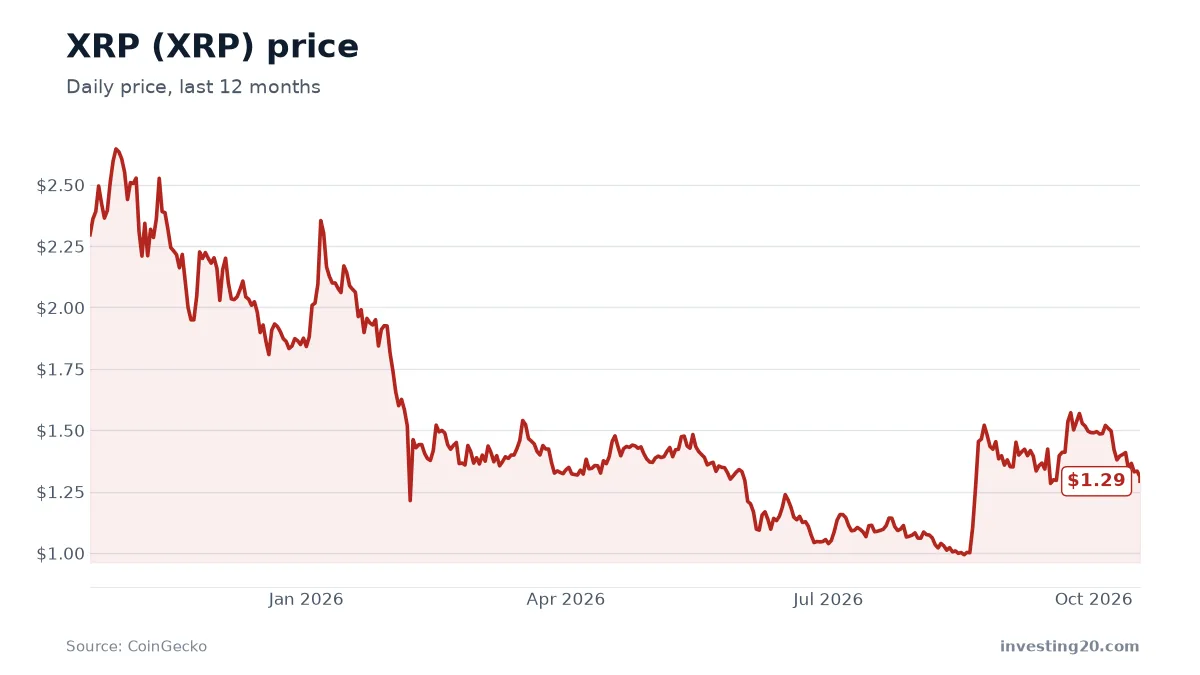
XRP trades around $1.29 today, down substantially from its peak but still anchoring itself as one of the largest digital assets in the world. This guide looks at where the token could realistically trade between now and 2030 by looking directly at circulating supply, token release schedules, and market capitalization math.
Before looking at any numbers, remember that long-range cryptocurrency projections are hypothetical scenarios, not guaranteed roadmaps. Cryptocurrencies do not generate corporate cash flows, carry no balance sheet guarantees, and can easily shed 70% or more of their value during extended downturns. Anyone investing money here must treat these models as thought exercises rather than promises.
| Price | $1.29 (October 17, 2026) |
| Market value | about $81.6 billion (#5 by market value) |
| Trading volume, 24 hours | about $861.1 million |
| Coins in circulation | 63.13 billion (63% of the 100 billion total) |
| Change, last 12 months | -44% |
| All-time high | $3.65 on July 17, 2025 (-65%) |
| Whole crypto market | about $2.7 trillion; XRP is 2.98% of it |
Market data from CoinGecko as of October 17, 2026. Crypto prices move fast; check current figures before making any decision.
In the past 24 hours, the price of XRP decreased by 0.74%. Over the past 7 days, XRP has shown mixed performance, with a decrease of 2.25%.
This week, XRP is struggling with mixed signals. Take a look at the technical analysis before reading a trend into it.
| Period | Change (USD) |
|---|---|
| Today | -0.74% |
| 7 days | -2.25% |
| 14 days | -4.40% |
| 30 days | -16.26% |
| 60 days | -8.76% |
| 200 days | -9.14% |
| 1 year | -49.82% |
Updated October 31, 2026 · Data provided by CoinGecko
The summary above reflects XRP’s position as of October 17, 2026. While short-term trading volume remains active near $861.1 million per day, long-term valuation depends entirely on how the underlying network functions and how many new tokens enter the market.
What is XRP and how is the token used?
XRP is the native digital token of the XRP Ledger, a Layer 1 blockchain built specifically to handle high-speed international settlements. Traditional cross-border payments rely on correspondent banks and pre-funded accounts in foreign jurisdictions, which tie up billions of dollars and take days to clear. XRP Ledger addresses this by acting as a neutral settlement rail, settling transactions in three to five seconds with fractional transaction costs.
Unlike Bitcoin or Ethereum, the XRP Ledger does not use proof-of-work mining or standard proof-of-stake rewards. Instead, it relies on a federated consensus mechanism. Independent servers look at a Unique Node List of trusted validators, requiring an 80% consensus threshold to validate a block of transactions. This design allows the network to process roughly 1,500 transactions per second without high energy usage, and it features an on-chain decentralized exchange that allows automated trading across tokenized assets.
The ledger traces its roots back to 2004 through developer Ryan Fugger, before Jed McCaleb and Chris Larsen co-founded its modern architecture. The private company Ripple uses this technology to build enterprise settlement products for institutional partners. Every time a transaction runs on the ledger, a tiny fraction of XRP is permanently burned to prevent network spam. Financial institutions also use the asset as bridge liquidity and collateral. A key milestone arrived in November 2025, when the SEC approved spot XRP exchange-traded funds from institutional managers including Bitwise, Grayscale, 21Shares, Canary Capital, and Franklin Templeton.
Where the price stands today
XRP currently ranks as the fifth-largest cryptocurrency, carrying a market capitalization of $81.6 billion. That gives it roughly 2.98% of the entire $2.7 trillion cryptocurrency market.
Over the past 12 months, the price has struggled, sliding 43.6%. While 30-day performance has flattened out with a mild 0.9% drop, XRP sits 65% below its all-time high of $3.65, which it reached on July 17, 2025.
To understand where the token goes from here, you have to look closely at circulating supply. There are 63.13 billion XRP tokens in circulation out of a fixed cap of 100 billion. The remaining 36.87 billion coins sit in scheduled lockups. As those coins enter the active market, each existing token represents a slightly smaller slice of the total network.
Can XRP reach $500, $100, or $50?
An earlier version of our analysis asked: XRP Price Prediction $500: Can XRP Reach $500, $100 or $50?. Online communities often throw out round targets like $50 or $500 without running the math on what those prices require. To evaluate whether these targets make any sense, we calculate the required market value using the 63.13 billion tokens circulating today.
| Price | Market value needed | Times today’s value | Share of today’s whole crypto market | Compared with Bitcoin today |
|---|---|---|---|---|
| $3.65 (all-time high) | $230.4 billion | 2.8× | 8.4% | 0.14× Bitcoin |
| $5.00 | $315.6 billion | 3.9× | 11.5% | 0.19× Bitcoin |
| $10.00 | $631.3 billion | 7.7× | 23.0% | 0.39× Bitcoin |
| $20.00 | $1.3 trillion | 15.5× | 46.1% | 0.78× Bitcoin |
| $50.00 | $3.2 trillion | 38.7× | 115.2% | 1.94× Bitcoin |
| $100 | $6.3 trillion | 77.4× | 230.3% | 3.88× Bitcoin |
| $200 | $12.6 trillion | 154.8× | 460.7% | 7.75× Bitcoin |
| $500 | $31.6 trillion | 387.0× | 1,151.6% | 19.38× Bitcoin |
Market value needed = price × today’s 63.13 billion coins in circulation; more coins in circulation would raise every figure.
The table above illustrates the sheer scale required for these milestones. To retest its record high of $3.65, XRP would need a market capitalization of $230.4 billion, which is roughly 2.8 times its current size. That would represent 14% of Bitcoin’s total valuation today, a challenging but technically plausible target during an aggressive market rally.
Move up to $10, and XRP would need to reach $631.3 billion. That is nearly 40% of what Bitcoin is worth right now.
Once you start looking at targets like $50, $100, or $500, the figures disconnect from economic reality:
- At $50, XRP’s market cap would hit $3.2 trillion, making this single asset worth more than the entire crypto industry today ($2.7 trillion) and nearly twice as large as Bitcoin ($1.6 trillion).
- At $100, the required market cap is $6.3 trillion, or nearly four times Bitcoin’s size.
- At $500, XRP would be valued at $31.6 trillion. That is more than 19 times Bitcoin’s entire value and more than 11 times the whole crypto market combined.
Can XRP reach $500? No. Barring extreme global hyperinflation that ruins fiat currencies, a $500 XRP coin is mathematically unworkable. Even $50 and $100 are extraordinarily far-fetched for the foreseeable future. Some internet commentators push targets out to 2040 or 2050, but modeling asset prices decades ahead is simply guessing. Similar mathematical constraints show up across other heavily supplied tokens; you can see a parallel dynamic in our Shiba Inu price prediction and our Algorand price prediction.
XRP price prediction for 2030: three scenarios
Because digital assets do not produce earnings, traditional valuation metrics like price-to-earnings ratios do not work. To build a credible long-term model, we project three variables to 2030: the size of the broader cryptocurrency market, XRP’s percentage share of that market, and the number of coins unlocked over time.
Historically, older alternative coins gradually lose market share as hundreds of newer networks compete for capital. Our base case assumes XRP captures 80% of its current market share, while our bear case assumes it drops to 40%. For circulating supply, our bear case assumes all 36.87 billion locked coins enter circulation by 2030 (reaching the 100 billion maximum). The base case assumes half are released (81.56 billion total), and the bull case assumes only a quarter are released (72.35 billion total).
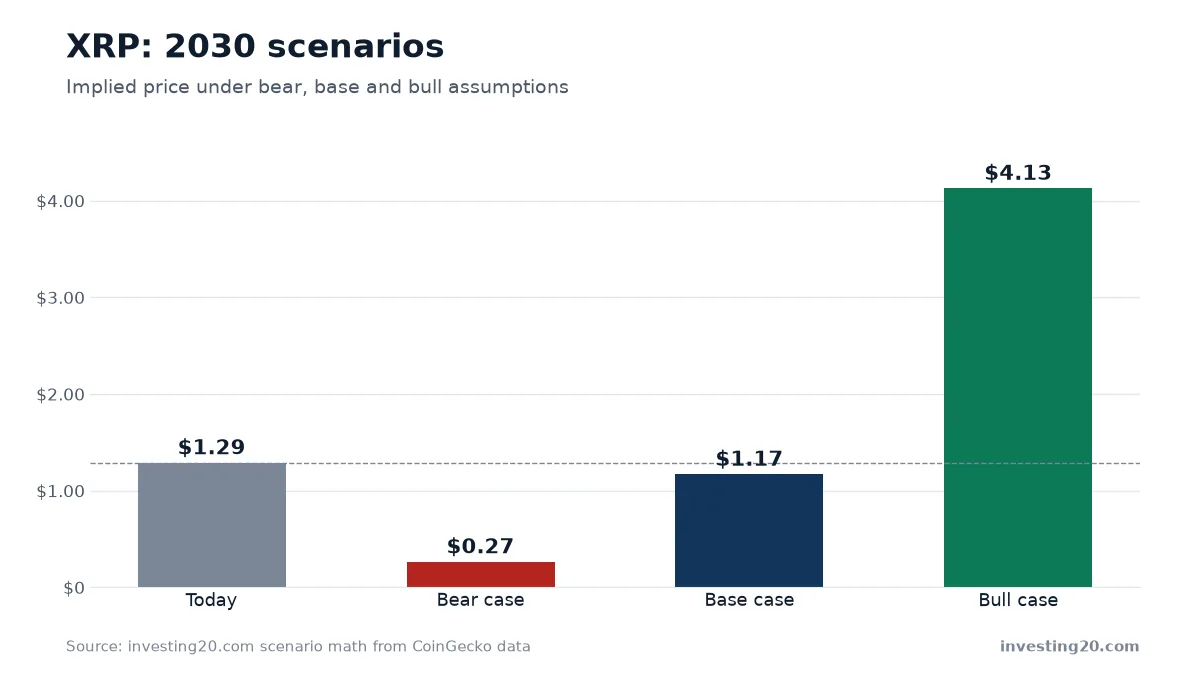
| Scenario | Whole crypto market in 2030 | XRP share of it | Coins in circulation | Implied price |
|---|---|---|---|---|
| Bear | $2.2 trillion (-5% a year) | 1.19% | 100 billion | about $0.266 (-79%) |
| Base | $4.0 trillion (+10% a year) | 2.38% | 81.56 billion | about $1.17 (-9%) |
| Bull | $6.7 trillion (+25% a year) | 4.46% | 72.35 billion | about $4.13 (+220%) |
The bear case ($0.266)
In the bear scenario, overall crypto market interest wanes, contracting 5% per year to roughly $2.2 trillion by 2030. Competition from newer payment rails and central bank digital currencies pushes XRP’s market share down to 1.19%. At the same time, the remaining supply enters the market, bringing active tokens to the full 100 billion cap. Under these conditions, the price falls to around $0.266, a 79% decline from today’s $1.29.
The base case ($1.17)
The base case assumes steady institutional adoption, expanding the broad crypto market by 10% annually to $4.0 trillion by 2030. XRP experiences modest competitive attrition, holding 2.38% of the total market (80% of its current share). Half of the reserved supply enters circulation, bringing total coins to 81.56 billion. Under these balanced assumptions, XRP trades at approximately $1.17, roughly 9% below where it sits today. The expanding market is offset by token dilution and slight share loss.
The bull case ($4.13)
The bull scenario models an aggressive secular boom. The total crypto market grows at 25% annually to reach $6.7 trillion in 2030. In this environment, institutional adoption from spot ETFs accelerates, and XRP expands its market share to 4.46% (150% of today’s level). Ripple limits reserve releases, leaving circulating supply at 72.35 billion. In this setup, XRP reaches $4.13, a 220% gain from current prices and a new record high.
The main takeaway from these scenarios is clear: even under enthusiastic growth conditions, XRP is likely a single-digit asset, not a three-digit one.
Risks to weigh
Before making any investment decisions involving XRP, keep these structural risks in mind:
- Supply dilution: With roughly 36.87 billion tokens yet to enter circulation, regular escrow releases add supply to the market, requiring constant new capital just to keep prices flat.
- Payment rail competition: Stablecoins running on networks like Solana and Ethereum, along with proprietary bank settlement networks, compete directly for cross-border payment flows.
- Regulatory shifts: While spot ETFs launched in late 2025, global regulatory frameworks around institutional token custody and cross-border settlement continue to shift.
- Loss of market share: Newer Layer 1 ecosystems consistently fight for liquidity, which historically erodes the dominance of legacy tokens over multi-year cycles.
What to watch next
If you are tracking XRP’s path toward 2030, focus on network adoption rather than social media price targets. The first metric to monitor is net inflows into spot XRP ETFs. Institutional custody volumes show whether traditional asset managers are accumulating the coin over multi-month stretches.
Second, keep an eye on total circulating supply figures. Watch the pace at which Ripple releases tokens from its reserves, as that directly dictates how much dilution existing holders must absorb. Finally, monitor overall cryptocurrency market share. If XRP can maintain or expand its 2.98% share while the total industry grows, long-term returns can be respectable, even if targets like $500 remain pure fantasy.
FAQ
Can XRP reach $500 by 2030?
No, a $500 price is mathematically unrealistic under current market dynamics. At today's circulating supply, $500 per coin requires a market cap of $31.6 trillion, which is nearly twelve times the size of the entire cryptocurrency market and over 19 times the size of Bitcoin.
Can XRP reach $50 or $100?
Reaching $50 requires a market value of $3.2 trillion, while $100 requires $6.3 trillion. Both targets would require XRP alone to become significantly larger than the entire current crypto market of $2.7 trillion, making them extreme long shots without massive, unexpected hyperinflation or global adoption.
What is a realistic price target for XRP in 2030?
Based on our model, XRP could trade around $1.17 in a moderate base case where the overall crypto market grows 10% annually and XRP holds 80% of its current market share. In a strong bull run where total crypto hits $6.7 trillion, the price could climb toward $4.13.
How many XRP coins are left to be unlocked?
Out of a 100 billion maximum supply, about 63.13 billion coins circulate today. That leaves roughly 36.87 billion tokens yet to enter circulation, which creates ongoing supply dilution as those reserves are released over time.
Market data: CoinGecko. Scenario math: investing20.
This article is for information only and is not investment advice. Do your own research before investing.