Dollar General (DG) Stock Forecast 2026–2030: Long-Term Outlook
Examine the Dollar General (DG) stock forecast for 2026 through 2030. Analysis includes 12-month analyst price targets, revenue growth, and long-term valuation scenarios.
On this page
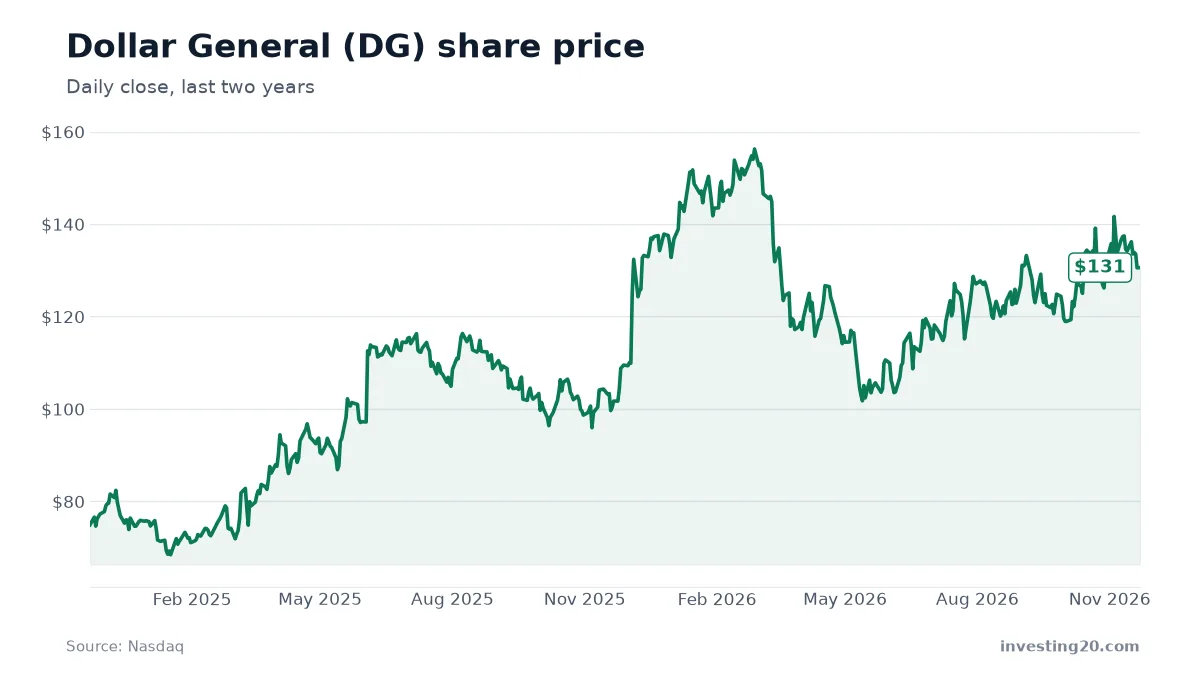
Dollar General shares traded around $130.58 in late November 2026, recovering significantly from their multi-year low of $68.44 in January 2025. This article outlines the long-term dollar general stock forecast by breaking down recent earnings performance, Wall Street’s 12-month expectations, and valuation modeling through 2030.
Long-range stock forecasts are not absolute price predictions or guarantees. Instead, they serve as structured scenarios built on specific assumptions about revenue growth, profit margins, and valuation multiples to help you decide if a stock fits your portfolio strategy.
| Share price | $130.58 (Nov 20, 2026) |
| Market value | about $28.8 billion |
| 52-week range | $99.57 – $158.23 |
| Revenue, last 12 months | about $43.6 billion |
| Revenue growth, last fiscal year | 5% |
| Net income, last 12 months | about $1.7 billion |
| Price-to-sales | about 0.7× |
| Price-to-earnings | about 17× |
| Analyst 12-month target | average $147.21 (range $123 – $178); 9 buy, 9 hold, 0 sell |
Market data from Nasdaq as of November 22, 2026. Check current figures before making any decision.
What Dollar General does
Founded in 1939, Dollar General operates as America’s neighborhood general store. As of July 31, 2026, the company ran 21,148 stores across the United States and Mexico under several formats, including standard Dollar General locations, DG Market, DGX, pOpshelf, and Mi Súper Dollar General.
The retail chain focuses on everyday essentials sold at accessible prices. Its product lineup spans paper and cleaning goods, packaged food and beverages, health and beauty products, household items, and seasonal goods. Dollar General stocks well-known national brands from manufacturers like Procter & Gamble, Coca-Cola, PepsiCo, General Mills, and Hershey alongside its own private-label brands.
The business model relies on placing small-footprint retail stores in underserved rural and suburban communities where larger big-box stores like Target or traditional supermarkets might not operate. By maintaining low operating costs and high inventory turnover, the company generates consistent cash flow from budget-conscious consumers.
Where the business stands: Revenue and profit trends
Dollar General has maintained steady top-line expansion over recent years. For the fiscal year ending January 30, 2026, the company generated $42.7 billion in revenue, up 5.2% from $40.6 billion in the previous fiscal year and $38.7 billion in the year ending February 2024. Over the last four reported quarters through July 2026, total sales reached $43.6 billion.
Quarterly sales figures show ongoing stability across the retail footprint:
- Quarter ending July 31, 2026: $11.29 billion
- Quarter ending May 1, 2026: $10.79 billion
- Quarter ending January 30, 2026: $10.91 billion
- Quarter ending October 31, 2025: $10.65 billion
Profitability has also expanded alongside top-line revenue. Net income over the last four reported quarters reached $1.7 billion, up from $1.5 billion in the fiscal year ending January 2026 and $1.1 billion in the year ending January 2025. Today, DG stock trades at a price-to-sales multiple of roughly 0.7 and a price-to-earnings ratio of 16.9.
Dollar General has consistently beaten consensus earnings estimates across all four reported quarters. In the quarter ending July 2026, reported earnings per share (EPS) of $2.23 beat the consensus estimate of $2.00 by 11.5%. That followed EPS surprises of 5.82% in April 2026 ($2.00 vs. $1.89), 19.88% in January 2026 ($1.93 vs. $1.61), and 39.13% in October 2025 ($1.28 vs. $0.92). Wall Street consensus forecasts EPS to grow to $7.70 for the fiscal year ending January 2027, $8.41 for 2028, and $9.47 for 2029.
DG stock forecast for the next 12 months
Looking at the 12-month horizon, consensus data from Nasdaq shows Wall Street analysts hold a moderately constructive outlook on the retail stock. Among 18 tracking analysts, 9 rate DG as a buy and 9 rate it as a hold, with no analysts issuing a sell rating.
The average 12-month dg stock price target is $147.21, representing an expected upside of about 12.7% from the current price of $130.58. The individual price targets span from a low of $123.00 to a high of $178.00.
For the shares to hit the higher end of the dg price target range, Dollar General will likely need to maintain its positive earnings beat momentum and demonstrate strong gross margin stability. Conversely, if retail spending cools sharply or wage inflation presses harder on store operating margins, the stock could test the lower analyst targets around $123.00.
DG stock forecast for 2030: Three scenarios
To evaluate where Dollar General stock could trade by 2030, we examine three potential scenarios. Keep in mind that analyst price targets apply to a short 12-month timeline, whereas long-term scenarios extend across multiple years.
Our model uses Dollar General’s trailing 12-month revenue of $43.6 billion as the starting point. It applies annual revenue growth rates, assumes changes in outstanding share count, and applies a realistic price-to-sales multiple based on mature retail benchmarks.
Today’s stock price of $130.58 already prices in a specific expectation: at the base-case valuation multiple (0.7x price-to-sales) and projected share count (221 million), Dollar General needs to maintain roughly $43.6 billion in revenue by 2030 just to hold its current share price.
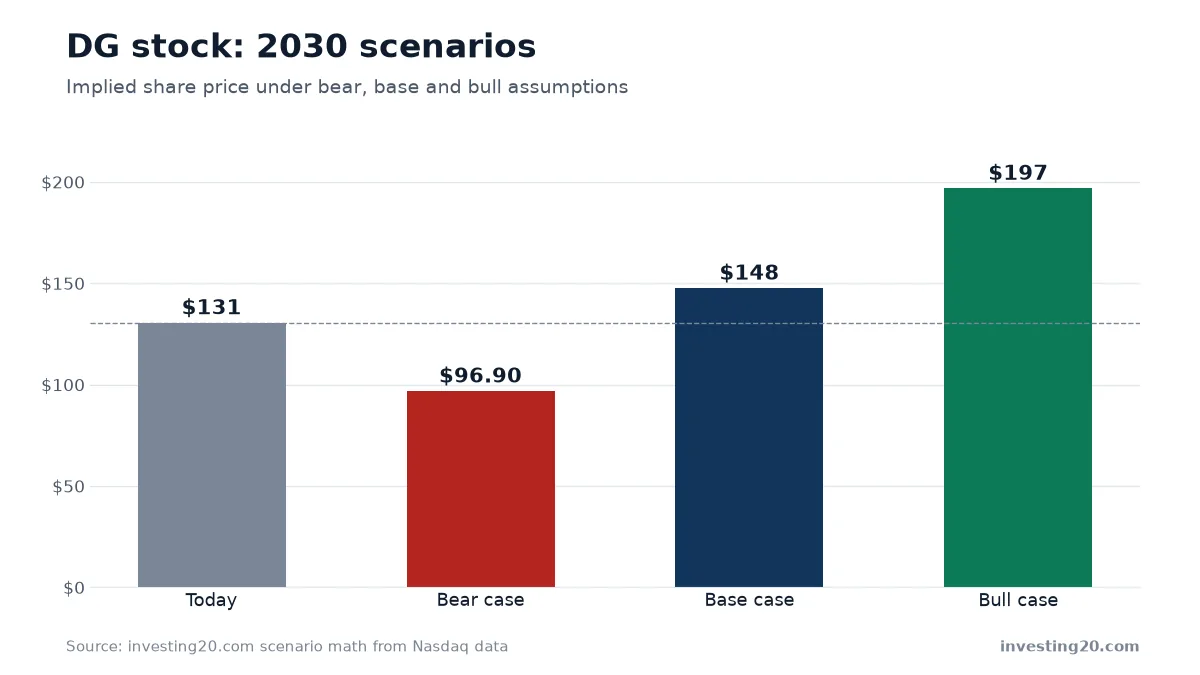
| Scenario | Revenue growth per year | 2030 revenue | Price-to-sales | Shares | Implied share price |
|---|---|---|---|---|---|
| Bear | -1% | $42.1 billion | 0.5× | 230 million | about $96.90 (-26%) |
| Base | 3% | $49.3 billion | 0.7× | 221 million | about $147.66 (+13%) |
| Bull | 7% | $57.5 billion | 0.7× | 212 million | about $196.89 (+51%) |
Bear case
In the bear case, store saturation, stiffer competition from online sellers and general discounters, or shrinking lower-income household budgets cause revenue to decline slightly by -1% per year. Total sales fall to $42.1 billion by 2030. If investors assign a reduced price-to-sales multiple of 0.5x to account for flat growth and share dilution pushes the count to 230 million, the implied dg stock price prediction lands at $96.90—a decline of about 26% from today’s price.
Base case
The base case assumes steady, moderate operational execution. Revenue grows at an average pace of 3% per year, pushing total revenue to $49.3 billion by 2030. Assuming the price-to-sales ratio remains unchanged at 0.7x and modest share repurchases lower the share count to 221 million, the implied dollar general stock price prediction is $147.66. That offers a modest return of roughly 13% over current levels, similar to mature consumer staples like those analyzed in our Walt Disney Company stock forecast.
Bull case
The bull case projects faster top-line growth of 7% per year, driven by steady customer foot traffic, successful expansion of new formats like pOpshelf, and store additions across domestic and international markets. Under this scenario, revenue reaches $57.5 billion by 2030. Maintaining a 0.7x price-to-sales multiple alongside stock buybacks that reduce the share count to 212 million yields an implied share price of $196.89, representing a gain of about 51%.
Key takeaway on 2030 projections
The long-term outlook highlights Dollar General’s status as a mature value retailer. The stock offers defensive stability, but reaching the higher $196.89 bull target requires consistent store sales growth and share buybacks over several years.
Risks to weigh
Before making an investment decision, consider these core risks facing Dollar General:
- Customer financial stress: Dollar General’s core customer base consists largely of lower-income households sensitive to food inflation, reduced government benefits, and general economic slowdowns.
- Shrink and margin compression: Retail theft (shrink) and higher freight or labor expenses can squeeze profit margins even when top-line store sales remain steady.
- Competition: Discount retailers like Walmart, Family Dollar, and online platforms compete aggressively on price for pantry items and everyday household supplies.
- Real estate footprint limits: With more than 21,000 stores already open, finding profitable new locations in the US becomes harder over time.
What to watch next
If you hold or are watching Dollar General stock, keep an eye on these near-term developments:
- Quarterly same-store sales: Track whether customer store traffic and average ticket size are rising or falling in upcoming quarterly reports.
- Gross profit margins: Watch how well management controls inventory shrink and transportation costs.
- Analyst revision trends: See if earnings beats lead analysts to revise their 12-month dg stock forecast upward.
- Capital allocation: Look for updates on store opening counts, renovations, and share buybacks.
FAQ
What is the 12-month DG stock price target?
Wall Street analysts have an average 12-month DG price target of $147.21, according to Nasdaq consensus data as of November 2026. Individual price targets range from a low of $123.00 to a high of $178.00.
What is the long-term dollar general stock price prediction for 2030?
Based on investing20 scenario modeling, a base-case dollar general stock prediction points to $147.66 by 2030. In a bull case with 7% annual revenue growth, the price reaches $196.89, while a bear case indicates $96.90.
What are Wall Street analyst ratings for DG stock?
As of November 2026, consensus data from Nasdaq shows 9 analysts rate Dollar General stock as a buy and 9 rate it as a hold, with 0 sell ratings.
What was Dollar General's recent revenue growth?
Dollar General reported $42.7 billion in revenue for the fiscal year ending January 30, 2026, representing a 5.2% increase from the prior fiscal year. Total revenue over the last four reported quarters reached $43.6 billion.
Market data: Nasdaq. Financials: Nasdaq. Scenario math: investing20.
This article is for information only and is not investment advice. Do your own research before investing.