Coinbase Global (COIN) Stock Forecast 2026–2030: Long-Term Outlook
Coinbase Global stock forecast for 2026 to 2030. Explore analyst 12-month price targets, financial trends, and long-range scenarios for COIN.
On this page
Coinbase Global (COIN) sits right at the intersection of traditional finance and the digital asset market. If you are researching a Coinbase stock price prediction, this article walks through where the company’s fundamentals stand today, what Wall Street analysts expect over the next 12 months, and what three distinct revenue scenarios suggest for the stock through 2030.
Long-range stock forecasts are not guaranteed predictions or price promises. Instead, they serve as structured scenario frameworks that help you test what business performance today’s share price already assumes. As crypto markets fluctuate, seeing the underlying math makes it much easier to separate operational progress from short-term market noise.
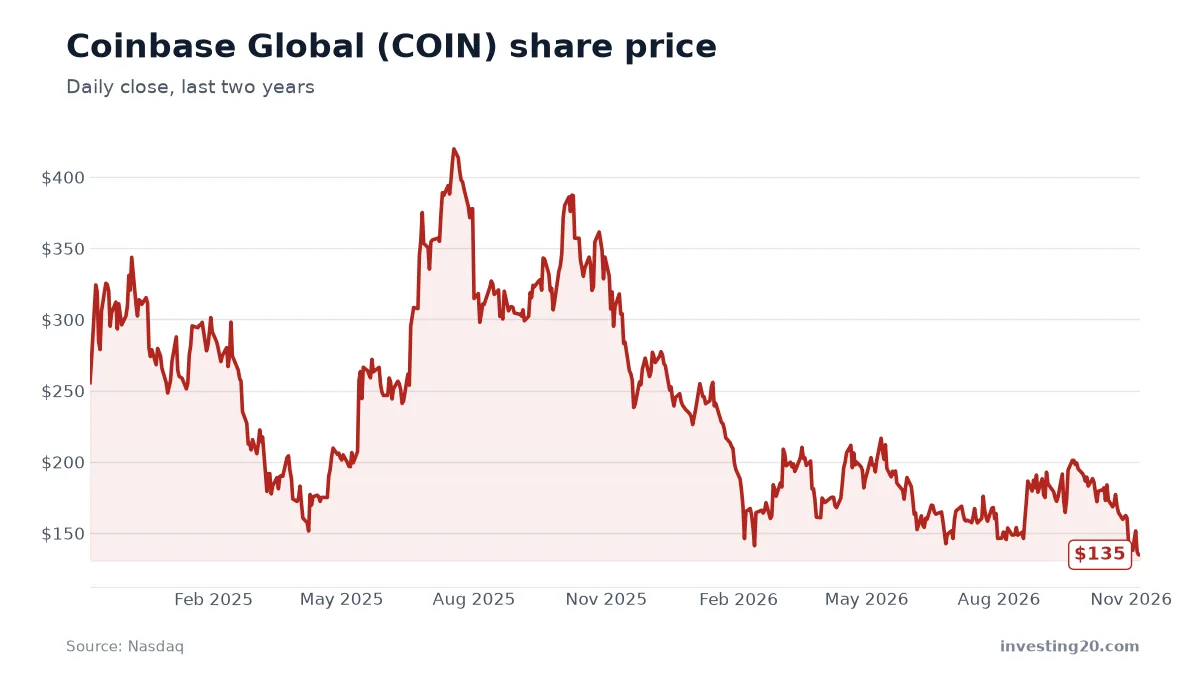
| Share price | $134.76 (Nov 6, 2026) |
| Market value | about $35.7 billion |
| 52-week range | $133.50 – $324.80 |
| Revenue, last 12 months | about $5.6 billion |
| Revenue growth, last fiscal year | 9% |
| Net income, last 12 months | a loss of about $701.6 million |
| Price-to-sales | about 6.3× |
| Price-to-earnings | n/a (not profitable) |
| Analyst 12-month target | average $197.96 (range $100 – $330); 16 buy, 7 hold, 3 sell |
Market data from Nasdaq as of November 7, 2026. Check current figures before making any decision.
The figures above highlight where Coinbase trades as of November 7, 2026. With shares sitting near their 52-week low of $133.50, the company carries a market value of about $35.7 billion. Over the last four reported quarters, revenue totaled $5.6 billion, while operations ran at a net loss of $701.6 million. Similar to other trading and retail platforms like Robinhood Markets (HOOD), shifts in retail activity directly sway revenue and profitability.
What Coinbase Global does
Coinbase operates what it calls an “everything exchange,” serving as a primary bridge between everyday investors, large institutions, and digital asset markets. The company stores more digital assets than any other firm in the sector and provides a full-stack platform built around custody, deep liquidity, stablecoin infrastructure, and global settlement rails.
The business generates revenue through three primary customer groups:
- Consumers: Everyday retail traders access digital assets through a suite of mobile and web financial apps. Coinbase earns transaction fees on trading volume across cryptocurrencies, equities, derivatives, and prediction markets.
- Institutions: Through Coinbase Prime, hedge funds, asset managers, and corporate treasuries access institutional-grade custody, trade execution, and financing services.
- Developers: The Coinbase Developer Platform offers tools, APIs, and infrastructure for builders creating decentralized applications and payment products.
Decade-plus investments in regulatory compliance and security help Coinbase position itself as the most trusted platform in digital assets, attracting both high-net-worth retail users and Wall Street institutions.
Where the business stands
Coinbase has experienced wide swings in its top and bottom lines over recent fiscal years. In 2023, the business booked $3.1 billion in revenue, which jumped to $6.6 billion in 2024 and reached $7.2 billion in 2025 (a 9.4% annual increase). Net income also reflected strong market conditions in those years, coming in at $2.6 billion in 2024 and $1.3 billion in 2025.
The past four quarters, however, reflect a noticeable slowdown in trading activity. Total revenue over the trailing 12 months slipped to $5.6 billion. Looking at the quarterly progression:
- Quarter ending December 31, 2025: $1.78 billion
- Quarter ending March 31, 2026: $1.41 billion
- Quarter ending June 30, 2026: $1.22 billion
- Quarter ending September 30, 2026: $1.22 billion
Over these four periods, the business recorded a cumulative net loss of $701.6 million. Earnings results have also surprised analysts on both sides of the ledger. In the quarter ending September 2026 (reported October 29, 2026), Coinbase delivered a positive EPS surprise of 275%, generating earnings per share of $0.28 against an expected loss of $0.16. That beat followed consecutive misses: an EPS of -$0.39 in June 2026 (against an estimated $0.14) and -$0.17 in March 2026 (against an estimated $0.36). Volatility like this is common among tech and crypto infrastructure names, an operational profile also visible in high-growth infrastructure plays like Hut 8 Corp. (HUT).
COIN stock forecast for the next 12 months
Looking ahead over the coming year, Wall Street sentiment remains largely positive despite recent operating losses. Nasdaq consensus data shows that across 26 analysts covering Coinbase, 16 rate the stock a buy, 7 rate it a hold, and 3 rate it a sell.
The average 12-month coin price forecast stands at $197.96. That represents potential upside of about 46.9% compared to the November 6, 2026 price of $134.76. The spread between targets reflects real uncertainty about crypto market cycles:
- Street High Target: $330.00 (+145%)
- Street Consensus Target: $197.96 (+46.9%)
- Street Low Target: $100.00 (-25.8%)
For Coinbase to reach that average target near $198, market conditions would need to support a rebound in retail trading volume and higher fee generation. Consensus estimates project full-year 2026 EPS at -$0.45 across 12 analysts, but see a rebound to $2.53 in 2027 (13 analysts) and $4.22 in 2028 (7 analysts). Meeting those forecasts requires trading volumes to stabilize and institutional custody revenue to keep growing.
Coinbase stock forecast for 2030: three scenarios
Looking past the next 12 months requires a different toolset. Our 2030 coin stock forecast relies on three clear revenue growth cases starting from the trailing 12-month revenue of $5.6 billion.
The math applies a price-to-sales multiple to projected 2030 sales and divides by a share count that accounts for dilution. Today, Coinbase trades at a price-to-sales ratio of 6.3. As companies grow, valuation multiples often contract toward mature industry benchmarks.
| Scenario | Revenue growth per year | 2030 revenue | Price-to-sales | Shares | Implied share price |
|---|---|---|---|---|---|
| Bear | 2% | $6.0 billion | 5.0× | 276 million | about $109.05 (-19%) |
| Base | 6% | $7.0 billion | 6.3× | 265 million | about $167.85 (+25%) |
| Bull | 10% | $8.1 billion | 7.0× | 254 million | about $223.01 (+65%) |
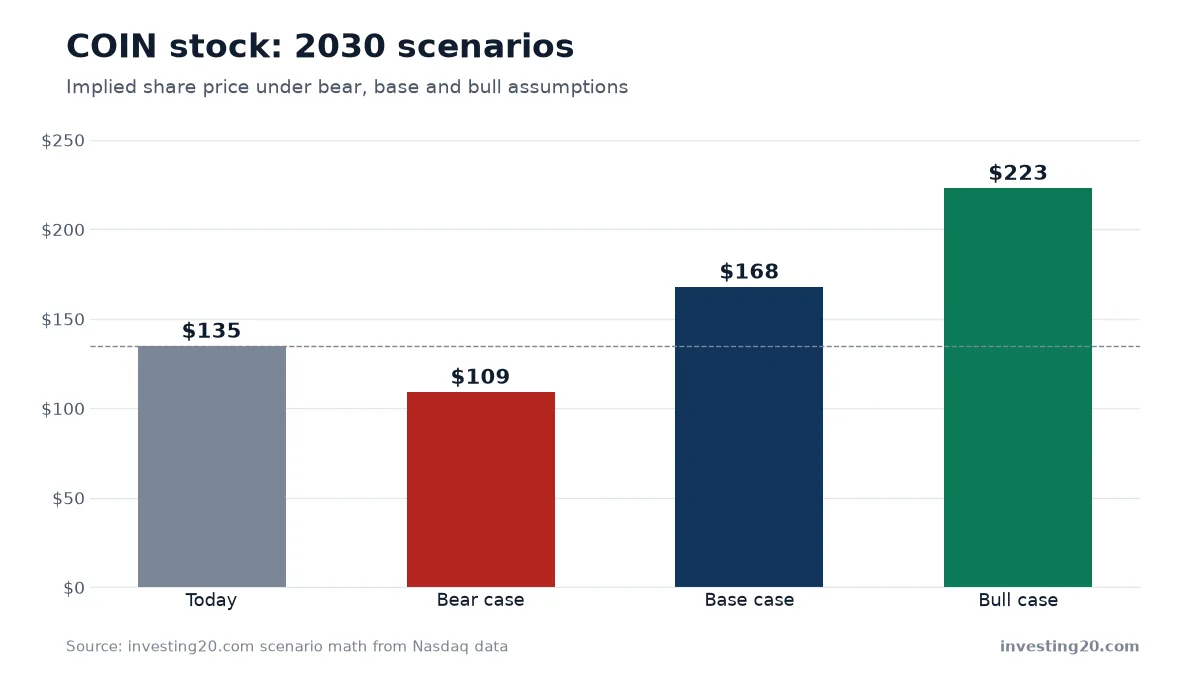
To understand what today’s $134.76 stock price implies, consider the break-even math. At the base-case multiple of 6.3 and a share count of 265 million, Coinbase would need to generate approximately $5.6 billion in revenue in 2030 just to support today’s valuation. In other words, today’s price already assumes the business holds its ground without further contraction.
Here is how each scenario breaks down:
- The Bear Case ($109.05): In this scenario, revenue grows at an average pace of 2% per year, bringing 2030 sales to $6.0 billion. If trading activity remains sluggish, fee compression accelerates, and the price-to-sales multiple compresses to 5.0 on 276 million diluted shares, the implied stock price falls about 19% from today’s level.
- The Base Case ($167.85): Assuming revenue expands at a moderate 6% annual pace, Coinbase reaches $7.0 billion in sales by 2030. Maintaining today’s 6.3 price-to-sales multiple with share count expanding slightly to 265 million points to a share price of about $167.85, roughly 25% above current levels.
- The Bull Case ($223.01): If the company sustains 10% annual revenue growth, 2030 revenue reaches $8.1 billion. With strong market sentiment lifting the price-to-sales ratio to 7.0 and share buybacks keeping the share count near 254 million, the stock would gain about 65% to trade around $223.
The key takeaway is that Coinbase does not require unrealistic growth rates to deliver solid returns from its current valuation. However, sustained multiple expansion depends heavily on whether the company can diversify beyond volatile trading fees into sticky custody and developer revenue.
Risks to weigh
Before making any investment decisions on Coinbase, weigh these company-specific and industry risks:
- Trading volume cyclicality: Retail transaction fees remain a major revenue driver, leaving quarterly earnings vulnerable during prolonged crypto market downturns.
- Fee compression: Increasing competition from low-cost brokerage apps and decentralized exchanges could put downward pressure on average take-rates over time.
- Dilution and share count: Stock-based compensation can increase outstanding shares, diluting per-share value if revenue growth slows down.
- Regulatory developments: Shifts in domestic or international rules regarding digital asset trading, staking, or custody can directly affect business operations and compliance costs.
What to watch next
If you are tracking Coinbase, keep a close eye on quarterly trading volumes and custody assets in upcoming earnings reports. Watch whether non-transaction revenue, such as stablecoin interest and developer platform fees, continues to gain share relative to standard exchange commissions.
Progress toward the consensus 2027 EPS estimate of $2.53 will show whether the company is successfully pivoting back toward sustained profitability after its recent quarterly losses.
FAQ
What is the 12-month COIN stock forecast from Wall Street analysts?
According to Nasdaq consensus data as of November 2026, 26 analysts offer an average 12-month price target of $197.96 for Coinbase, representing roughly 47% upside from its price of $134.76. Targets span from a low of $100.00 to a high of $330.00, with 16 buy, 7 hold, and 3 sell ratings.
What is the Coinbase stock price prediction for 2030?
Based on investing20 scenario modeling, Coinbase shares could reach about $109 in a bear case (2% revenue growth), $168 in a base case (6% growth), and $223 in a bull case (10% growth). These models depend on revenue reaching between $6.0 billion and $8.1 billion alongside changing share counts and valuation multiples.
Can you rely on a Coinbase stock price prediction tomorrow?
Short-term predictions for tomorrow are essentially random noise driven by day trading, crypto volatility, and headline swings. Fundamental investors focus on multi-year business drivers like trading volumes, custody adoption, and institutional platform expansion rather than daily price fluctuations.
Market data: Nasdaq. Financials: Nasdaq. Scenario math: investing20.
This article is for information only and is not investment advice. Do your own research before investing.