Lucid Group (LCID) Stock Forecast 2026–2030: Long-Term Outlook
Lucid Group (LCID) stock forecast for 2026 to 2030. Explore Wall Street analyst price targets, revenue growth, losses, and bull, base, and bear valuation scenarios.
On this page
- What Lucid Group does: products and business model
- Where the business stands: revenue and widening losses
- What do analysts expect for LCID over the next 12 months?
- LCID stock forecast for 2030: three scenarios
- Bear case: $2.67 (-15%)
- Base case: $7.00 (+124%)
- Bull case: $13.83 (+342%)
- Risks to weigh
- What to watch next
- FAQ
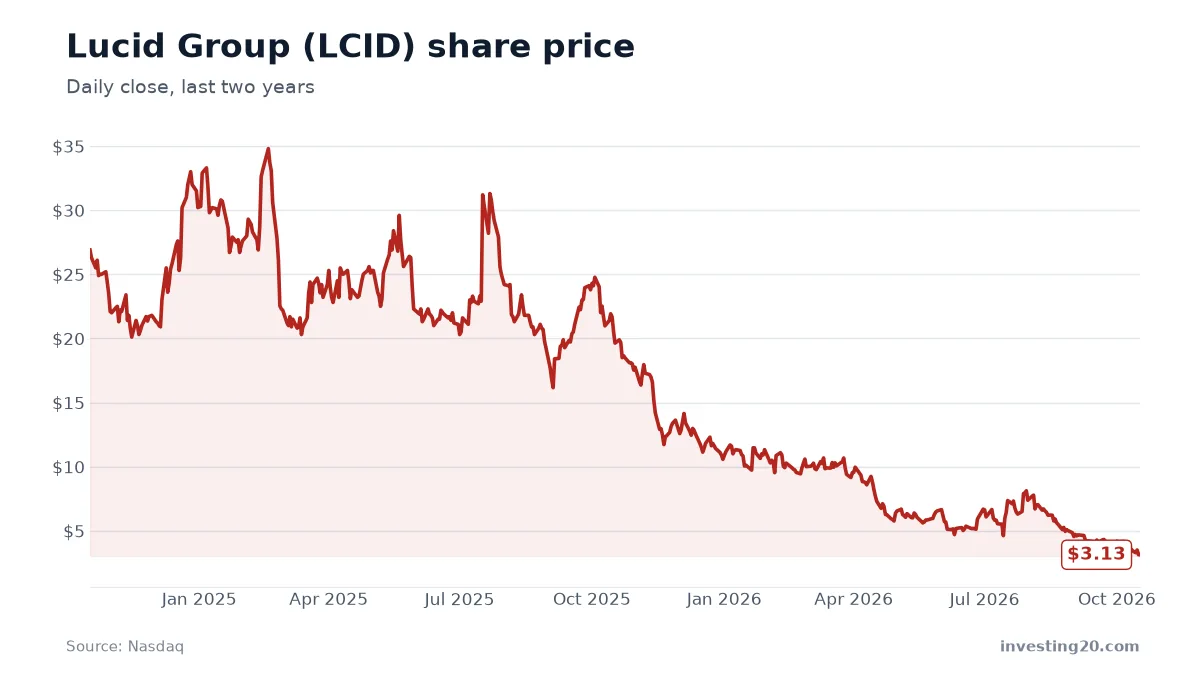
Lucid Group (LCID) trades around $3.13 after an 88.4% drop over the past two years, leaving retail investors wondering whether the luxury electric vehicle maker can stage a long-term comeback. This forecast breaks down Lucid’s business fundamentals, 12-month Wall Street targets, and revenue-driven price projections through 2030.
Long-range stock forecasts are structured scenarios, not guaranteed predictions. Nobody knows where luxury auto demand, interest rates, or supply chains will sit at the end of the decade, but modeling different operational paths can help you see what kind of growth is already baked into today’s valuation.
| Share price | $3.13 (Oct 15, 2026) |
| Market value | about $1.2 billion |
| 52-week range | $2.37 – $21.85 |
| Revenue, last 12 months | about $1.5 billion |
| Revenue growth, last fiscal year | 68% |
| Net income, last 12 months | a loss of about $3.9 billion |
| Price-to-sales | about 0.8× |
| Price-to-earnings | n/a (not profitable) |
| Analyst 12-month target | average $7.69 (range $4 – $17); 1 buy, 7 hold, 3 sell |
Market data from Nasdaq as of October 17, 2026. Check current figures before making any decision.
The table above summarizes Lucid’s core market and financial metrics as of mid-October 2026. The stock sits near the low end of its 52-week range of $2.37 to $21.85, carrying a price-to-sales ratio of 0.8 on roughly $1.5 billion in trailing twelve-month sales.
What Lucid Group does: products and business model
Lucid Group designs, engineers, and builds premium electric vehicles. The company sells its vehicles directly to consumers, targeting the higher-end luxury market through proprietary powertrain technology and software-defined vehicle architectures. It also develops in-house software, advanced driver assistance systems, and autonomy-ready vehicle features.
The company handles assembly at vertically integrated manufacturing plants in Arizona and Saudi Arabia. Beyond vehicle hardware, Lucid aims to generate revenue through software features, charging services, and vehicle service programs. Much like peers analyzed in our Tesla (TSLA) stock forecast and NIO stock forecast, scaling automotive production lines requires massive upfront capital before manufacturing costs drop per unit.
Where the business stands: revenue and widening losses
Lucid has grown top-line sales over the last three fiscal years, but deep operational losses remain the main challenge for the business. Annual revenue grew from $595.3 million in 2023 to $807.8 million in 2024, reaching $1.4 billion for the fiscal year ending December 31, 2025: a 67.6% yearly increase. Over the most recent four quarters ending June 30, 2026, total sales reached $1.5 billion.
Quarterly sales, however, show uneven execution:
- Quarter ending September 30, 2025: $336.58 million
- Quarter ending December 31, 2025: $522.73 million
- Quarter ending March 31, 2026: $282.46 million
- Quarter ending June 30, 2026: $405.35 million
Bottom-line results remain deeply negative. Lucid posted net losses of $2.7 billion in both fiscal 2024 and 2025. Over the last four reported quarters, total net losses stretched to $3.9 billion.
Lucid has also missed consensus earnings per share (EPS) forecasts in each of its last four reports. In the quarter ending June 2026, EPS came in at -$3.30 versus an expected -$3.12 (a 5.77% negative surprise). Earlier misses were steeper: March 2026 EPS of -$3.46 missed estimates by 27.21%, December 2025 EPS of -$3.62 missed by 45.38%, and September 2025 EPS of -$3.31 missed by 42.67%. Wall Street consensus forecasts indicate losses will persist, projecting an annual EPS of -$12.15 for fiscal 2026, -$6.50 for 2027, and -$5.96 for 2028.
What do analysts expect for LCID over the next 12 months?
Wall Street sentiment on Lucid is cautious. Out of 11 covering analysts tracked by Nasdaq, 7 rate the stock a hold, 3 rate it a sell, and only 1 rates it a buy.
Despite the cautious ratings, the average 12-month price target is $7.69, which is 145.7% above the recent $3.13 share price. Analyst estimates range from a low of $3.50 (around 12% upside) to a high of $17.00.
For the stock to hit that $7.69 average over the next year, Lucid would need to demonstrate narrower quarterly losses, steady manufacturing execution out of its Arizona and Saudi facilities, and evidence that demand is expanding fast enough to curtail ongoing cash burn. If you follow earlier market discussions on long-range valuation like our Lucid stock price prediction guide, high analyst targets often reflect past expectations that take time to reset lower when delivery numbers lag.
LCID stock forecast for 2030: three scenarios
To model where LCID stock could trade by 2030, we start from the current four-quarter revenue base of $1.5 billion, apply three realistic compound growth trajectories, adjust the price-to-sales multiple toward mature industry levels, and factor in ongoing share dilution.
Today, Lucid trades at a price-to-sales multiple of 0.8. At our base-case assumptions (a 0.7 multiple and 418 million shares), Lucid would need roughly $1.8 billion in revenue in 2030 just to support today’s $3.13 price. Anything beyond that $1.8 billion breakeven mark creates room for upside.
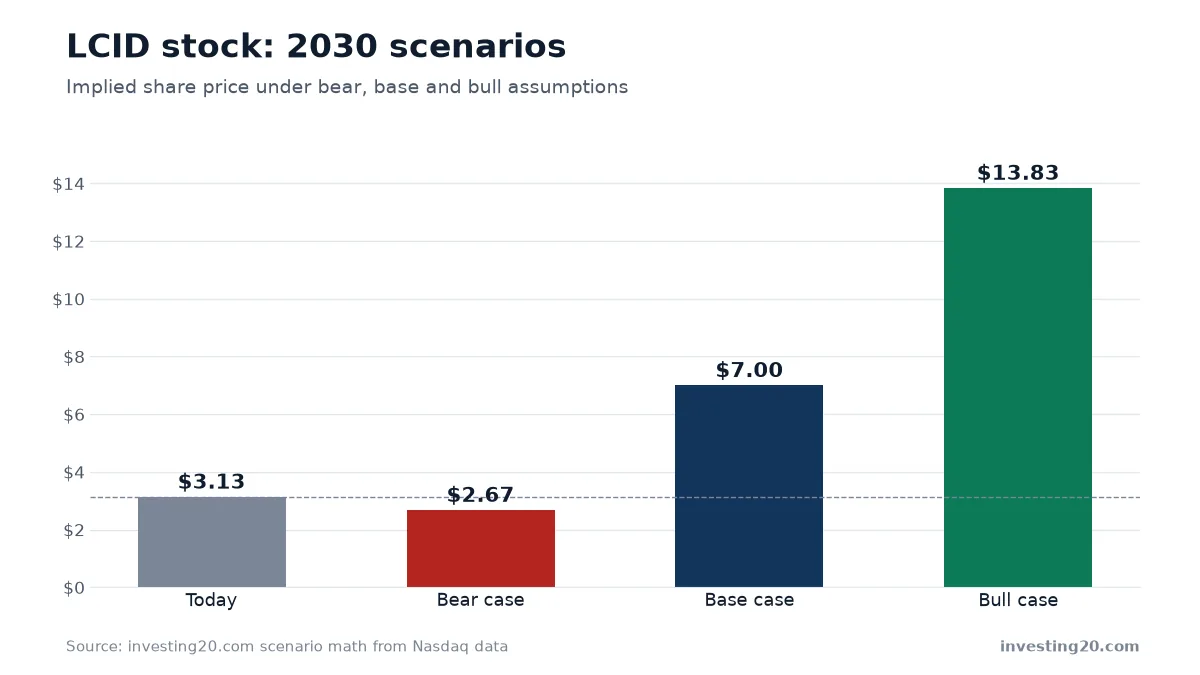
| Scenario | Revenue growth per year | 2030 revenue | Price-to-sales | Shares | Implied share price |
|---|---|---|---|---|---|
| Bear | 20% slowing to 5% | $2.5 billion | 0.5× | 444 million | about $2.67 (-15%) |
| Base | 41% slowing to 15% | $4.1 billion | 0.7× | 418 million | about $7.00 (+124%) |
| Bull | 61% slowing to 25% | $6.3 billion | 0.9× | 402 million | about $13.83 (+342%) |
Bear case: $2.67 (-15%)
In the bear scenario, revenue growth slows rapidly from 20% down to 5% per year, averaging about 12% annually. Lucid reaches $2.5 billion in sales by 2030. Continued cash burn leads to additional share issuance, expanding the share count to 444 million. With low margins and muted growth, the price-to-sales multiple contracts to 0.5, leaving the stock at $2.67.
Base case: $7.00 (+124%)
In the base scenario, annual revenue growth moderates from 41% down to 15%, averaging roughly 27% per year. Lucid scales manufacturing across both assembly plants, generating $4.1 billion in revenue by 2030. Moderate dilution brings the share count to 418 million. Trading at a price-to-sales multiple of 0.7, the implied share price reaches $7.00.
Bull case: $13.83 (+342%)
In the bull scenario, Lucid maintains brisk demand, with sales expansion slowing gradually from 61% down to 25% annually (averaging 42% per year). Production ramps efficiently in North America and overseas, lifting 2030 revenue to $6.3 billion. Better capital management limits dilution to 402 million shares. With improved operating margins, the market awards a price-to-sales multiple of 0.9, resulting in a share price of $13.83.
The main takeaway from these scenarios is that even under the bull case, Lucid does not return to its February 2025 high of $34.80. The math behind our longer-term Lucid stock price prediction shows how much sustained revenue expansion is required to overcome dilution and bottom-line losses.
Risks to weigh
Before taking a position in LCID, consider the primary headwinds facing the company:
- Heavy ongoing cash burn: Lucid posted a net loss of $3.9 billion over the past four quarters. Continued negative cash flow could require further capital raises.
- Dilution risk: Issuing new shares to fund operations reduces existing shareholders’ ownership stake and caps per-share price appreciation.
- Earnings misses: Lucid has missed consensus EPS expectations for four consecutive quarters, reflecting persistent cost overruns.
- Intense competition: Established legacy automakers and dedicated EV companies are aggressively cutting prices in the premium electric vehicle category.
- Factory ramp execution: Running parallel manufacturing plants in Arizona and Saudi Arabia introduces international logistics and supply chain complexities.
What to watch next
The clearest indicator of Lucid’s progress will be its upcoming quarterly earnings reports. Watch whether quarterly revenue can consistently top the $500 million mark and whether net losses begin to shrink rather than expand.
Investors should also monitor changes in the total share count each quarter. If share dilution accelerates to cover operating expenses, long-term per-share value targets become much harder to reach. Keeping tabs on gross margin improvements will tell you whether the factory footprint is moving toward breakeven economics.
FAQ
What is the 12-month analyst target for LCID stock?
According to Nasdaq consensus data as of October 2026, the average 12-month price target is $7.69, with a range between $3.50 and $17.00. Wall Street sentiment leans cautious, with 1 buy, 7 hold, and 3 sell ratings.
Is Lucid Group profitable right now?
No, Lucid Group is not profitable. Over the four quarters ending June 30, 2026, the company posted a net loss of $3.9 billion on $1.5 billion of revenue.
What could Lucid stock be worth in 2030?
Scenario modeling shows three paths: a bear case of $2.67 (-15%), a base case of $7.00 (+124%), and a bull case of $13.83 (+342%). These depend heavily on whether annual revenue reaches $2.5 billion, $4.1 billion, or $6.3 billion by 2030.
What revenue does Lucid need by 2030 to maintain its current price?
At a base-case price-to-sales multiple of 0.7 and 418 million shares, Lucid needs approximately $1.8 billion in revenue in 2030 to justify today's $3.13 share price.
Market data and financials: Nasdaq. Scenario math: investing20.
This article is for information only and is not investment advice. Do your own research before investing.