Ford Motor Company (F) Stock Forecast 2026–2030
Looking at the Ford stock forecast through 2030? Explore 12-month analyst targets, long-term valuation scenarios, financial trends, and key risks.
On this page
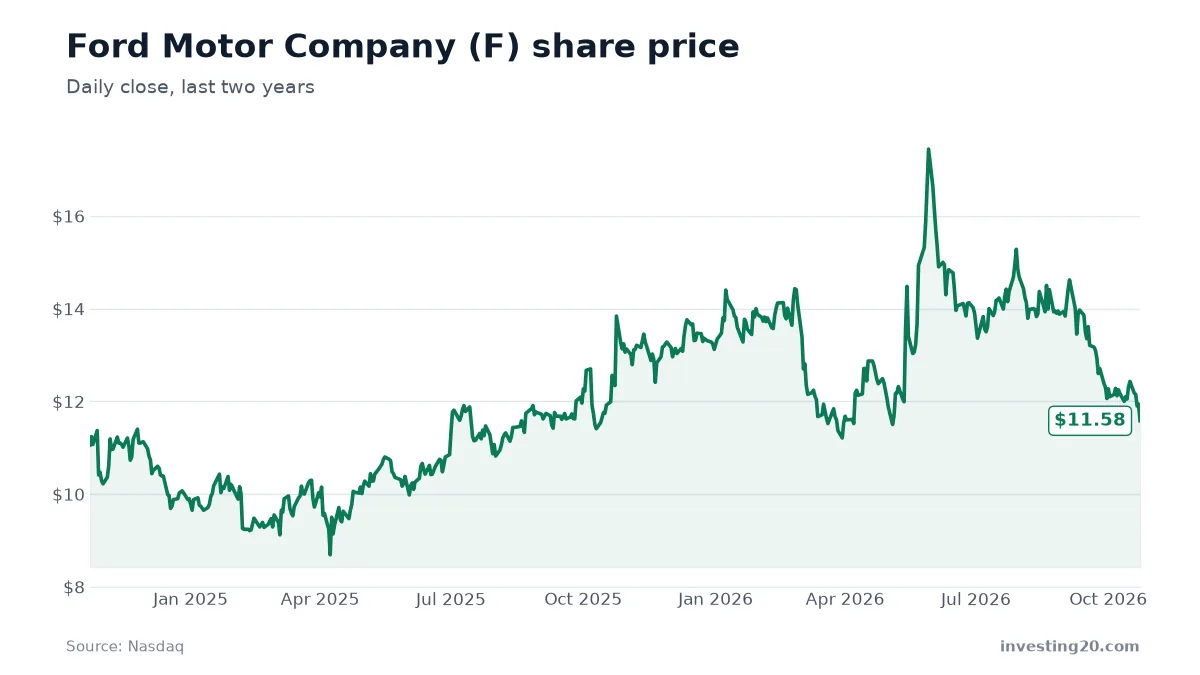
Ford Motor Company (NYSE: F) trades around $11.58, giving the legacy automaker a market valuation of about $45.4 billion. This article looks at what Wall Street analysts expect from Ford over the next 12 months, along with three multi-year revenue scenarios through 2030.
Long-range stock projections are not guaranteed predictions. They are analytical tools designed to show what kind of business performance and growth rates are required to justify different price targets over time.
| Share price | $11.58 (Oct 23, 2026 5:44 PM ET) |
| Market value | about $45.4 billion |
| 52-week range | $11.11 – $17.78 |
| Revenue, last 12 months | about $188.0 billion |
| Revenue growth, last fiscal year | 1% |
| Net income, last 12 months | a loss of about $7.4 billion |
| Price-to-sales | about 0.2× |
| Price-to-earnings | n/a (not profitable) |
| Analyst 12-month target | average $16.04 (range $14 – $20); 7 buy, 7 hold, 0 sell |
Market data from Nasdaq as of October 23, 2026. Check current figures before making any decision.
What Ford Motor Company does
Ford Motor Company is a global automaker headquartered in Dearborn, Michigan. The company designs, manufactures, and services a wide range of vehicles, including Ford trucks, sport utility vehicles, commercial vans, and Lincoln luxury vehicles.
Ford makes money primarily through direct vehicle sales to retail customers and fleet operators, commercial vehicle service programs, connected digital services, and automotive financing through Ford Motor Credit Company. Under its Ford+ growth initiative, the company focuses on building long-term customer relationships while developing self-driving mobility solutions and electric vehicle technologies. The automaker employs approximately 182,000 people worldwide.
Where the business stands today
Ford reported $188.0 billion in total revenue over the last four quarters, continuing a modest upward trend from prior years. The company generated $187.3 billion in revenue during fiscal year 2025, up 1.2% from $185.0 billion in 2024 and $176.2 billion in 2023. Quarterly top-line performance has varied, with $48.30 billion reported for the quarter ending June 30, 2026, following $43.25 billion in the quarter ending March 31, 2026.
Despite top-line gains, profitability remains under pressure. Ford recorded a net loss of $7.4 billion over the last four reported quarters, driven largely by a net loss of $8.2 billion in fiscal year 2025. That marks a sharp shift from fiscal year 2024, when Ford reported net income of $5.9 billion.
On an adjusted basis, recent quarterly earnings results have consistently beaten consensus estimates. In the quarter ending June 30, 2026, Ford reported earnings per share (EPS) of $0.42 against an expected $0.33, representing a 27.27% positive surprise. That followed a strong quarter ending March 31, 2026, where reported EPS reached $0.66 against a consensus estimate of $0.20.
For full-year fiscal 2026, consensus estimates from eight analysts project earnings of $1.86 per share. Analysts expect EPS to hold steady at $1.88 in fiscal 2027 before rising to $2.09 in fiscal 2028, according to estimates tracked by Nasdaq.
What is the 12-month f stock forecast?
Wall Street consensus data on Nasdaq shows a positive short-term outlook for Ford stock. Among 14 analysts covering the stock, 7 rate it a buy and 7 rate it a hold, with zero sell ratings.
The average 12-month price target is $16.04, which represents a potential gain of 38.5% from the October 23, 2026 price of $11.58. The target range spans from a low of $14.00 (a 20.9% upside) to a high of $20.00 (a 72.7% upside).
To reach that average target of $16.04 over the coming year, Ford will need to maintain its positive earnings surprises, stabilize its bottom-line profit performance, and maintain commercial momentum in its core truck and vehicle lines. Investors monitoring automotive models like the Tesla stock forecast or the Rivian stock forecast often track how established players like Ford defend market share while building out electric vehicle capacity.
What are the long-term ford stock projections for 2030?
To evaluate where Ford could trade by 2030, we model three revenue scenarios starting from the last four quarters’ baseline revenue of $188.0 billion. The calculations apply a price-to-sales multiple to projected 2030 revenue and divide by an adjusted share count to account for potential share changes over time. Ford currently trades at a price-to-sales multiple of 0.2.
To maintain its current share price of $11.58 through 2030 under base-case valuation multiples, Ford needs to generate about $188.0 billion in revenue in 2030. That means current stock levels already reflect flat revenue expectations over the next four years.
| Scenario | Revenue growth per year | 2030 revenue | Price-to-sales | Shares | Implied share price |
|---|---|---|---|---|---|
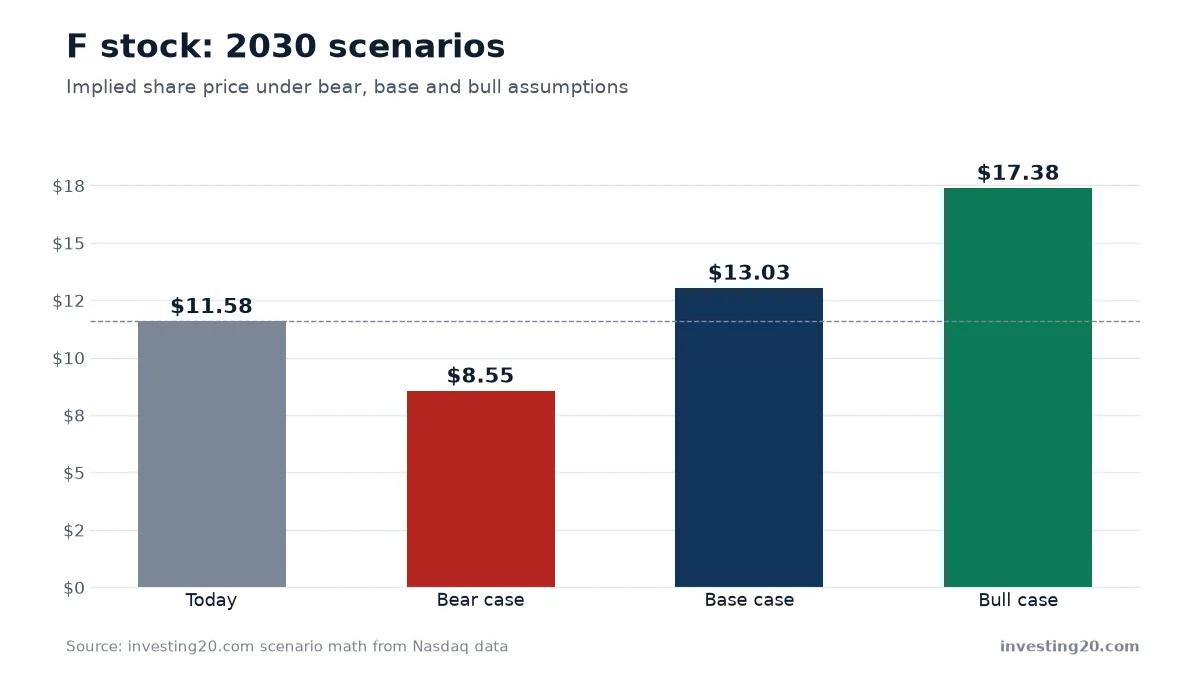
| Bear | -1% | $180.6 billion | 0.2× | 4.08 billion | about $8.55 (-26%) |
| Base | 3% | $211.6 billion | 0.2× | 3.92 billion | about $13.03 (+13%) |
| Bull | 7% | $246.4 billion | 0.3× | 3.76 billion | about $17.38 (+50%) |
Bear case scenario
In the bear case, Ford’s annual revenue contracts by about 1% per year through 2030, reducing total annual sales to $180.6 billion. Assuming the price-to-sales multiple remains depressed at 0.2 and share dilution expands the share count to 4.08 billion, the implied share price falls to $8.55. That represents a 26% decline from today’s price.
Base case scenario
The base case projects moderate top-line expansion of 3% per year, bringing 2030 revenue to $211.6 billion. Maintaining a 0.2 price-to-sales multiple with a share count of 3.92 billion leads to an implied share price of $13.03, offering a modest 13% total return above the current market price.
Bull case scenario
In the bull case, revenue grows at an average pace of 7% per year, reaching $246.4 billion by 2030. If market sentiment improves and lifts Ford’s price-to-sales multiple slightly to 0.3 with 3.76 billion shares outstanding, the implied share price reaches $17.38. That corresponds to a 50% upside from current levels.
The main takeaway from these scenarios is that Ford stock is heavily dependent on valuation multiples staying firm and modest revenue growth occurring. Because the current price-to-sales ratio is already low at 0.2, any valuation expansion combined with steady growth produces meaningful upside, while outright revenue contraction puts pressure on the stock. Similar valuation dynamics can be observed when looking at other capital-intensive companies like the NIO stock forecast.
Key risks facing Ford stock
- Net losses and margin pressures: Ford posted an $8.2 billion net loss in fiscal 2025 and a $7.4 billion loss over the last four reported quarters, highlighting ongoing execution and cost challenges.
- Capital spending requirements: Transforming production lines for electric and hybrid vehicles requires heavy capital expenditure, which can drag on bottom-line profitability.
- Competitive environment: High competition from both domestic auto manufacturers and foreign entrants places pressure on Ford’s truck and SUV market share.
- Cyclical economic sensitivity: Auto sales depend heavily on broader macroeconomic conditions, consumer spending power, and prevailing interest rates.
What to watch next
If you own Ford stock or are watching for an entry point, keep an eye on upcoming quarterly earnings reports to see if EPS beats continue. Watch whether the company can turn its recent net losses back into sustained net profitability, and monitor full-year 2026 earnings execution against the $1.86 consensus forecast.
FAQ
What is the 12-month Ford stock forecast?
Wall Street analysts tracked by Nasdaq have an average 12-month price target of $16.04 on Ford Motor Company shares, with a high target of $20.00 and a low of $14.00. That average target implies an upside of about 38.5% from the current price of $11.58 as of October 23, 2026.
Is Ford stock expected to grow by 2030?
In our base-case projection, Ford stock reaches about $13.03 by 2030 if annual revenue grows by 3% to $211.6 billion and valuation multiples remain at 0.2 times sales. In a bull case with 7% annual revenue growth and a 0.3 price-to-sales multiple, shares could reach $17.38.
What is Ford's current market value and revenue?
As of October 23, 2026, Ford has a market value of $45.4 billion. Over the last four reported quarters, the company generated $188.0 billion in revenue, up slightly from $187.3 billion in fiscal year 2025.
Market data and financials: Nasdaq. Scenario math: investing20.
This article is for information only and is not investment advice. Do your own research before investing.