Stellar (XLM) Price Prediction 2026–2030: Can It Reach $1?
Realistic scenarios for Stellar (XLM) through 2030. We examine market cap math, token supply releases, and whether a $1 price target is achievable.
On this page
Stellar (XLM) remains one of the oldest cross-border payments networks in crypto, but holding it requires realistic expectations about market math. This guide models three detailed scenarios for XLM from 2026 through 2030, testing popular targets like $1 against circulating supply and historical market share.
Before looking at the numbers, remember that long-range crypto predictions are mathematical scenarios, not guaranteed forecasts. Digital assets carry no earnings, and individual altcoins can lose most of their value or fail to recover after prolonged downturns. An earlier edition looked at Stellar Lumens XLM Price Prediction 2025, 2030, 2040, but looking out to 2040 is simply too far out to model honestly in an industry that moves this fast.
| Price | $0.177 (October 17, 2026) |
| Market value | about $6.2 billion (#20 by market value) |
| Trading volume, 24 hours | about $96.9 million |
| Coins in circulation | 35.20 billion (70% of the 50 billion total) |
| Change, last 12 months | -42% |
| All-time high | $0.876 on January 2, 2018 (-80%) |
| Whole crypto market | about $2.7 trillion; Stellar is 0.23% of it |
Market data from CoinGecko as of October 17, 2026. Crypto prices move fast; check current figures before making any decision.
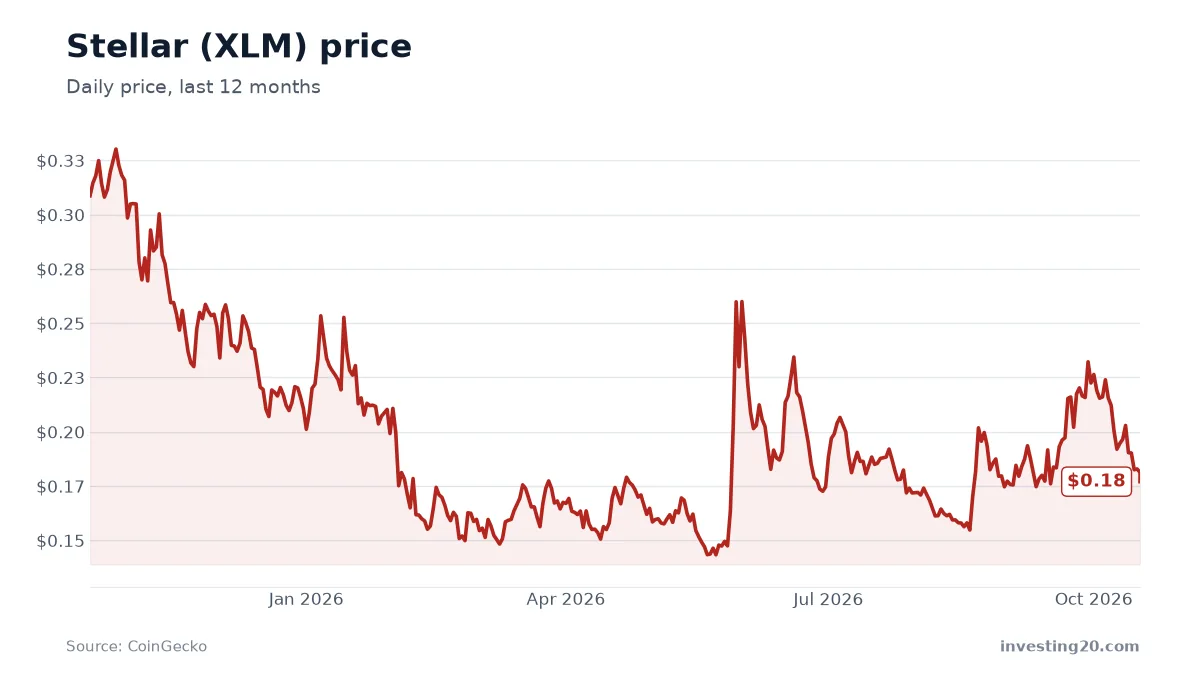
In the past 24 hours, the price of Stellar increased by 1.67%. However, over the past 7 days, despite the recent increase, Stellar experienced a decline of 0.21%.
This week, Stellar is showing signs of a potential reversal. Take a look at the technical analysis before reading a trend into it.
| Period | Change (USD) |
|---|---|
| Today | +1.67% |
| 7 days | -0.21% |
| 14 days | -5.77% |
| 30 days | -24.33% |
| 60 days | -4.13% |
| 200 days | +7.55% |
| 1 year | -44.08% |
Updated October 31, 2026 · Data provided by CoinGecko
The table above outlines where Stellar stands today on October 17, 2026. With a market value of $6.2 billion, Stellar ranks as the 20th-largest cryptocurrency, representing about 0.227% of the entire $2.7 trillion digital asset market.
What is Stellar and what is the XLM token used for?
Jed McCaleb and Joyce Kim founded Stellar in 2014 as an open-source payment rail designed to move money across borders quickly and at minimal cost. The network connects individuals, payment processors, and banking institutions through trusted gateways called Anchors. Anchors hold fiat deposits and issue corresponding credits on the Stellar ledger, bridging traditional financial accounts with digital settlement.
The infrastructure avoids traditional proof-of-work mining or standard proof-of-stake validators. Instead, it relies on the Stellar Consensus Protocol, a Federated Byzantine Agreement system where nodes pick trusted groups of peers to confirm ledger updates. This structure settles transactions in seconds with absolute finality. Over time, the network has expanded beyond simple cash transfers by introducing the Soroban smart contract platform, native tokenization for real-world assets, and a built-in distributed exchange.
The native asset, XLM (often called Lumens), serves two core technical roles. It pays the tiny network transaction fees that discourage spam, and accounts must hold a small reserve balance of XLM to remain active on the ledger. XLM also acts as a bridge currency when two parties want to exchange illiquid asset pairs. The network has no ongoing token inflation; the community voted in the past to disable the automatic creation of new coins.
Where the price stands today
Stellar trades at $0.177 as of October 17, 2026, marking a 42.1% decline over the past 12 months and a 4.9% dip over the last 30 days. Its 24-hour trading volume sits near $96.9 million, reflecting steady liquidity relative to its $6.2 billion market capitalization.
Long-term holders will recall Stellar’s all-time high of $0.876, reached on January 2, 2018. The current price sits 80% below that peak. While other major payment-focused projects like XRP and smart contract layers like Algorand have experienced similar multi-year cycles, Stellar’s inability to revisit its 2018 peak highlights how difficult it is for older altcoins to reclaim peak speculative enthusiasm.
Can Stellar reach $1?
Hitting $1 is a common target among retail investors because it represents a clean round number. To see whether that milestone is realistic, we have to look at the market capitalization required to support it.
| Price | Market value needed | Times today’s value | Share of today’s whole crypto market | Compared with Bitcoin today |
|---|---|---|---|---|
| $0.50 | $17.6 billion | 2.8× | 0.6% | 0.01× Bitcoin |
| $0.876 (all-time high) | $30.8 billion | 4.9× | 1.1% | 0.02× Bitcoin |
| $1.00 | $35.2 billion | 5.6× | 1.3% | 0.02× Bitcoin |
| $2.00 | $70.4 billion | 11.3× | 2.6% | 0.04× Bitcoin |
| $20.00 | $704.0 billion | 113.0× | 25.7% | 0.43× Bitcoin |
Market value needed = price × today’s 35.20 billion coins in circulation; more coins in circulation would raise every figure.
The table above details the market values required to support various XLM prices based on the 35.20 billion tokens currently circulating. Reaching $0.50 would push Stellar’s market value to $17.6 billion, roughly 2.8 times where it sits today. Returning to its record high of $0.876 requires a valuation of $30.8 billion.
For Stellar to reach $1.00, its market cap would need to climb to $35.2 billion, a 5.6-fold jump. In today’s terms, that valuation equals roughly 1.3% of the entire cryptocurrency market and about 2% of Bitcoin’s total worth ($1.6 trillion). That is achievable in an aggressive bull market, but it would require Stellar to attract substantial new liquidity.
Higher targets quickly become detached from reality. A $2.00 token demands a $70.4 billion valuation, or 11.3 times today’s size. Wild internet predictions of $20.00 would require a staggering $704.0 billion market cap, which is 43% of Bitcoin’s entire current value. Because supply expands when dormant tokens enter circulation, the actual hurdle to hit these dollar targets will be higher than the current math indicates.
Stellar price prediction for 2030: three scenarios
Cryptocurrencies do not produce corporate cash flow or earnings, so standard valuation ratios do not apply. Instead, long-range modeling relies on three factors: the total size of the crypto market, Stellar’s market share, and the number of coins circulating.
Right now, 14.80 billion XLM remain outside active circulation, out of a 50 billion total supply. As these reserves enter circulation over time, they increase the total coin count, diluting the price per token unless market value expands faster than supply. Our model accounts for these additional coins across three scenarios through 2030.
| Scenario | Whole crypto market in 2030 | XLM share of it | Coins in circulation | Implied price |
|---|---|---|---|---|
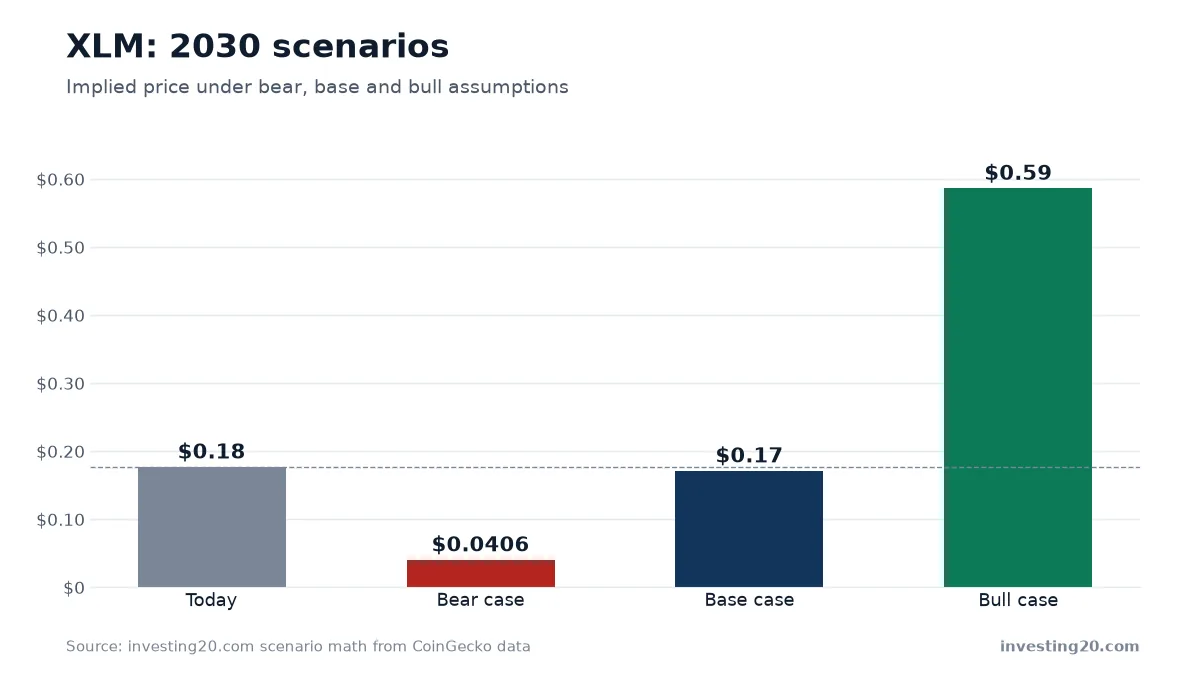
| Bear | $2.2 trillion (-5% a year) | 0.09% | 50 billion | about $0.0406 (-77%) |
| Base | $4.0 trillion (+10% a year) | 0.18% | 42.60 billion | about $0.171 (-3%) |
| Bull | $6.7 trillion (+25% a year) | 0.34% | 38.90 billion | about $0.587 (+231%) |
Bear case ($0.0406)
In the bear scenario, the total digital asset market shrinks by 5% annually, falling to $2.2 trillion by 2030. Competing networks take users from older payment chains, dropping Stellar’s market share from 0.227% down to 0.091%. Meanwhile, all remaining 14.80 billion uncirculated tokens enter the market, bringing circulating supply to the full 50 billion cap. Under these conditions, the implied price drops 77% to approximately $0.0406.
Base case ($0.171)
The base scenario assumes steady broader adoption, with the global crypto market growing 10% per year to hit $4.0 trillion by 2030. Most mature altcoins lose market share over time to newer projects, so this case models Stellar retaining 80% of its current share (0.182%). Half of the uncirculated supply (7.40 billion tokens) enters the market, pushing circulating supply to 42.60 billion. In this scenario, XLM trades at roughly $0.171, essentially flat compared to today’s price.
Bull case ($0.587)
In a sustained bull market, the total crypto ecosystem expands at 25% annually to reach $6.7 trillion by 2030. Real-world asset adoption and Soroban smart contract use expand Stellar’s footprint, lifting its market share to 0.341% (1.5 times today’s level). With conservative releases bringing circulating supply to 38.90 billion, the implied price reaches about $0.587, a 231% gain from current levels.
The main takeaway from this modeling is that even under strong market conditions, token dilution and broader industry competition make a move past $1.00 difficult by 2030.
Risks to weigh
Before allocating money to Stellar, consider the structural hurdles the network faces:
- Token dilution: With 14.80 billion tokens yet to enter circulation, incoming supply will continually create potential selling pressure.
- Enterprise competition: Stellar competes directly for institutional settlement volume with ripple networks, private bank consortia, and high-speed Layer 1 blockchains.
- Stablecoin preference: Many cross-border transactions now occur directly using dollar-pegged stablecoins on low-cost networks, reducing the need to route payments through XLM.
- Developer adoption: While the Soroban upgrade introduced smart contracts, Stellar must compete against established decentralized ecosystems with far deeper liquidity.
- Market concentration: Altcoin valuations remain heavily dependent on broader crypto sentiment and Bitcoin’s macro direction.
What to watch next
If you hold XLM or are watching for an entry point, focus on practical utility metrics rather than social media price hype. Watch whether real-world asset issuance on the Stellar ledger translates into active daily transaction growth. Track the pace of reserve tokens entering the market, as sudden increases in circulating supply can cap price rallies. Finally, keep an eye on developer activity across the Soroban contract platform to see if decentralized finance applications gain meaningful, sticky liquidity.
FAQ
Can Stellar (XLM) reach $1 by 2030?
To reach $1 at today's circulating supply of 35.20 billion coins, Stellar would need a market value of $35.2 billion, roughly 5.6 times its current size. While mathematically possible in an aggressive bull market, our 2030 bull scenario points closer to $0.59 when accounting for future token supply releases.
Why is Stellar Lumen's price down from its all-time high?
Stellar set its all-time high of $0.876 on January 2, 2018. Over the years, broad altcoin competition and general market cycles have pulled the price down roughly 80% to $0.177 as of October 2026.
What is the 2030 price target for Stellar (XLM)?
Our scenario modeling points to three possible outcomes by 2030 based on crypto market growth and token releases: a bear case of about $0.0406, a base case around $0.171, and a bull case near $0.587.
Market data: CoinGecko. Scenario math: investing20.
This article is for information only and is not investment advice. Do your own research before investing.