Fed Rate Decision Update: Why Rates Are on Hold and What It Means for You
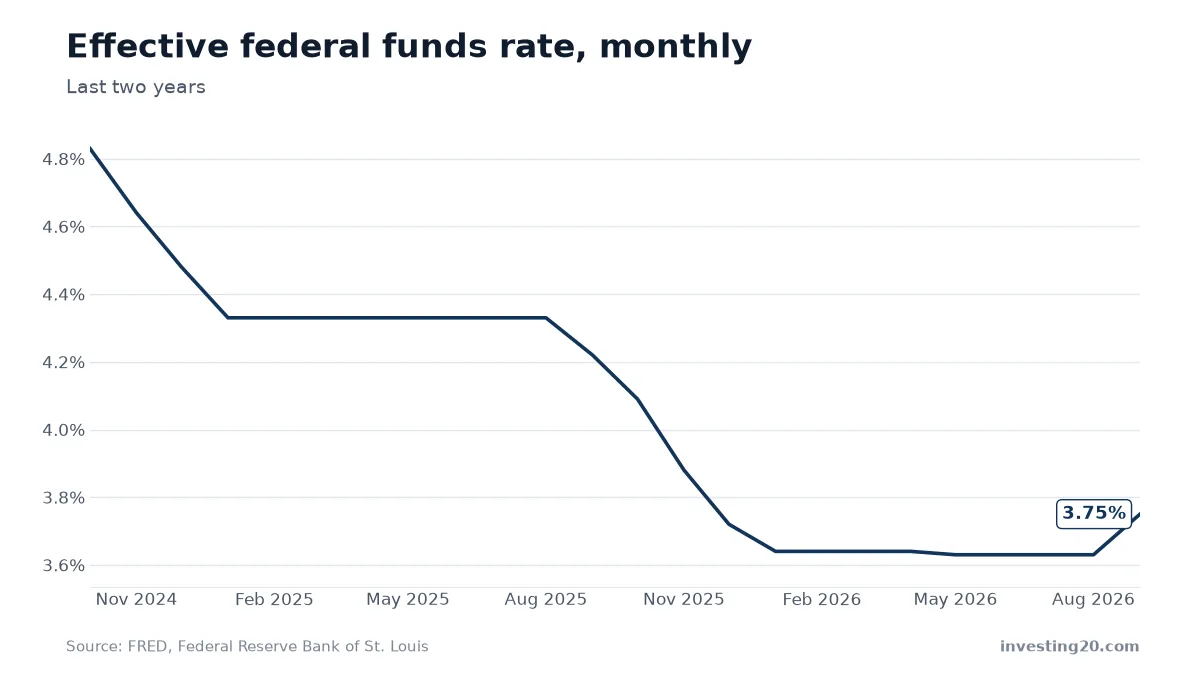
The Fed held its benchmark rate at 3.75% to 4%. Here is what the pause means for your mortgage, credit cards, high-yield savings, and stock portfolio.
On this page
- The numbers that matter from today’s decision
- Why the Fed decided to hold borrowing costs steady
- What this means for your credit cards and loans
- What this means for mortgage rates and housing
- What this means for your stock portfolio and savings cash
- A big procedural shift: Fewer rate decisions ahead
- What to watch next
- FAQ
The Federal Reserve voted today to keep its benchmark interest rate unchanged at a target range of 3.75% to 4%. For anyone paying down debt, managing a retirement portfolio, or shopping for a home, this pause offers a brief breath of stability, but it comes with a strong warning that borrowing costs may head higher before the year ends.
The decision follows a quarter-point rate hike in September, which marked the central bank’s first rate increase in three years. Today’s outcome was widely expected on Wall Street, and the three major stock indexes closed essentially flat following the announcement. Beneath the surface, the Federal Open Market Committee (FOMC) revealed signs of an intense internal debate over how to manage persistent price pressures.
The numbers that matter from today’s decision
Ten members of the FOMC voted to hold rates steady, while two dissented. Fed Board Governor Lisa Cook and Cleveland Fed President Beth Hammack both voted to lift the benchmark rate by another 0.25 percentage points immediately.
Fed Chairman Kevin Warsh described the policy session as “a heck of a family fight, a serious, sober discussion.” The numbers behind that debate highlight why officials are split:
| Metric | Latest Figure | Previous Figure / Context |
|---|---|---|
| Federal Funds Target Range | 3.75% – 4.00% | Held steady after 25 bps hike in Sept 2026 |
| Headline CPI Inflation | 3.7% (September) | Up from 3.4% in August |
| Core CPI Inflation | 2.6% (September) | Excludes food and energy; above forecasts |
| 2-Year Treasury Yield | 4.714% (October 28) | Sensitive to monetary policy expectations |
| 30-Year Fixed Mortgage Rate | 7.32% (October 22) | FRED data; up from 6.17% one year earlier |
| First-Half 2026 GDP Growth | 2.4% | Revised up from an earlier 1.8% estimate |
Economic growth has stayed resilient. Chairman Warsh highlighted that first-half GDP growth was revised upward to 2.4%, and the third quarter appears to have expanded even faster. Consumer spending remains healthy and capital spending is broadening across industries. The primary challenge remains inflation, which has run above the central bank’s 2% goal for nearly six years.
Why the Fed decided to hold borrowing costs steady
The FOMC stated that economic activity is expanding at a “strong pace,” but policymakers want more data before tightening borrowing conditions further. Phil Camporeale, chief investment strategist at JPMorgan Wealth Management, noted that the central bank is “leaning into patience” as geopolitical instability clouds the outlook.
A significant driver of stubborn consumer prices is the ongoing war in the Middle East with Iran. The closure of the Strait of Hormuz has severely disrupted trade, pushing oil prices above $117 a barrel earlier this week. Higher energy costs led the headline Consumer Price Index up to 3.7% in September. Mark Zandi, chief economist at Moody’s Analytics, calculated that the conflict has already cost the typical American household roughly $2,000 through increased fuel and interest expenses.
Because energy spikes represent supply-side shocks, raising borrowing costs cannot instantly resolve them. As NYU Stern economics professor Nicholas Economides pointed out, hiking rates works when an economy faces excessive demand, but cannot drill oil or reopen shipping lanes. Pausing today allows policymakers to see whether energy prices stabilize or bleed into broader production costs.
Chairman Warsh also emphasized that political timing played no part in today’s vote, despite the midterm elections scheduled for November 3. Warsh told reporters, “I didn’t hear an utterance about politics” during deliberations.
What this means for your credit cards and loans
If you carry variable-rate debt, this rate pause prevents an immediate bump in your interest charges, but it does not roll back recent increases. Credit card interest rates typically mirror the prime rate, which moves alongside the federal funds target.
Because issuers take one to two billing cycles to process Fed adjustments, many borrowers are still absorbing the September rate hike. Matt Schulz, chief consumer finance analyst at LendingTree, noted that credit card rates have climbed for three straight months and currently sit at their highest levels since December 2025. With holiday shopping approaching, Schulz warned that consumers carrying balances could see borrowing costs edge higher if the Fed hikes again in December.
For auto loans, Edmunds reports that headline APRs for new cars have hovered around 7% all year, while used car rates continue to exceed 10%. Auto shoppers may spot discounted financing incentives over the next two months, but Edmunds senior analyst Joseph Yoon explained that those holiday promotional rates are standard seasonal clearance efforts for top-tier credit profiles rather than a sign of cheaper market-wide credit.
Federal student loans remain insulated from this decision for existing borrowers because their rates are fixed. Rates for new loans issued following May’s 10-year Treasury note auction currently range between 6.52% to 9.07%.
What this means for mortgage rates and housing
Prospective homebuyers will not find immediate relief from today’s rate pause. Unlike credit cards, 30-year fixed mortgages do not track the overnight federal funds rate. Instead, they move alongside the 10-year Treasury yield, which is steered by long-term growth and inflation forecasts.
Data from the Federal Reserve Bank of St. Louis shows the Freddie Mac 30-year fixed mortgage average was 7.32% as of October 22, 2026. That is slightly below the two-year peak of 7.40% set on October 8, but considerably higher than the 6.17% recorded a year ago.
Jeff DerGurahian, chief investment officer at LoanDepot, observed that bringing home loan rates down requires cooler energy prices, softer consumer demand, and sustained progress toward the central bank’s 2% inflation benchmark. While Bankrate home lending expert Linda Bell pointed out that home equity lines of credit may see a temporary leveling off, broad borrowing costs in housing remain elevated.
What this means for your stock portfolio and savings cash
For equity investors, the Fed’s stance reinforces a split market environment. Higher interest rates raise the cost of corporate debt, particularly for capital-intensive companies. Chairman Warsh observed that higher rates have influenced spending across the artificial intelligence build-out, causing credit spreads on some corporate assets to widen. You can read more about how higher borrowing expenses impact tech balance sheets in our analysis of the AI Tech Stock Selloff: Why Debt Fears Sparked Wall Street’s Slide.
At the same time, high-income households are actively spending out of their equity gains, supporting corporate top lines. If you own cash-generative technology leaders, such as those highlighted in our report on NVIDIA Earnings Surpasses Estimates and Highlights Generative AI Growth, broader balance sheets have held up well despite higher baseline yields. However, bond yields continue to compete directly with equities for investor dollars; DoubleLine Capital CEO Jeffrey Gundlach noted on CNBC that the 2-year Treasury yield traded at 4.714% following the news conference, offering an attractive risk-free yield.
Cash savers continue to benefit from this environment. Top-yielding online savings accounts pay over 4%, according to Bankrate data. If you have an emergency fund or short-term cash parked in a traditional bank account paying near zero, shopping around for a high-yield account remains an easy win.
A big procedural shift: Fewer rate decisions ahead
Beyond today’s interest rate hold, Warsh introduced a major operational reform that will change how the Fed conducts business.
The FOMC will maintain its calendar of eight annual gatherings, but beginning in 2027, one meeting each year will be dedicated solely to long-term monetary strategy rather than voting on rate changes or publishing formal policy statements. By 2028, two of the eight meetings will focus on broad strategy, leaving six meetings per year to adjust interest rates.
Warsh has long voiced skepticism about forward guidance, the practice where central bankers telegraph their future policy moves to markets. Aside from emergencies like the 2008 financial crisis, Warsh stated that he opposes forward guidance during normal, strong economic conditions. Paring back the frequency of voting meetings gives policymakers more room to deliberate without whipsawing market expectations every six weeks.
What to watch next
The Fed’s next policy gathering takes place on December 8-9, 2026. When asked whether another hike is on the table, Warsh declined to tip his hand, saying, “A lot of things can happen, so I’m not going to be able to share with you my musings about what happens when this group gets together six weeks from now.”
Even without clear forward guidance from the Fed, several economists expect borrowing costs to rise again. Michael Pearce, chief U.S. economist at Oxford Economics, and Seema Shah, chief global strategist at Principal Asset Management, both expect a quarter-point rate hike in December, with potential for another move in early 2027. Samuel Tombs at Pantheon Macroeconomics notes that financial markets are pricing in a cumulative 0.75 percentage points of policy tightening over the next twelve months.
Between now and December, keep an eye on crude oil prices and the next Consumer Price Index release. If headline inflation remains stuck near 3.7%, expect borrowing costs across cards and loans to climb again before the new year. For now, prioritize eliminating high-interest credit card balances and lock in higher yields on your cash reserves.
FAQ
What did the Fed decide at its October 2026 meeting?
The Federal Reserve voted 10 to 2 to keep its benchmark federal funds rate steady at a range of 3.75% to 4%. This followed a quarter-point rate increase in September 2026, which was the central bank's first rate hike in three years.
Why are mortgage rates still high if the Fed paused?
Fixed mortgage rates track long-term Treasury yields and inflation expectations rather than the Fed's overnight target rate. With inflation reaching 3.7% in September and oil prices elevated due to Middle East conflict, the 30-year fixed mortgage rate stood at 7.32% as of October 22, 2026.
Will the Federal Reserve raise interest rates again in 2026?
While Fed Chair Kevin Warsh declined to give specific forward guidance for future meetings, two FOMC members dissented in favor of an immediate rate hike. Economists at firms like Oxford Economics and Principal Asset Management anticipate another rate hike could arrive at the December 2026 meeting.
Sources: Here are five key takeaways from the Fed rate decision and Warsh news conference (CNBC); Fed holds interest rates steady even as inflation remains high (CBS MoneyWatch); Fed meeting recap: Warsh says central bank will host fewer rate-setting meetings in future years (CNBC); Fed leaves rates unchanged: What it means for credit cards, mortgages, auto loans and savings accounts (CNBC); Fed holds interest rates steady in last decision before midterms (The Guardian).
Economic data: FRED, Federal Reserve Bank of St. Louis
This article is for information only and is not investment advice. Do your own research before investing.