AMC Entertainment (AMC) Stock Forecast 2026–2030
An honest AMC stock forecast for 2026 through 2030. Explore revenue trends, long-term scenarios and what AMC stock predictions mean for investors.
On this page
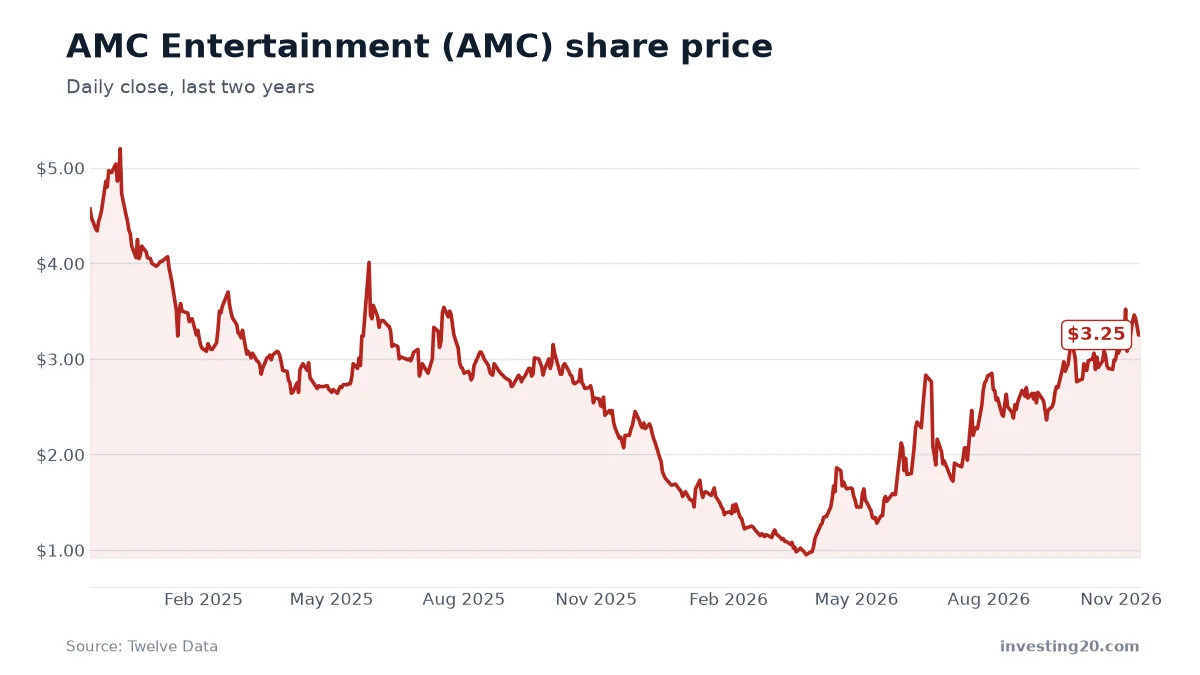
AMC Entertainment trades around $3.25 per share as of November 2026, down roughly 29% over the past two years despite an ongoing recovery in box office attendance. If you are weighing an investment in AMC stock, looking past short-term volatility requires analyzing how the business handles its heavy debt load and theatrical attendance trends over the rest of the decade.
Long-term stock forecasts should never be treated as guaranteed price targets. Instead, an AMC stock forecast works best as a framework to understand what level of revenue growth and valuation multiples are required to generate positive returns for shareholders.
| Share price | $3.25 (2026-11-13) |
| Market value | about $2.9 billion |
| 52-week range | $0.93 – $3.77 |
| Revenue, last 12 months | about $5.6 billion |
| Revenue growth, year over year | 16% |
| Net income, last 12 months | a loss of about $146.6 million |
| Price-to-sales | about 0.5× |
| Price-to-earnings | n/a (not profitable) |
Market data from Twelve Data as of November 14, 2026. Revenue and net income from the company’s SEC filings. Check current figures before making any decision.
What AMC Entertainment does
AMC Entertainment Holdings operates the world’s largest movie theater chain, offering theatrical exhibition across hundreds of locations in the United States and international markets. The company makes money through three primary channels: ticket sales, high-margin food and beverage concessions, and screen advertising or promotional partnerships.
Ticket revenue is split with movie studios, making concessions a central driver of overall profitability. Over recent years, AMC has expanded premium large-format screens like IMAX and Dolby Cinema to command higher ticket prices per patron, while also introducing branded retail popcorn and loyalty program tiers to capture more spending from regular moviegoers.
Where the business stands today
AMC generated $5.6 billion in revenue over the last four reported quarters, reflecting a 15.9% increase compared to the same period a year earlier. Annual revenue stood at $4.8 billion in fiscal year 2023, dropped to $4.6 billion in 2024, and recovered to $4.8 billion in 2025. Quarterly performance shows noticeable seasonality, with revenue reaching $1.05 billion in the quarter ending March 31, 2026, rising to $1.60 billion in the quarter ending June 30, 2026, and topping $1.71 billion in the quarter ending September 30, 2026.
Despite top-line improvements, bottom-line profitability remains out of reach. AMC recorded a net loss of $146.6 million over the trailing 12 months ending September 30, 2026. While that represents an improvement over full-year net losses of $352.6 million in 2024 and $632.4 million in 2025, persistent net losses highlight the ongoing cost burden of theater leases and corporate interest expenses.
The stock trades at a price-to-sales multiple of roughly 0.5, with a market valuation of $2.9 billion. Over the past 52 weeks, shares have fluctuated between a low of $0.93 and a high of $3.77, trading below the high of $5.20 set on December 5, 2024.
AMC stock forecast for the next 12 months
Looking out over the next year, any realistic AMC entertainment stock prediction hinges on theater attendance momentum and cost controls. Because the company carries significant fixed operating expenses, small shifts in box office sales heavily influence earnings and cash flow generation.
For AMC stock to maintain positive momentum over the next 12 months, investors will be looking for a few key developments:
- Consistent theatrical releases: A steady pipeline of Hollywood blockbusters and event cinema is essential to fuel ticket demand across all four quarters.
- Higher food and beverage spending: Food and beverage sales carry far higher gross margins than box office receipts, making concession spend per patron vital to narrowing net losses.
- Debt management and equity dilution: AMC has routinely issued shares to raise cash and service debt. Investors need to see management control interest costs without excessively diluting existing equity holders.
Analyzing turnarounds in consumer-facing sectors requires looking closely at unit economics and capital structure, much like evaluating high-growth tech stocks or electric vehicle makers in an evolving market like NIO’s long-term outlook.
AMC stock price prediction for 2030: three potential scenarios
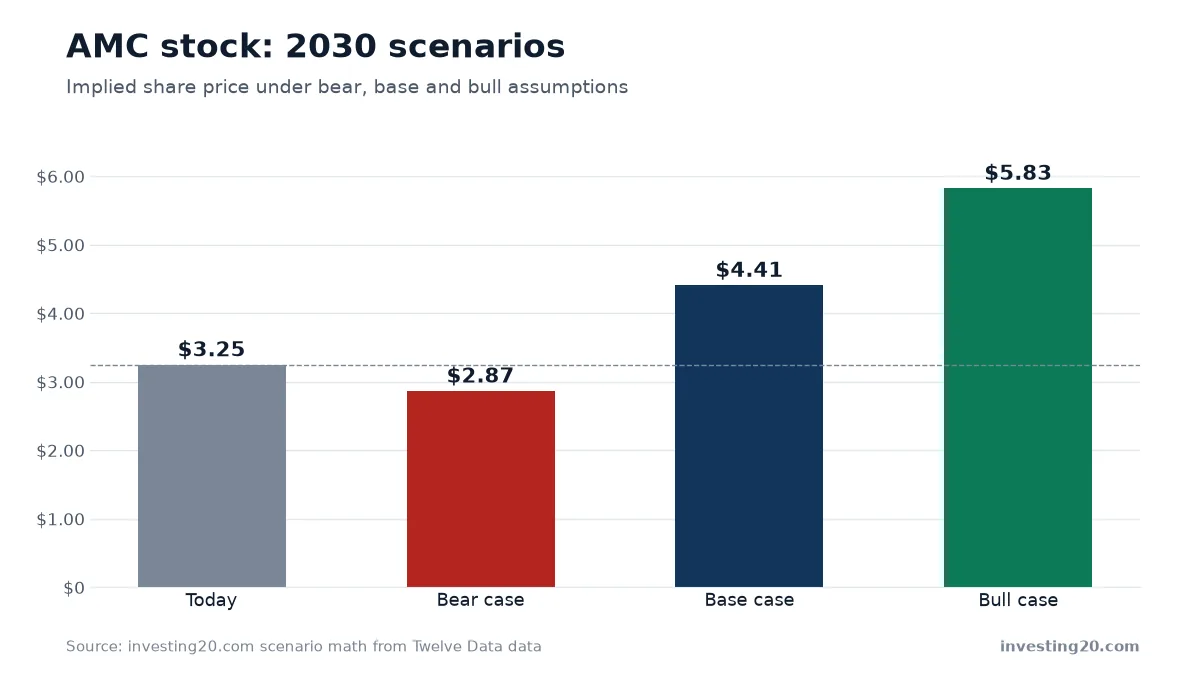
To project where AMC stock future pricing could land by 2030, we model three scenarios starting from the last four quarters of reported revenue ($5.6 billion). Each case applies an average annual revenue growth rate, a price-to-sales multiple, and an estimated share count that accounts for potential dilution.
| Scenario | Revenue growth per year | 2030 revenue | Price-to-sales | Shares | Implied share price |
|---|---|---|---|---|---|
| Bear | 6% | $7.0 billion | 0.4× | 1.00 billion | about $2.87 (-12%) |
| Base | 10% | $8.1 billion | 0.5× | 947 million | about $4.41 (+36%) |
| Bull | 14% | $9.4 billion | 0.6× | 911 million | about $5.83 (+79%) |
The bear case
In the bear case, annual revenue growth slows to 6% per year, bringing 2030 revenue to $7.0 billion. If theater attendance plateaus and share count expands to 1.00 billion due to ongoing debt refinancing via equity sales, a conservative price-to-sales multiple of 0.4 implies a 2030 share price of about $2.87. That represents a 12% decline from the current price of $3.25.
The base case
The base case assumes revenue grows at an average pace of 10% per year, pushing annual sales to $8.1 billion by 2030. Assuming the price-to-sales ratio remains unchanged at 0.5 and share count rises moderately to 947 million, the implied share price reaches $4.41. That outcome would yield a 36% gain over today’s price.
The bull case
In the bull case, box office demand rebounds sharply and premium screen upgrades drive average revenue growth to 14% annually, reaching $9.4 billion by 2030. If AMC stabilizes its share count at 911 million and its price-to-sales multiple expands slightly to 0.6, the implied share price rises to $5.83, or roughly 79% above today’s price.
What today’s valuation implies
At today’s price of $3.25 and assuming the base-case multiple and share count, AMC needs to generate approximately $6.0 billion in revenue by 2030 just to break even on an investment made today. Investors holding AMC stock are effectively betting that annual sales will comfortably pass that mark over the coming four years.
Evaluating speculative retail sentiment alongside fundamental turnaround efforts is also a common factor when assessing retail trading platforms, such as in our Robinhood stock price prediction scenarios.
Key risks to weigh before investing
Before acting on any AMC stock prediction, consider the specific operational and financial risks confronting the company:
- Ongoing net losses: AMC lost $146.6 million over the past four quarters and over $600 million in 2025, showing that top-line growth has not yet restored sustained net profitability.
- Dilution risk: AMC has historically used share offerings to manage its heavy debt load, which increases the total outstanding share count and reduces existing shareholders’ slice of future earnings.
- Streaming competition: Shorter theatrical release windows and direct-to-streaming alternatives remain persistent secular headwinds for movie theater attendance.
- Box office volatility: Theater revenue depends heavily on studio release slates, making quarterly results unpredictable if major releases underperform.
What to watch next
If you are following AMC Entertainment, track the quarterly revenue trend relative to the trailing $5.6 billion baseline. Watch whether net losses continue to shrink in upcoming SEC filings, and monitor corporate announcements regarding lease negotiations, debt maturities, or new share issuance. Those factors will determine whether the business moves toward the base case or remains weighed down by costs.
FAQ
What is the AMC stock forecast for 2030?
In a base-case scenario assuming 10% average yearly revenue growth and a 0.5 price-to-sales multiple, AMC stock could reach about $4.41 by 2030. Bullish and bearish scenarios project $5.83 and $2.87, respectively.
Is AMC Entertainment profitable?
No, AMC is currently operating at a net loss. Over the trailing 12 months ending September 30, 2026, the company reported a net loss of $146.6 million on $5.6 billion in revenue.
What revenue does AMC need to support its current stock price?
Based on a 0.5 price-to-sales multiple and moderate share dilution, AMC needs to generate about $6.0 billion in annual revenue by 2030 to maintain its price of $3.25.
Market data: Twelve Data. Financials: SEC filings. Scenario math: investing20.
This article is for information only and is not investment advice. Do your own research before investing.