Pi Network (PI) Price Prediction 2026–2030
Pi Network price prediction for 2026 to 2030. See the math behind $0.50 targets, token release risks, and realistic market cap scenarios.
On this page
Pi Network (PI) has built one of the largest mobile user bases in crypto, but translating phone engagement into lasting market value remains an uphill climb. This guide examines what Pi Network could realistically be worth between 2026 and 2030 by looking at network adoption, market share, and the heavy supply releases still to come.
Before looking at any numbers, keep in mind that long-range cryptocurrency predictions are hypothetical scenarios rather than bankable forecasts. Early crypto assets are volatile, and tokens can easily lose most or all of their value if community interest fades or supply swamps demand. While an earlier look asked what phase is Pi Network now, trying to model token prices out beyond 2030 is simply too far out to do honestly.
| Price | $0.0793 (October 17, 2026) |
| Market value | about $891.9 million (#82 by market value) |
| Trading volume, 24 hours | about $2.7 million |
| Coins in circulation | 11.25 billion (11% of the 100 billion total) |
| Change, last 12 months | -61% |
| All-time high | $2.99 on February 26, 2025 (-97%) |
| Whole crypto market | about $2.8 trillion; Pi Network is 0.03% of it |
Market data from CoinGecko as of October 17, 2026. Crypto prices move fast; check current figures before making any decision.
In the past 24 hours, the price of Pi Network increased by 0.21%. Over the past 7 days, Pi Network continued to perform well, with a further increase of 0.76%.
This week, Pi Network is continuing its positive momentum. Take a look at the technical analysis before reading a trend into it.
| Period | Change (USD) |
|---|---|
| Today | +0.21% |
| 7 days | +0.76% |
| 14 days | -2.46% |
| 30 days | -12.99% |
| 60 days | -14.47% |
| 200 days | -52.61% |
| 1 year | -68.10% |
Updated October 31, 2026 · Data provided by CoinGecko
The figures above highlight the core tension in Pi Network today. While the project holds a top-100 market standing, its daily trading volume sits at just $2.7 million, and roughly 89% of its total supply has yet to hit the market.
What is Pi Network and what is the coin used for?
Pi Network launched with the goal of making cryptocurrency mining accessible to ordinary people through everyday smartphones. Traditional proof-of-work mining requires expensive computer rigs and heavy electricity consumption. In contrast, Pi lets users tap a button on their phone once a day to earn rewards without draining battery life or burning through cellular data.
The project was founded by Dr. Nicolas Kokkalis and Dr. Chengdiao Fan, two Stanford University PhD graduates, and is managed by Social Chain Inc. Instead of external venture capital backing, the team chose to rely on organic community growth.
Under the hood, Pi uses the Stellar Consensus Protocol and a Federated Byzantine Agreement. This architecture relies on trust groups rather than energy-intensive proof-of-work. Users establish “security circles” by vouching for people they know, creating an interconnected trust graph across the entire network. Participants take on roles as pioneers, contributors, ambassadors, or running desktop nodes. Much like Stellar (XLM) or other low-cost networks like Algorand (ALGO), the focus is fast, accessible settlement.
Within this ecosystem, the PI token is designed as practical money rather than a purely speculative asset. It serves several core functions:
- Peer-to-peer payments and network transaction fees.
- Buying goods and services inside Pi’s native marketplace and decentralized applications.
- Participating in launchpad staking opportunities.
- Voluntary token lockups, where users freeze a portion of their holdings to support market stability in exchange for a higher mining rate.
Where the price stands today
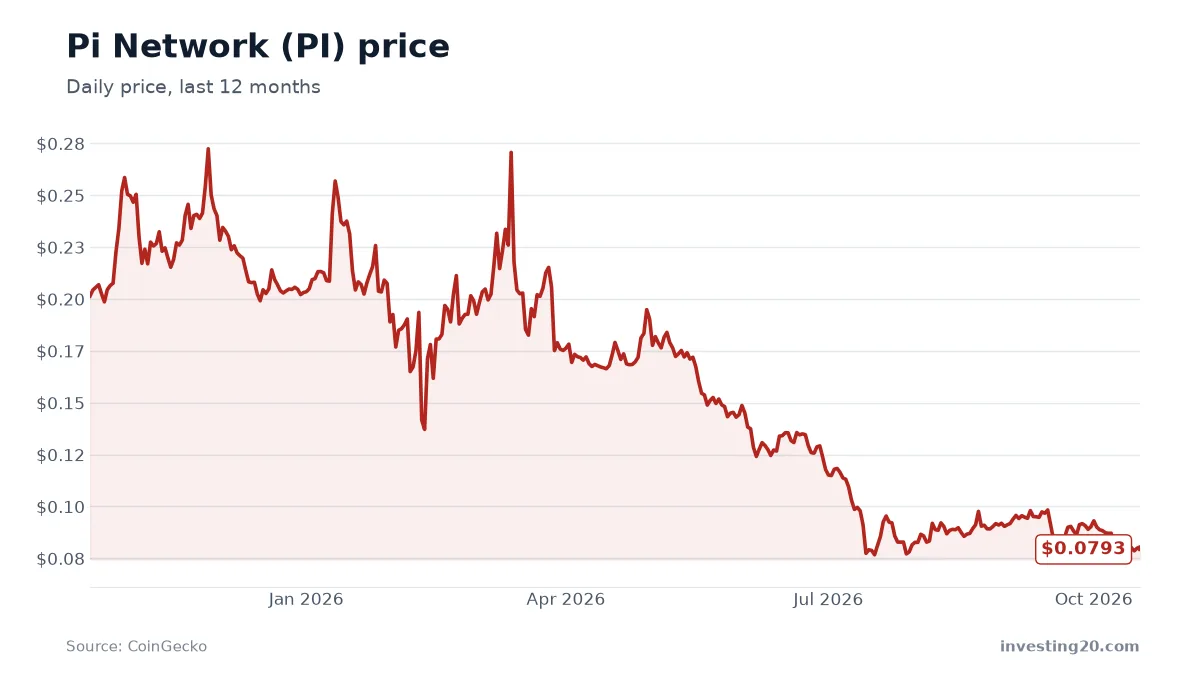
Pi Network has had a rough run over the past year. As of October 17, 2026, PI trades at $0.0793 with an overall market value of $891.9 million. That puts it at rank #82 among all cryptocurrencies.
The token reached its all-time high of $2.99 on February 26, 2025. Since that peak, the price has dropped 97%. Over the trailing 12 months, PI is down 60.8%, with a 3.6% decline over the last 30 days.
Trading interest is modest relative to its valuation. With 24-hour trading volume sitting at $2.7 million, PI trades only a tiny fraction of its total value each day. The broader crypto market is valued at $2.8 trillion, with Bitcoin accounting for $1.6 trillion. Pi Network makes up about 0.032% of that broader market.
Can Pi Network reach $0.50?
A common question among community members is whether PI can climb back up toward $0.50, or even retest $1.00 and its former record. To see if that is plausible, you have to look at the market capitalization required at each price point.
| Price | Market value needed | Times today’s value | Share of today’s whole crypto market | Compared with Bitcoin today |
|---|---|---|---|---|
| $0.20 | $2.2 billion | 2.5× | 0.1% | 0.00× Bitcoin |
| $0.50 | $5.6 billion | 6.3× | 0.2% | 0.00× Bitcoin |
| $1.00 | $11.2 billion | 12.6× | 0.4% | 0.01× Bitcoin |
| $2.99 (all-time high) | $33.6 billion | 37.7× | 1.2% | 0.02× Bitcoin |
| $10.00 | $112.5 billion | 126.1× | 4.1% | 0.07× Bitcoin |
Market value needed = price × today’s 11.25 billion coins in circulation; more coins in circulation would raise every figure.
The table above calculates the required market value using the 11.25 billion tokens currently in circulation. At $0.20, Pi would need a market value of $2.2 billion, roughly 2.5 times where it trades now.
To reach $0.50, Pi Network’s market value would have to climb to $5.6 billion. That is 6.3 times its current valuation. In the context of the current $2.8 trillion crypto market, a $5.6 billion valuation would represent about 0.2% of all digital assets. That does not sound impossible on paper, it is still less than 1% of Bitcoin’s total size, but there is a major catch: token supply.
These calculations assume the circulating supply stays frozen at 11.25 billion tokens. Pi Network has a maximum cap of 100 billion tokens, meaning 88.75 billion tokens are not yet in circulation. As those coins are released and enter the market, the circulating supply expands. If the circulating supply doubled to 22.5 billion, reaching $0.50 would require an $11.2 billion market value instead. For context on high targets against heavy token supplies, readers often explore similar dynamics in our XRP price prediction analysis.
Higher targets look far more demanding. Getting to $1.00 requires an $11.2 billion valuation with current coins, while revisiting the record of $2.99 demands $33.6 billion. A jump to $10.00 would push the project to $112.5 billion, or 4.1% of the entire crypto market today. Without massive real-world transaction demand, supply dilution makes those upper levels hard to sustain.
Pi Network price prediction for 2030: three scenarios
Because cryptocurrencies do not produce corporate earnings or cash flow, standard stock metrics do not apply. Instead, a sensible long-range model estimates three variables: the size of the total crypto market, the token’s market share, and how many new tokens enter circulation over time.
Most secondary tokens shed market share as newer projects arrive. In our base model, Pi retains 80% of its current market share. For token supply, we model releasing all remaining tokens in the bear case, half in the base case, and one-quarter in the bull case.
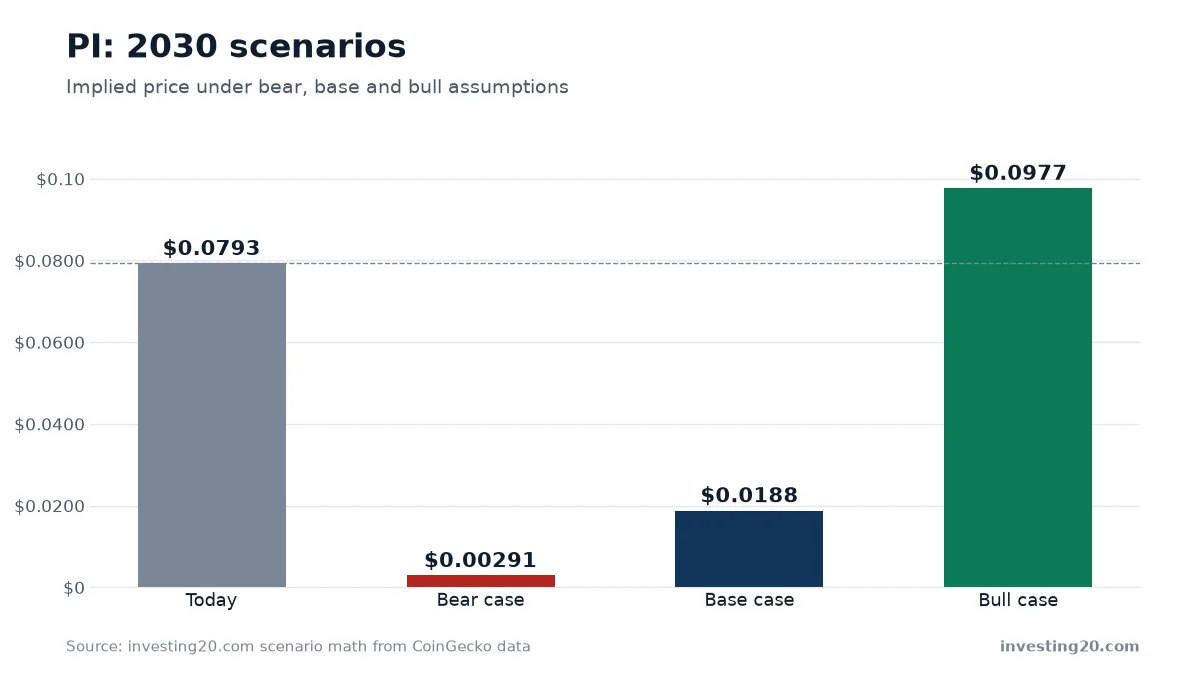
| Scenario | Whole crypto market in 2030 | PI share of it | Coins in circulation | Implied price |
|---|---|---|---|---|
| Bear | $2.2 trillion (-5% a year) | 0.01% | 100 billion | about $0.00291 (-96%) |
| Base | $4.0 trillion (+10% a year) | 0.03% | 55.62 billion | about $0.0188 (-76%) |
| Bull | $6.7 trillion (+25% a year) | 0.05% | 33.44 billion | about $0.0977 (+23%) |
The bear case: $0.00291 (-96%)
In this scenario, the crypto market contracts 5% annually, falling to $2.2 trillion by 2030. User interest drops, and Pi’s share of the market slips to 0.013% (40% of its current share). At the same time, the remaining 88.75 billion tokens fully enter the market, pushing circulating supply to the 100 billion maximum. That combination of shrinking market share and full supply dilution sends the price down 96% to roughly $0.00291.
The base case: $0.0188 (-76%)
The base case assumes the broader crypto market grows at a steady 10% annual clip, reaching $4.0 trillion in 2030. Pi Network holds up relatively well, retaining 80% of its market share (0.026% of the crypto pie). However, about half of the reserved coins are distributed over the next four years, expanding circulating supply to 55.62 billion tokens. Even though the overall crypto market grows, the expanding supply drags the price down 76% from current levels to about $0.0188.
The bull case: $0.0977 (+23%)
In the bull scenario, crypto adoption accelerates at 25% per year, driving the total market to $6.7 trillion by 2030. Pi Network expands its utility in real-world commerce, lifting its market share by 50% to 0.049%. New coin distributions are strictly paced, with only a quarter of the unreleased tokens entering the market, bringing supply to 33.44 billion. Under these optimistic conditions, the price edges up 23% to approximately $0.0977.
The takeaway across all three scenarios is that new token supply presents the single biggest hurdle for PI holders. Even in an expanding crypto market, incoming supply creates continuous downward pressure on unit prices unless organic buying demand outpaces it.
Risks to weigh
Before holding or trading PI, consider these structural risks:
- Massive pending supply releases: Over 88 billion tokens, roughly 89% of the ultimate 100 billion supply, have yet to reach circulation. Every batch of newly accessible coins increases supply.
- Low trading liquidity: A daily volume of $2.7 million on an $891.9 million valuation means that large holders cannot sell significant amounts without pushing the price down sharply.
- Ecosystem retention: The mobile mining model succeeded by rewarding simple clicks. Transitioning millions of casual phone users into paying consumers who spend real value on decentralized apps is a far harder task.
- Absence of institutional capital: While organic growth avoids venture capital dumping, the project lacks deep-pocketed institutional partners that often support network infrastructure during extended market downturns.
What to watch next
If you follow Pi Network, the most important metric to monitor over the coming months is not daily price movement. Keep an eye on the circulating supply figure on blockchain trackers. If supply grows faster than merchant adoption and real peer-to-peer usage, prices will face persistent headwinds.
You should also track exchange liquidity and 24-hour trading volumes. Until volume expands well beyond the low single-digit millions, price swings will remain choppy, and sustaining moves toward higher targets like $0.50 will remain difficult.
FAQ
Can Pi Network reach $0.50 by 2030?
To reach $0.50 with today's 11.25 billion circulating tokens, Pi Network would need a market value of $5.6 billion, about 6.3 times its current size. However, because nearly 89 billion tokens remain unreleased, future supply expansion makes sustaining that price level much harder.
What is the 2030 price forecast for Pi Network?
Based on scenario modeling, the base case suggests a price of around $0.0188 by 2030 as additional supply enters circulation. A conservative bull case projects about $0.0977, while a bear case could drop the token to roughly $0.00291.
What is Pi Network's all-time high?
Pi Network reached an all-time high of $2.99 on February 26, 2025. As of October 2026, the price trades down roughly 97% from that record.
Market data: CoinGecko. Scenario math: investing20.
This article is for information only and is not investment advice. Do your own research before investing.