SoundHound AI, Inc (SOUN) Stock Forecast: 2026–2030 Scenarios
SoundHound AI stock forecast and price prediction through 2030. See 12-month analyst targets, long-term revenue scenarios, and key business risks.
On this page
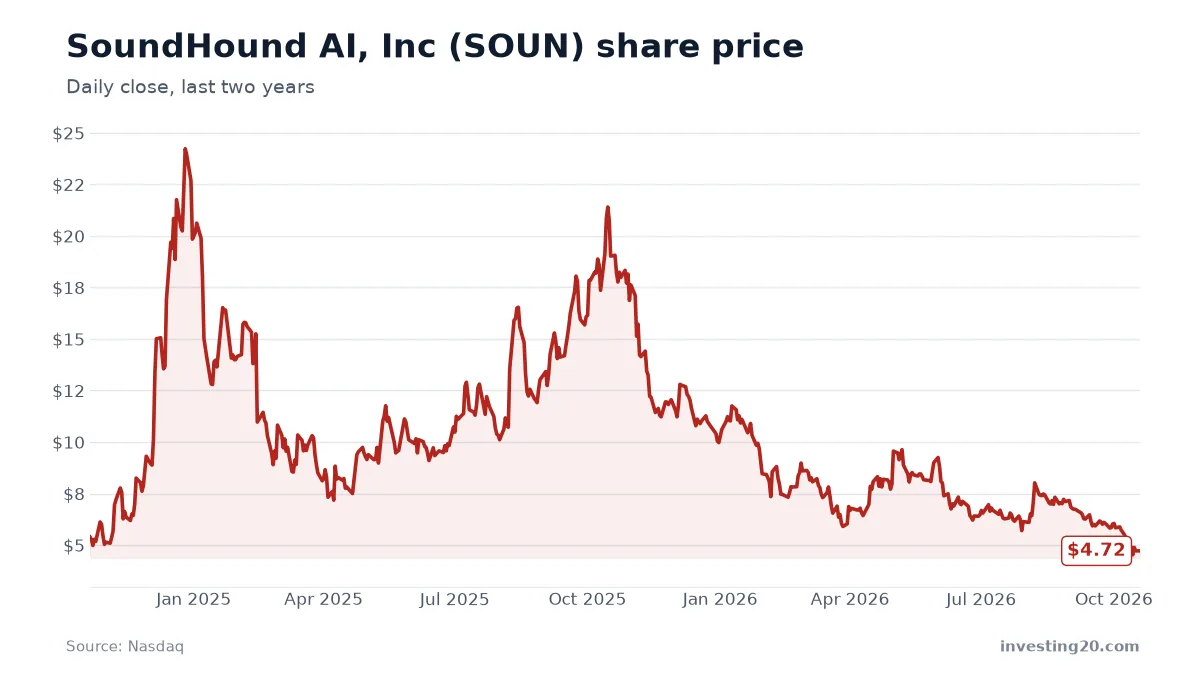
SoundHound AI, Inc (SOUN) stock traded near $4.11 in early November 2026, down sharply from its late 2024 high of $24.23. Investors evaluating the business today are trying to determine whether the voice artificial intelligence specialist can turn expanding enterprise contracts into long-term profit.
This article reviews where the company stands right now, breaks down analyst targets for the next 12 months, and models three long-term valuation scenarios through 2030. Remember that long-range financial forecasts are structured planning tools rather than definitive predictions.
| Share price | $4.11 (Nov 6, 2026) |
| Market value | about $2.0 billion |
| 52-week range | $3.88 – $15.68 |
| Revenue, last 12 months | about $203.2 million |
| Revenue growth, last fiscal year | 99% |
| Net income, last 12 months | a loss of about $137.1 million |
| Price-to-sales | about 9.7× |
| Price-to-earnings | n/a (not profitable) |
| Analyst 12-month target | average $8.30 (range $5 – $16); 2 buy, 2 hold, 0 sell |
Market data from Nasdaq as of November 8, 2026. Check current figures before making any decision.
What changed since our last update
Since our November 1, 2026 update, SoundHound AI shares slipped slightly from $4.22 to $4.11, representing a 2.6% decline. Wall Street analyst price targets adjusted lower during the week, moving the 12-month average consensus target from $10.92 down to $8.30 as firms updated their financial models following recent earnings reports.
Because the share count and trailing 12-month revenue base remained steady over the past week, our 2030 model outputs stayed grounded: the base-case implied price shifted slightly from $12.36 to $12.03, while the bull case shifted from $26.53 to $25.84 due to updated multiple assumptions. The bear case projection remains unchanged at $3.52.
What SoundHound AI does
SoundHound AI designs natural language processing and voice interaction software. Instead of relying on basic text-to-speech tools, the company builds conversational systems that process human speech directly in real time.
Its core product architecture centers on OASYS, an agentic AI platform that allows enterprise clients to create self-learning voice agents. These software agents handle customer transactions, answer complex questions, and run automated workflows across multiple channels, including phone lines, in-vehicle dashboards, drive-thrus, smart TVs, and web chats.
The company earns money primarily through recurring software subscriptions, usage-based transaction fees, and custom implementation services. Its target markets include automotive manufacturers integrating voice assistants into vehicles, quick-service restaurants automating ordering kiosks, financial services firms managing high phone call volumes, and telecom operators. SoundHound holds over 800 issued and pending patents to protect its underlying technology stack.
Where the business stands
SoundHound AI has grown its top-line revenue rapidly over the past three calendar years. Full-year revenue rose from $45.9 million in 2023 to $84.7 million in 2024, and then jumped 99.4% to reach $168.9 million in fiscal 2025. Trailing 12-month revenue across the four reported quarters ending in mid-2026 totaled $203.2 million.
Quarterly revenue performance shows consistent momentum:
- Quarter ending September 30, 2025: $42.05 million
- Quarter ending December 31, 2025: $55.06 million
- Quarter ending March 31, 2026: $44.20 million
- Quarter ending June 30, 2026: $61.90 million
Despite top-line growth, profitability remains elusive. The company posted a net loss of $350.7 million in fiscal 2024 before narrowing its loss to $14.0 million in 2025. Over the last four reported quarters, net losses expanded to $137.1 million as the enterprise reinvested heavily in research and client expansion.
Earnings performance relative to Wall Street expectations has shown steady improvement. On February 26, 2026, SoundHound reported fourth-quarter 2025 earnings per share (EPS) of $0.10, easily beating the consensus estimate of -$0.11. In the first quarter of 2026, reported EPS matched expectations at -$0.11. For the second quarter of 2026, reported on August 5, EPS arrived at -$0.10 compared to an estimated -$0.13. On November 5, 2026, the company reported third-quarter EPS of -$0.10, topping expectations of -$0.12 by 16.7%.
Consensus analyst estimates project continued annual losses over the coming years, forecasting EPS of -$0.39 for fiscal 2026, -$0.52 for fiscal 2027, and -$0.38 for fiscal 2028.
SOUN stock forecast for the next 12 months
Wall Street consensus data from Nasdaq shows a positive short-term soun stock outlook among tracking analysts. Out of four covering analysts, two recommend buying the stock, two suggest holding, and zero advise selling.
The average 12-month price target stands at $8.30, which implies a potential gain of 101.9% from the current price of $4.11. Targets range from a conservative low of $5.00 to an optimistic high of $16.00.
For the stock to reach the average target of $8.30 over the coming year, SoundHound AI would need to maintain quarterly revenue growth above recent historical trends while showing clear progress toward controlling operating expenses. If enterprise clients expand deployment contracts faster than anticipated, valuation multiples could expand toward the upper analyst target. Conversely, if growth stalls or cash burn accelerates, the stock could test the lower boundary near $5.00.
Investors looking at early-stage tech valuations may also want to compare SoundHound’s trajectory against established platforms reviewed in our Apple (AAPL) Stock Forecast or high-growth hardware providers in our Super Micro Computer (SMCI) Stock Forecast.
SOUN stock forecast for 2030: three scenarios
Long-term stock forecasts require modeling how revenue growth, profit margins, share count dilution, and market valuation multiples interact over time. SoundHound AI currently trades at a price-to-sales ratio of 9.7 based on trailing 12-month revenue of $203.2 million.
To determine today’s market expectations, we calculated a break-even benchmark. At a baseline valuation multiple of 8.8 times sales, SoundHound AI needs about $239.6 million in 2030 annual revenue simply to justify its current $4.11 share price.
Here is how three distinct business trajectories could play out by 2030:
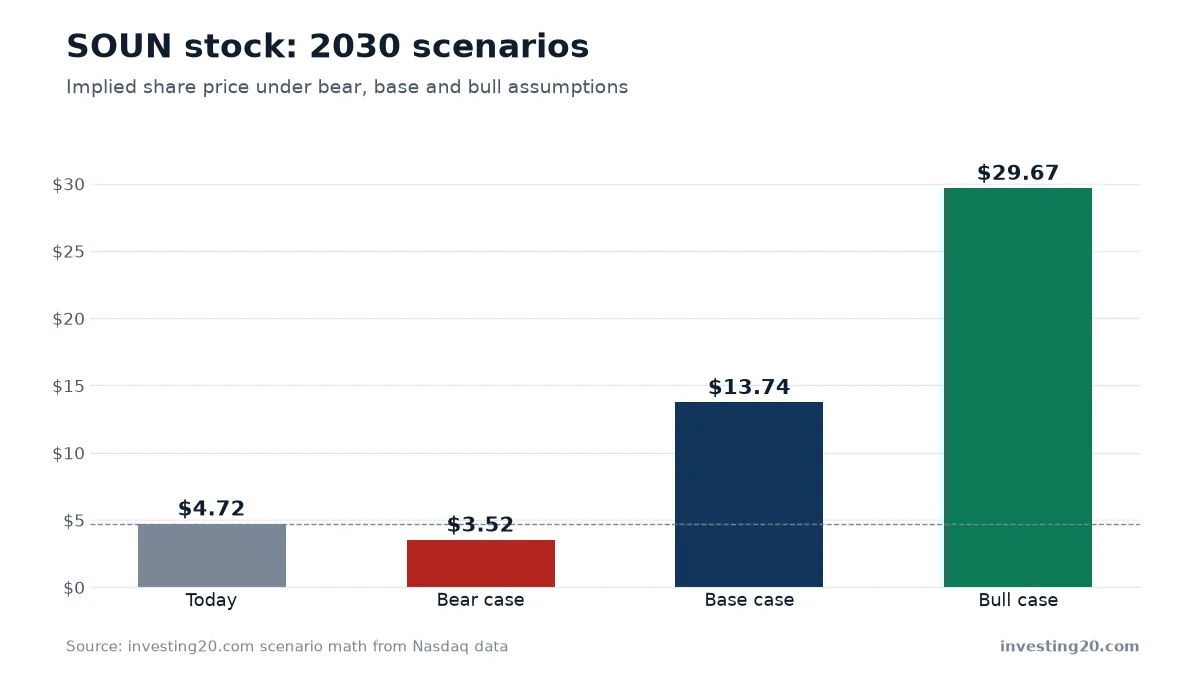
| Scenario | Revenue growth per year | 2030 revenue | Price-to-sales | Shares | Implied share price |
|---|---|---|---|---|---|
| Bear | 30% slowing to 5% | $381.4 million | 5.0× | 541 million | about $3.52 (-14%) |
| Base | 60% slowing to 15% | $701.7 million | 8.8× | 511 million | about $12.03 (+193%) |
| Bull | 90% slowing to 25% | $1.2 billion | 10.7× | 491 million | about $25.84 (+529%) |
Bear case
In the bear case, annual revenue growth slows quickly from 30% down to 5%, averaging roughly 17% per year. Total revenue reaches $381.4 million by 2030. Ongoing net losses force the company to issue equity, pushing the diluted share count up to 541 million. With market enthusiasm for specialized voice software cooling, the price-to-sales multiple drops to 5.0. Under these conditions, the implied share price falls to $3.52, representing a 14% decline from today’s price.
Base case
The base case assumes annual top-line growth begins around 60% and moderates to 15% over time, averaging 36% annually. Annual revenue reaches $701.7 million by 2030. Moderate share issuance to support operating expenses increases the share count to 511 million. Assuming the business commands a price-to-sales multiple of 8.8 as it nears cash-flow break-even, the implied share price rises to $12.03, offering a potential return of 193%.
Bull case
The bull case models aggressive expansion, with initial revenue growth of 90% tapering down to 25% a year (an average of 55% annually). Under this scenario, enterprise adoption across automotive and retail sectors elevates 2030 revenue to $1.2 billion. Stronger operational cash flows limit share count expansion to 491 million shares. A market valuation multiple of 10.7 times sales yields an implied share price of $25.84, representing a 529% gain.
The core takeaway from these soun stock predictions is that SoundHound’s long-term value depends entirely on its ability to scale revenue far beyond its current $203.2 million base. If sales growth decelerates too quickly, dilution and multiple compression can easily erase equity value.
For context on how other growth companies manage share dilution and market valuations over multi-year periods, review our Rocket Lab (RKLB) Stock Forecast.
Risks to weigh
Investors considering SoundHound AI should balance the growth potential against several clear risks:
- Continued net losses: The business lost $137.1 million over the past four quarters, and analysts expect negative annual earnings to persist through at least 2028.
- Shareholder dilution: Ongoing operating losses could require future capital raises, increasing share counts and diluting existing equity holders.
- Competition from big tech: Major platform providers with vast capital resources continue to develop proprietary voice and agentic AI models.
- High stock volatility: SoundHound shares have traded in a wide 52-week range between $3.88 and $15.68, demonstrating high sensitivity to market sentiment.
- Concentration in discretionary sectors: Revenue relies heavily on enterprise spending in sectors like automotive and hospitality, which can decline during economic downturns.
What to watch next
To track whether SoundHound AI is trending toward its base or bull scenarios, focus on quarterly revenue updates over the next year. Watch specifically for steady progress toward the $250 million annual revenue run rate.
Equally important will be management’s ability to reduce quarterly net losses. Reductions in operating expense growth relative to gross profit gains will signal whether the business model can generate positive cash flow before requiring additional equity financing.
FAQ
What is the 12-month soun stock forecast?
Wall Street analysts set an average 12-month price target of $8.30 for SoundHound AI, Inc, ranging from a low of $5.00 to a high of $16.00. That consensus represents a potential upside of about 102% from its early November 2026 trading price of $4.11.
What is the soundhound stock prediction for 2030?
Our long-term modeling projects a 2030 base-case price of $12.03, assuming revenue reaches $701.7 million. Under a bullish case with $1.2 billion in annual sales, the stock could reach $25.84, while a bear case suggests a decline to $3.52.
Is SoundHound AI profitable?
No, SoundHound AI remains unprofitable. Over the four reported quarters ending in mid-2026, the company recorded a net loss of $137.1 million, and analysts project continued annual losses through at least 2028.
What is the soundhound stock forecast based on sales growth?
SoundHound AI generated $203.2 million in revenue over the last four reported quarters after growing full-year sales by 99.4% in 2025. Future valuation depends heavily on whether the business can scale its automated voice services across automotive, restaurant, and enterprise sectors.
Market data: Nasdaq. Financials: Nasdaq. Scenario math: investing20.
This article is for information only and is not investment advice. Do your own research before investing.