Walt Disney Company (The) (DIS) Stock Forecast 2026–2030
An analysis of the DIS stock forecast through 2030, covering 12-month Wall Street targets, current revenue trends, and three long-term price scenarios.
On this page
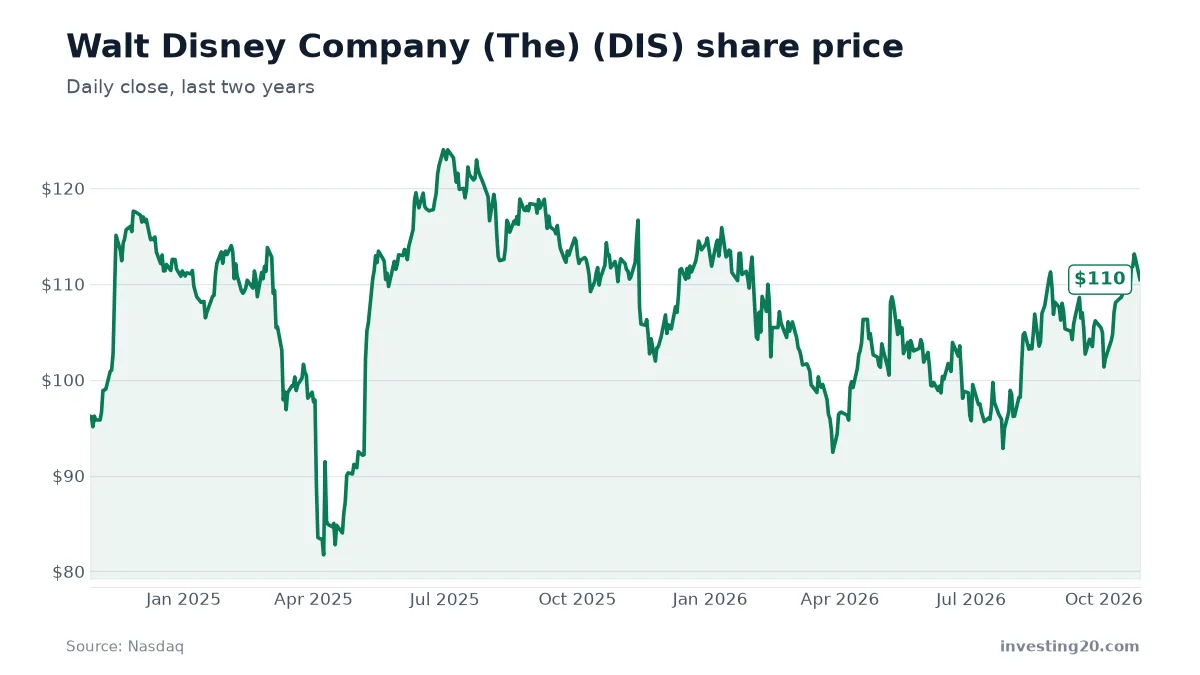
The Walt Disney Company trades around $110.45 per share, up about 15% from its level two years ago but well below its past highs. This walt disney stock forecast breaks down where the media giant stands today, what Wall Street expects over the next year, and how different growth rates could shape the DIS future stock price through 2030.
Long-range stock projections are not guarantees or precise predictions. They are scenario models that illustrate how revenue trends, profit margins, and valuation multiples might combine over a multi-year timeline.
| Share price | $110.45 (Oct 26, 2026 3:43 PM ET) |
| Market value | about $190.7 billion |
| 52-week range | $92.19 – $117.09 |
| Revenue, last 12 months | about $98.9 billion |
| Revenue growth, last fiscal year | 3% |
| Net income, last 12 months | about $8.6 billion |
| Price-to-sales | about 1.9× |
| Price-to-earnings | about 22× |
| Analyst 12-month target | average $128.53 (range $115 – $144); 18 buy, 1 hold, 0 sell |
Market data from Nasdaq as of October 26, 2026. Check current figures before making any decision.
What The Walt Disney Company does
Disney is an international entertainment enterprise organized into three primary operating segments: Entertainment, Sports, and Experiences.
The Entertainment division includes direct-to-consumer streaming services, theatrical film production and distribution, and legacy television networks. The Sports segment centers on ESPN and related sports content and distribution networks. The Experiences division operates Disney’s theme parks, resort properties, cruise line, and consumer products licensing.
Money flows in from streaming subscriptions, park admissions and hotel stays, television affiliate fees, advertising, box office receipts, and merchandise licensing fees.
Where the business stands today
Disney generated $98.9 billion in revenue over the last four reported quarters, maintaining a steady upward path in annual sales. Fiscal year 2023 revenue reached $88.9 billion, rising to $91.4 billion in fiscal year 2024 and $94.4 billion in the fiscal year ending September 27, 2025. That represents a top-line growth rate of 3.4% in its most recent full fiscal year.
Net income over the last four quarters came in at $8.6 billion, compared to $12.4 billion in fiscal year 2025 and $5.0 billion in fiscal year 2024. The stock trades at a price-to-earnings ratio of 22.2 and a price-to-sales multiple of 1.9 based on its $190.7 billion market capitalization.
Disney has consistently topped Wall Street earnings targets across its recent quarterly reports. For the quarter ending June 27, 2026, Disney reported diluted earnings per share of $2.06 against a consensus estimate of $1.88, a 9.57% beat. The three prior quarters also exceeded consensus estimates:
- Quarter ending March 28, 2026: EPS of $1.57 versus $1.49 expected.
- Quarter ending December 27, 2025: EPS of $1.63 versus $1.57 expected.
- Quarter ending September 27, 2025: EPS of $1.11 versus $1.03 expected.
Unlike rapid-growth technology companies covered in our Super Micro Computer stock forecast, Disney operates as an established media staple where profitability and cash generation take priority over exponential revenue expansion.
DIS stock forecast for the next 12 months
Wall Street analysts hold a constructive view on Disney over a one-year horizon. According to Nasdaq consensus data from 19 analysts, the average 12-month price target is $128.53, implying a potential gain of 16.4% from the current price of $110.45. The price target range spans from a low of $115.00 to a high of $144.00, with 18 analysts issuing buy ratings and 1 recommending a hold.
Earnings expectations call for steady per-share profit growth over the coming years:
- Fiscal year ending September 2026: EPS forecast of $6.92 (11 analysts).
- Fiscal year ending September 2027: EPS forecast of $7.48 (11 analysts).
- Fiscal year ending September 2028: EPS forecast of $8.18 (6 analysts).
To hit the top end of analyst targets near $144 over the next 12 months, Disney would need to demonstrate margin expansion in its direct-to-consumer streaming operations alongside stable attendance and spending in its theme parks division.
DIS stock future: three scenarios for 2030
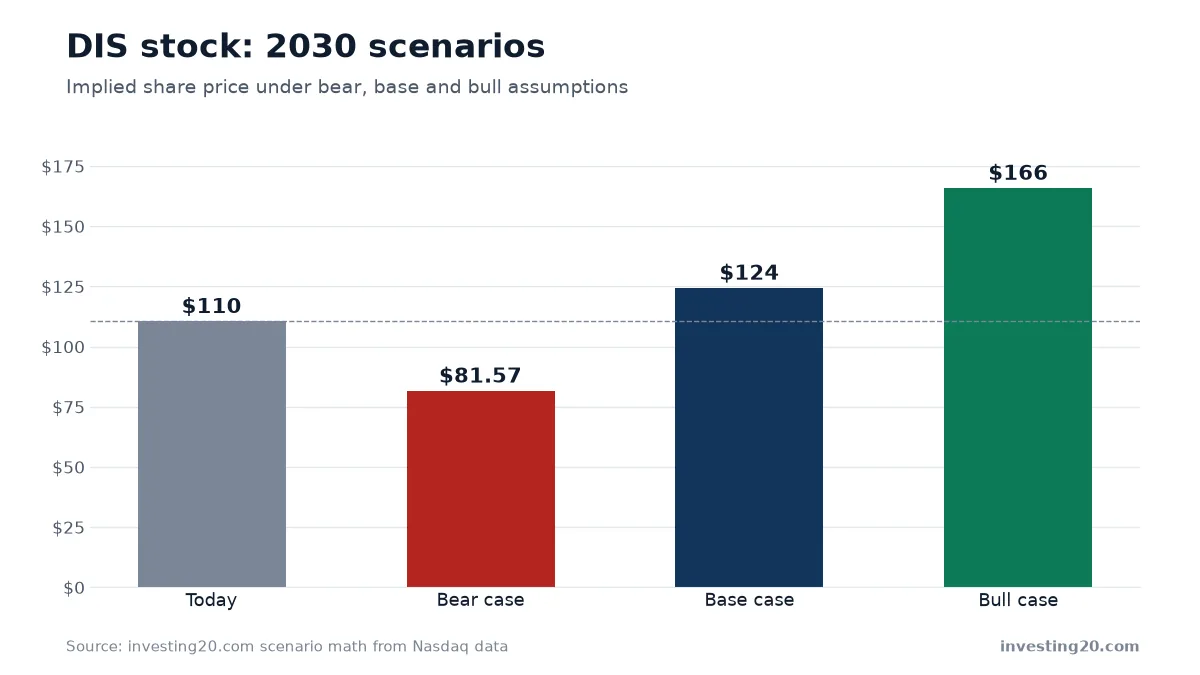
To evaluate the dis stock future through 2030, we examine three potential outcomes based on compounding revenue growth rates, modest changes in valuation multiples, and baseline share count assumptions.
| Scenario | Revenue growth per year | 2030 revenue | Price-to-sales | Shares | Implied share price |
|---|---|---|---|---|---|
| Bear | -1% | $95.0 billion | 1.5× | 1.80 billion | about $81.57 (-26%) |
| Base | 3% | $111.3 billion | 1.9× | 1.73 billion | about $124.31 (+13%) |
| Bull | 7% | $129.6 billion | 2.1× | 1.66 billion | about $165.79 (+50%) |
Base case
In the base case, Disney increases revenue by 3% per year, matching its recent top-line trajectory. Total revenue reaches $111.3 billion by 2030. Maintaining the current price-to-sales multiple of 1.9 and accounting for modest share repurchases that lower the share count to 1.73 billion, the share price reaches roughly $124.31, representing a 13% total return from today’s price.
Bull case
The bull case assumes Disney accelerates top-line growth to 7% annually through international theme park expansion, stronger streaming subscriber monetization, and higher media licensing revenue. Under this scenario, 2030 revenue reaches $129.6 billion. With the price-to-sales multiple expanding slightly to 2.1 and share buybacks reducing the share count to 1.66 billion, the stock reaches about $165.79, a 50% gain.
Bear case
The bear case reflects macro economic drag, cord-cutting acceleration in traditional television, and slower park spending, resulting in a 1% annual revenue decline to $95.0 billion by 2030. If the price-to-sales multiple drops to 1.5 and moderate dilution increases the share count to 1.80 billion, the implied stock price falls to $81.57, a 26% decline.
Break-even valuation
At the base-case price-to-sales multiple of 1.9, Disney needs to generate roughly $98.9 billion in annual revenue in 2030 to support today’s share price of $110.45. Because trailing 12-month revenue is already $98.9 billion, today’s stock price assumes the company can preserve its existing sales volume over the long term without structural revenue contraction.
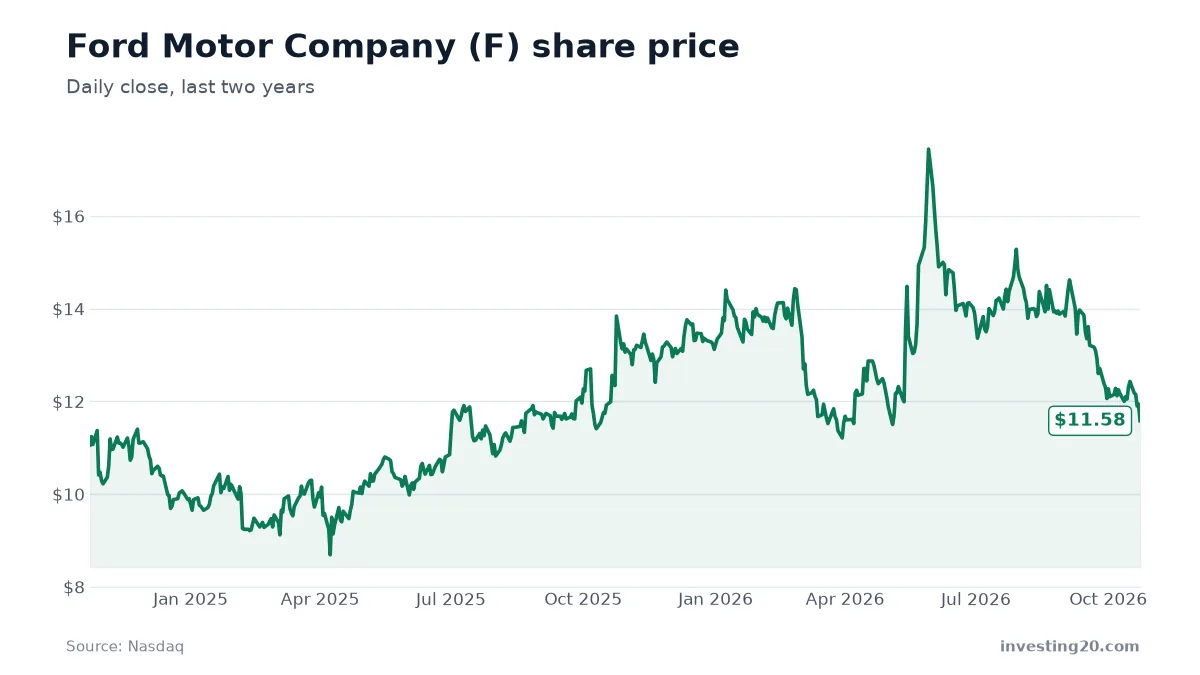
Investors evaluating multi-year holding periods across different market sectors may also want to review our Ford Motor Company stock forecast or our breakdown of Robinhood Markets stock predictions for comparisons on how mature and growth businesses trade relative to their sales multiples.
Risks to weigh
- Streaming competition and profitability: Direct-to-consumer streaming remains highly competitive, requiring heavy ongoing content investment to maintain subscriber retention.
- Linear television decline: Accelerated consumer cord-cutting continues to pressure traditional broadcast and cable network affiliate revenue.
- Consumer spending sensitivity: Theme park attendance, resort spending, and cruise bookings depend heavily on general consumer confidence and discretionary income levels.
- Capital allocation and balance sheet: Disney must manage significant capital spending across park expansions and content production alongside its existing debt burden.
What to watch next
Keep an eye on Disney’s upcoming quarterly earnings reports for updates on direct-to-consumer operating margins and subscriber metrics.
Watch ESPN’s transition progress toward direct-to-consumer distribution channels, as well as capital expenditure commentary regarding theme park investments and cruise ship additions over the coming fiscal years.
FAQ
What is the dis stock forecast for the next 12 months?
Wall Street analysts have an average 12-month price target of $128.53 on Disney stock, with estimates ranging from a low of $115.00 to a high of $144.00. Out of 19 analysts tracked by Nasdaq, 18 rate the stock a buy and 1 rates it a hold.
What is the walt disney stock forecast for 2030?
Under a base-case scenario assuming 3% annual revenue growth and a price-to-sales multiple of 1.9, Disney stock could reach roughly $124.31 by 2030. A bull case with 7% yearly growth implies $165.79, while a bear case with declining revenue yields $81.57.
What is the dis future stock price break-even level?
To maintain today's share price of $110.45 in 2030 at its current price-to-sales valuation of 1.9, Disney would need to generate approximately $98.9 billion in annual revenue, which matches its trailing 12-month sales total.
Market data and financials: Nasdaq. Scenario math: investing20.
This article is for information only and is not investment advice. Do your own research before investing.