Why Intel Stock Plunged 21% After Earnings
Intel stock plunged 21% after weak guidance and a PC market slump. Here is what the numbers mean for your tech investments and portfolio.
On this page
Intel shares plunged 21% in extended trading on October 29, 2026, after the company delivered fourth-quarter guidance that fell far short of Wall Street forecasts. If you own chip stocks or broad tech index funds, this sharp drop shows that artificial intelligence excitement cannot hide old-school hardware weakness forever.
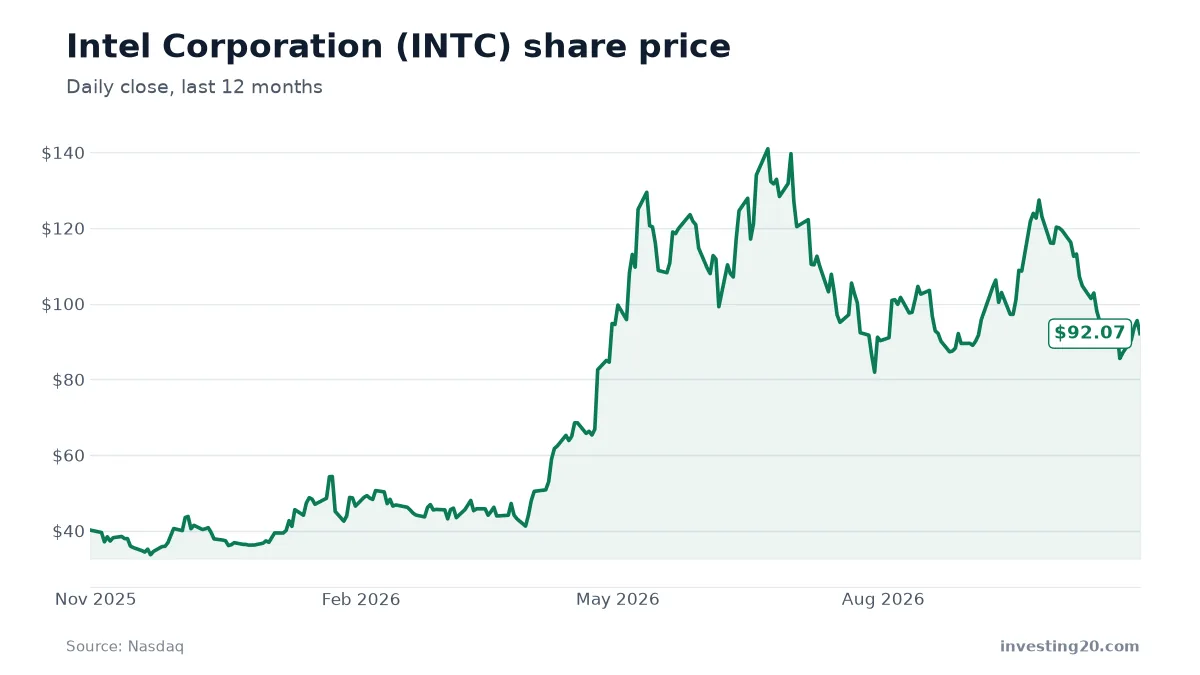
Before the selloff, Intel stock closed regular trading at $92.07 with a market valuation of $486.6 billion. The company had staged a massive run, gaining roughly 150% in 2026 through October before pulling back. Now, management is warning that a persistent slump in personal computer demand will drag on earnings well into the first half of 2027.
Here is a breakdown of what happened inside the numbers, why the PC business stumbled, and what it means for your portfolio.
The numbers behind the Intel earnings drop
Intel reported third-quarter revenue of $16.58 billion, climbing 21% from $13.7 billion during the same period last year. That looks respectable on the surface, but the underlying business showed sharp divides, and the outlook for the holiday quarter missed expectations across the board.
For the fourth quarter, Intel guided for adjusted profit of 25 cents per share on total revenue spanning $15 billion to $16 billion, according to CNBC. Consensus estimates compiled by LSEG had projected adjusted profit of 43 cents per share on $17.1 billion in sales.
| Metric | Q4 Company Guidance | Q4 Wall Street Consensus (LSEG) | Gap |
|---|---|---|---|
| Adjusted EPS | $0.25 | $0.43 | -$0.18 (-42%) |
| Quarterly Revenue | $15.0B – $16.0B | $17.1B | -$1.6B at midpoint (-9.4%) |
A major reason for the shortfall sits in Intel’s core consumer market. Sales inside the client computing and physical AI division slipped 5% year-over-year to $8.1 billion. That decrease dragged down an otherwise strong showing in data centers and AI, where sales surged 78% to reach $7.3 billion.
Adding to operational headwinds, Chief Financial Officer David Zinsner confirmed that a fatal explosion at an Intel fab in Israel will cost the company about $600 million in lost sales spread over two quarters. CEO Lip-Bu Tan said the tragic accident forced an extended shutdown that interrupted shipments of 10-nanometer processors.
Why is the PC market dragging Intel down?
For decades, Intel made the bulk of its money selling central processing units (CPUs) for desktop computers and laptops. While the market focuses heavily on graphics processing units (GPUs) from Nvidia for training AI models, ordinary personal computers remain Intel’s biggest revenue engine.
That engine is sputtering. Global PC shipments dropped 4% year-over-year in the second quarter, according to data from Counterpoint Research. MarketWatch reported that memory chip prices have surged, driving up the cost of finished hardware. When memory costs spike, laptop makers either raise prices or trim build volumes, and corporate IT departments hold off on upgrading hardware.
Zinsner was blunt on the post-earnings call: “We see the PC slowdown continuing at least through the first half of next year.”
Intel also faces internal delays. After completing a $23 billion equity offering in August, the company is still building out its manufacturing footprint. While Intel is in high-volume production of its 18A chip at its Arizona fab, it currently has no major external customers signed up. Structural construction on its flagship Ohio plant only recently began installing framing trusses, pushing high-volume output well past its initial 2025 target.
What this means for your tech investments
When a heavyweight like Intel drops more than 20% overnight, it ripples across the entire market. Futures on the tech-heavy Nasdaq-100 fell 1.7% Thursday evening, while S&P 500 futures slid 0.7%.
Tech investors should take away three specific lessons from this report.
First, pure AI demand does not insulate a company from cyclical hardware downturns. While agentic AI applications like Meta’s Muse and OpenAI’s Dots rely on Intel CPUs to direct tasks across servers, high cloud demand could not overcome the drop in consumer laptop buying. We have seen similar valuation pressure play out across the sector; look at our breakdown of the AI tech stock selloff and debt fears to see how capital expenses can test investor patience.
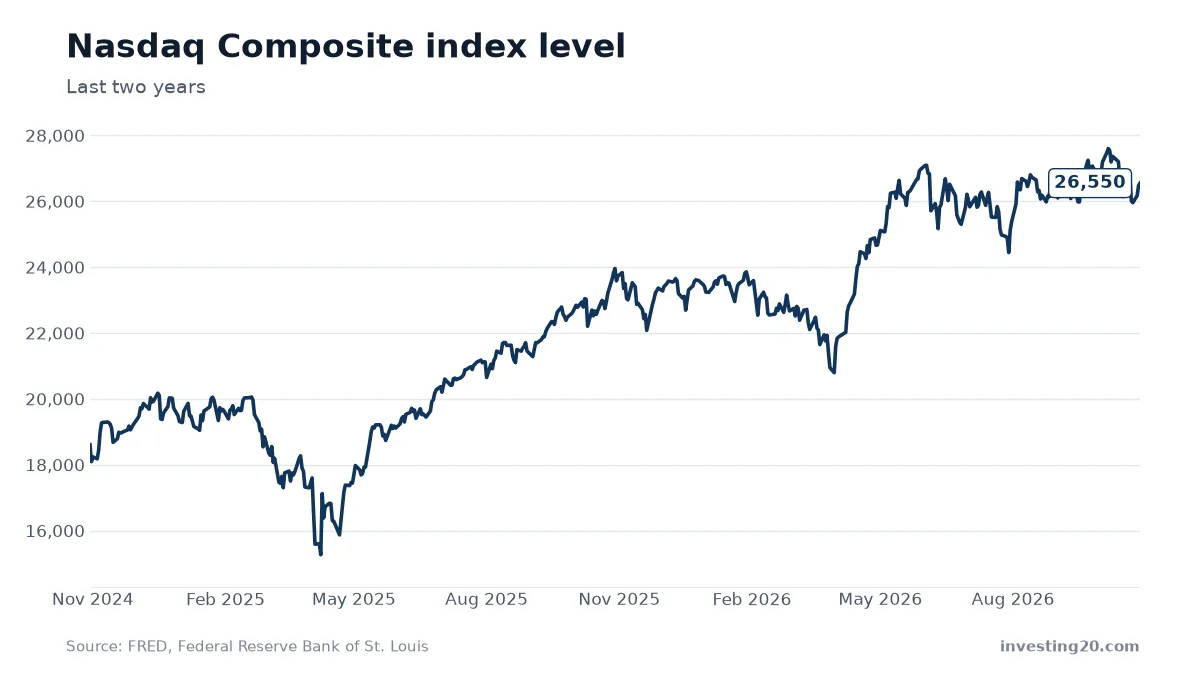
Second, the broader market rally is showing signs of fatigue. On October 28, the Nasdaq Composite sat at 26,549.85, down from its two-year high of 27,599.89 set earlier in the month, according to St. Louis Fed data. October has been a difficult month for tech names: Google parent Alphabet plunged 12% after missing estimates, and Amazon lost 6% in extended trading after posting negative free cash flow of $42.4 billion.
Third, company turnarounds require time and discipline. Tan replaced Pat Gelsinger and slowed down aggressive capital outlays, insisting Intel will not spend money without firm customer commitments. Buying a stock simply because it bounced off historical lows often leads to costly mistakes, something we examine in 5 reasons why people fail in the stock market. Intel has posted an aggregate net loss of $11.3 billion over its last four reported quarters, and its price-to-sales ratio sat at 8.5 before the post-earnings plunge.
What to do with your money now
If you own Intel inside a diversified index fund or 401(k), you do not need to panic. The S&P 500 is still up roughly 0.9% for October, standing near 7,743.98, and large index funds naturally absorb shocks from individual corporate earnings.
If you hold individual shares of Intel or are thinking about buying this dip, consider these steps:
- Check your exposure to hardware suppliers: Intel’s warning highlights softening consumer electronics spending. Component makers, memory suppliers, and PC brands could face lower orders over the next two quarters.
- Do not anchor to recent highs: Intel traded as high as $142.35 over the past 52 weeks. A stock falling from $142 to the low $70s in after-hours trading looks cheap only if future earnings recover. Wall Street’s consensus 2026 earnings estimate sat at $1.05 per share before this report, and analysts will likely revise those targets lower.
- Keep cash needs out of volatile single stocks: If you need cash for a down payment or tuition within the next two years, volatile turnaround plays in the chip sector carry too much single-company risk.
What to watch next
The semiconductor story will get much clearer over the next two weeks.
Advanced Micro Devices (AMD), Intel’s primary rival in PC and server CPUs, reports earnings next week. Watch whether AMD echoes Intel’s warnings about PC demand or captures market share at Intel’s expense.
Nvidia reports its results in mid-November. That report will show whether heavy cloud spending on AI hardware remains disconnected from the broader slowdown in everyday consumer electronics.
Finally, listen for updates on Intel’s foundry business over the next two quarters. Tan stated that Intel plans to announce external commercial customers for its advanced chips soon. Until those contracts materialize and PC inventory clears, Intel faces an uphill climb.
FAQ
Why did Intel stock drop 21% after earnings?
Intel issued fourth-quarter guidance that missed Wall Street targets, projecting adjusted profit of 25 cents per share on sales ranging from $15 billion to $16 billion. The chipmaker cited a prolonged downturn in personal computers and an estimated $600 million top-line hit following a fatal fab explosion in Israel.
How is the PC market affecting Intel?
Sales inside Intel's division for client computing and physical artificial intelligence slipped 5% compared to the prior year, reaching $8.1 billion in the third quarter. Counterpoint Research reported that worldwide PC shipments dropped 4% during the second quarter as climbing component and memory expenses pinched budgets.
Is Intel making money from artificial intelligence?
Yes, Intel's data center and AI segment grew 78% year-over-year to $7.3 billion in the third quarter. Agentic AI tools from Meta and OpenAI use Intel central processing units to manage cloud data, though this growth was not enough to offset weakness in consumer PCs and foundry delays.
Sources: Intel stock plunges 21% as chipmaker blames PC slowdown for weak guidance (CNBC); Intel plunges on a major guidance miss. What went wrong — and how to proceed (CNBC); Nasdaq-100 futures fall as Amazon and Intel swoon after earnings: Live updates (CNBC); Why Intel’s stock is sinking toward its worst drop in two years (MarketWatch).
Market data: Nasdaq; Economic data: FRED, Federal Reserve Bank of St. Louis
This article is for information only and is not investment advice. Do your own research before investing.