October Jobs Report Blows Past Forecasts: What It Means for Rates
The U.S. added 165,000 jobs in October as unemployment fell to 4.1%. Here is what hotter labor data means for Fed rate hikes and your portfolio.
On this page
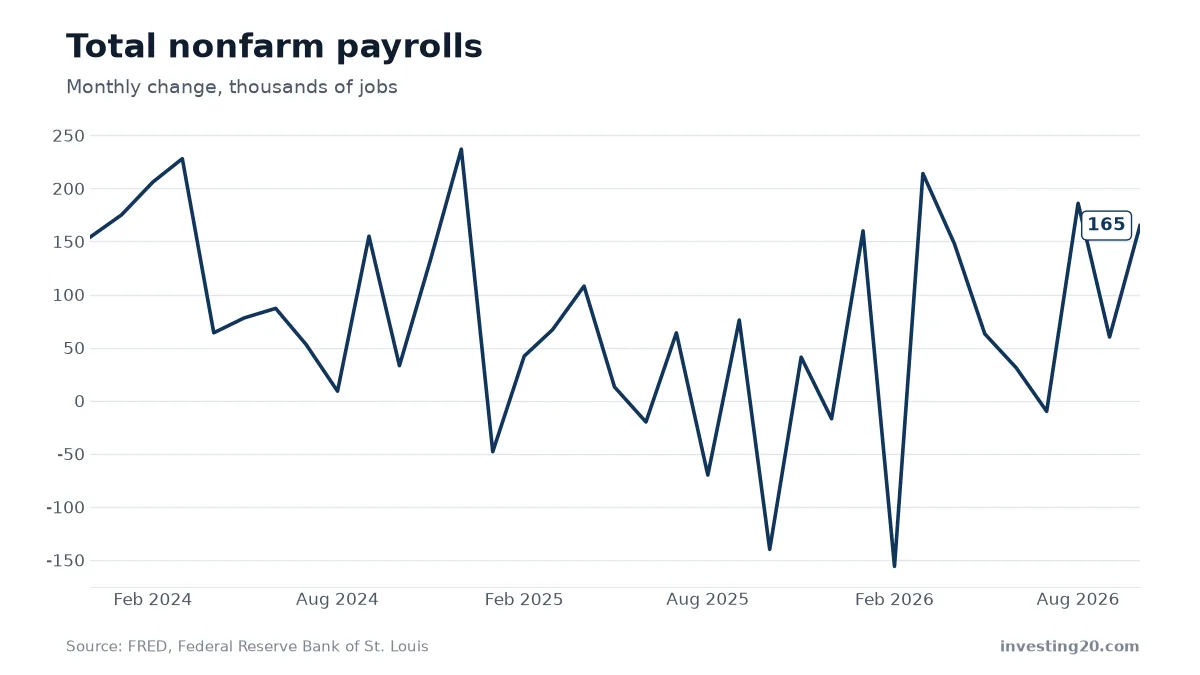
The U.S. economy added 165,000 jobs in October 2026, crushing Wall Street estimates and pushing the unemployment rate down to 4.1%. If you hold a retirement portfolio or money in cash, this surprise strength makes another Federal Reserve interest rate hike in December far more likely.
Forecasters expected a sleepy report, with consensus projections surveyed by Dow Jones at 59,000 and FactSet at 65,000. Instead, hiring accelerated sharply from earlier in the year. For everyday investors, good news for workers brings an uncomfortable complication: a stubbornly strong economy gives the central bank every reason to keep borrowing costs elevated to battle persistent inflation.
Here is a breakdown of the numbers, what drove the surprise, and what it means for your savings, loans, and investment accounts.
The numbers that matter from the October jobs report
The headline payroll beat was not the only surprise in the Bureau of Labor Statistics data released on Friday, November 6. The report showed broad hiring momentum alongside meaningful upward revisions to prior months.
| Metric | October 2026 Actual | Expected / Prior |
|---|---|---|
| Nonfarm Payrolls Added | 165,000 | 59,000 (Dow Jones est.) |
| Unemployment Rate | 4.1% | 4.2% (September) |
| Average Hourly Earnings (MoM) | 0.4% | 0.3% expected |
| Average Hourly Earnings (YoY) | 3.1% | 2.9% expected |
| August Payroll Revision | 186,000 | Up by +53,000 |
| September Payroll Revision | 60,000 | Up by +31,000 |
August and September payroll gains were revised up by a combined 84,000 jobs. That tells us late-summer hiring was sturdier than early estimates suggested. The labor force also expanded by 421,000 people, helping lift the labor force participation rate to 61.9%. Meanwhile, the household survey found 463,000 more individuals working.
The report also contained a few cracks. A broader gauge of joblessness that counts discouraged workers and those working part-time for economic reasons climbed 0.3 percentage point to 7.9%. Jobless Americans spent an average of 27.1 weeks looking for work, an increase of 2.3 weeks from September and the highest level seen since September 2021. Those out of work for longer than 27 weeks reached 1.96 million. While employers are reluctant to fire staff, those who lose a job are taking longer to find a new one.
Where the jobs came from
Unlike much of 2025, when payroll growth averaged just 10,000 jobs a month and was concentrated in healthcare, October’s gains showed healthy breadth across the private sector.
Professional and business services led the expansion, adding 70,000 positions. Healthcare followed with 42,000 new workers. Transportation and warehousing gained 25,000 jobs, while manufacturing added 19,000. On the flip side, NPR reported that restaurants and construction companies trimmed payrolls during the month.
Layoffs also remained subdued. Challenger, Gray & Christmas tracked under 44,000 layoffs in October, which marks a 71% decrease compared to October 2025. Employers appear to be holding onto staff, even as broader economic conditions stay challenging.
What this means for interest rates
The Federal Reserve held its benchmark rate steady at its late-October meeting, keeping the target range at 3.75% to 4.00% after hiking rates in September for the first time since 2023. You can read more about how policymakers reached this stance in our breakdown of the Fed rate decision update and borrowing costs.
Friday’s jobs numbers tilt the scales heavily toward another rate hike at the Federal Open Market Committee meeting on December 8-9. According to the CME Group’s FedWatch tool, traders raised the odds of a quarter-point increase to 76.8% shortly after the data crossed the wire.
The issue is inflation. Consumer price inflation rose to 3.7% in September, remaining well above the Fed’s 2.0% target. Much of that pressure has been driven by high energy costs, with crude and diesel markets strained by the war with Iran. Gas prices are roughly $1 a gallon higher than a year ago, while diesel sits 60% above prewar levels.
Because average hourly earnings climbed 0.4% in October (3.1% year over year), policymakers worry that solid wage growth will continue to feed into service prices. When combined with an unemployment rate sitting near historic lows, the central bank has little reason to ease borrowing costs.
What the jobs report means for your retirement portfolio
Market reactions on Friday showed higher Treasury yields across the board and a mixed open for equity futures. If you are managing your own portfolio or contributing to an IRA or 401(k), the backdrop creates two competing forces.
First, corporate earnings get a backstop from an active workforce. As Seema Shah, chief global strategist at Principal Asset Management, noted to CNBC, the data delivers a firm rebuttal to fears that the economy is sliding into a recession. A resilient consumer keeps business cash flows intact.
Second, persistent interest rates keep financial pressure on equity valuations. Tech stocks have already shown signs of strain, with the Nasdaq index recently dipping into correction territory over questions about heavy capital spending on artificial intelligence. We examined these pressures in our look at the AI tech stock selloff and debt fears. When risk-free Treasury yields sit high, investors are less willing to pay steep multiples for long-dated corporate earnings.
For everyday savers, the takeaway is straightforward:
- Cash and high-yield savings: Yields on certificates of deposit and high-yield accounts are likely to stay elevated well into 2027. If you have an emergency fund, you are still earning decent income on parked cash.
- Bonds: Rising Treasury yields mean bond prices take short-term hits, but newly purchased fixed-income assets offer stronger baseline yields.
- Equities: If you are building a diversified portfolio based on standard principles, such as those outlined in our guide to investing 101: what, why, and how much, a strong labor market is generally healthier over multi-year horizons than a recessionary slump. Volatility will remain elevated as markets price in Fed moves, but regular automated contributions help smooth out entry prices.
For household budgets, the tension remains real. While wage growth climbed to 3.1% annually, it still trails the 3.7% September inflation rate. Even with widespread job stability, the purchasing power of each paycheck continues to get squeezed by higher fuel and grocery tabs.
What to watch next
The Fed meets next on December 8-9. Between now and then, two main data releases will determine whether central bankers pull the trigger on another quarter-point rate increase.
The next Consumer Price Index report will show whether September’s energy-driven inflation spike is spilling into broader core categories. At the same time, keep an eye on November weekly jobless claims to see if October’s low layoff trend holds steady.
If inflation prints hot again alongside stable hiring, expect a December rate hike to become a certainty. If price pressures begin to cool, the Fed may choose to extend its pause into 2027. For now, plan on borrowing costs staying elevated for longer.
FAQ
What were the key numbers in the October jobs report?
The U.S. economy added 165,000 nonfarm payroll jobs in October 2026, easily beating consensus forecasts of 59,000 to 65,000. The unemployment rate nudged down to 4.1%, while prior payroll gains for August and September were revised up by a combined 84,000.
Will the Federal Reserve raise interest rates in December?
Following the strong jobs release, traders priced in roughly a 77% probability of a quarter-point rate hike at the Fed's December 8-9 meeting, according to the CME FedWatch tool. With annual inflation running at 3.7% in September, solid job growth gives central bankers more room to tighten policy.
How does the October employment data affect individual retirement accounts?
Higher Treasury yields pressure tech stocks and rate-sensitive assets, while corporate earnings benefit from a sturdy economy. For long-term retirement savers, the data suggests bond yields and cash returns will stay elevated, but stubborn inflation continues to eat away at purchasing power.
Sources: U.S. economy added 165,000 jobs in October, way more than expected; unemployment rate slips to 4.1% (CNBC); Employers added 165,000 jobs in October, soaring past expectations (CBS MoneyWatch); Hiring jumps: The economy added 165,000 jobs last month (NPR); US job growth exceeds expectations in October despite economic uncertainty (The Guardian).
Economic data: FRED, Federal Reserve Bank of St. Louis
This article is for information only and is not investment advice. Do your own research before investing.