BigBear.ai (BBAI) Stock Forecast 2026–2030: Long-Term Outlook
Read our BigBear.ai (BBAI) stock forecast through 2030. Explore revenue trends, Wall Street price targets, and three long-term valuation scenarios.
On this page
- What changed since our last update
- What BigBear.ai does: products, customers, and business model
- Where the business stands: revenue and losses
- BBAI stock forecast for the next 12 months
- BBAI stock forecast 2030: three long-term scenarios
- The bear case: prolonged headwinds
- The base case: steady contract expansion
- The bull case: strong adoption in defense and border security
- Risks to weigh
- What to watch next
- FAQ
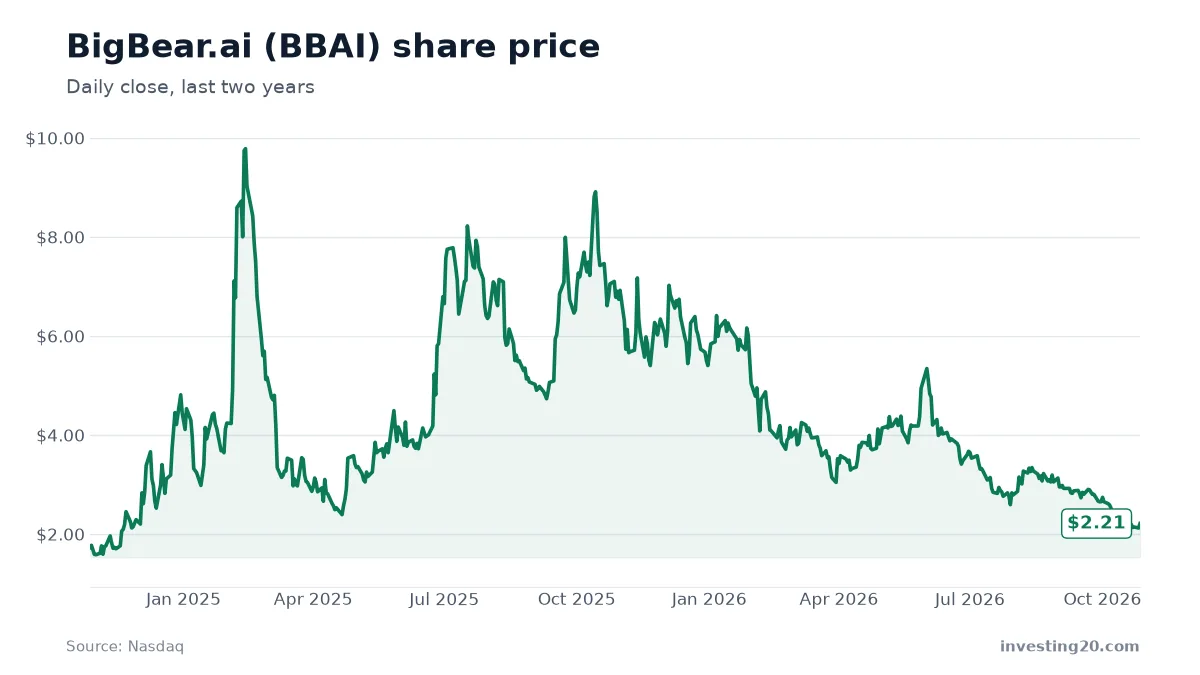
BigBear.ai (NYSE: BBAI) trades around $2.45, sitting near the lower end of its 52-week range as investors weigh defense AI demand against persistent net losses. If you are tracking the stock, this breakdown examines where the underlying business stands today, what Wall Street models over the next 12 months, and how different growth trajectories could shape its value by 2030.
Before reading any long-range projection, remember that multi-year stock forecasts are hypothetical scenarios rather than certain predictions. They are useful tools to test what today’s valuation implies about future revenue, dilution, and market sentiment, but they cannot guarantee how markets will price the stock years down the road.
| Share price | $2.45 (Nov 9, 2026 4:23 PM ET) |
| Market value | about $1.2 billion |
| 52-week range | $2.07 – $7.40 |
| Revenue, last 12 months | about $142.1 million |
| Revenue growth, last fiscal year | -19% |
| Net income, last 12 months | a loss of about $180.2 million |
| Price-to-sales | about 8.3× |
| Price-to-earnings | n/a (not profitable) |
| Analyst 12-month target | average $3.25 (range $3 – $4); 0 buy, 2 hold, 0 sell |
Market data from Nasdaq as of November 9, 2026. Check current figures before making any decision.
What changed since our last update
Since our October 27, 2026 update, BigBear.ai shares have risen 10.9% from $2.21 to $2.45. Over the same stretch, the average 12-month analyst target adjusted down from $4.00 to $3.25, while our modeled 2030 base-case target moved from $2.49 to $2.76. The tightening gap between the share price and analyst targets shows the market pricing in higher baseline expectations even as near-term Wall Street estimates turn more conservative.
What BigBear.ai does: products, customers, and business model
Headquartered in McLean, Virginia, BigBear.ai operates as a specialized security and defense technology company providing mission-ready artificial intelligence. The firm focuses primarily on two main areas: National Security and Trade & Travel.
The company builds and deploys AI-powered software, operational solutions, and analytic services designed to give strategic advantages to the United States government, foreign allies and partners, and select commercial clients in critical infrastructure. In practice, its technology aggregates complex operational data, identifies patterns, and helps commanders or agency personnel make real-time operational decisions.
Like many enterprise software firms serving government sectors, BigBear.ai generates revenue through a mix of software licenses, subscription tools, and multi-year consulting or systems integration contracts. Because government procurement cycles run long, revenue tends to land in large chunks tied to contract milestones rather than smooth monthly subscription streams.
Where the business stands: revenue and losses
BigBear.ai has experienced volatile top-line trends over the last three fiscal years. Full-year revenue stood at $155.2 million in 2023 and rose slightly to $158.2 million in 2024 before dropping 19.3% to $127.7 million in fiscal year 2025.
Recent quarterly performance shows signs of steady sequential recovery through 2026. The company posted $27.30 million in revenue for the quarter ending December 31, 2025, followed by:
- $34.44 million for the quarter ending March 31, 2026
- $36.75 million for the quarter ending June 30, 2026
- $43.58 million for the quarter ending September 30, 2026
Over the last four reported quarters, total revenue reached $142.1 million.
Despite top-line gains in recent quarters, profitability remains a challenge. BigBear.ai reported a net loss of $180.2 million over the trailing four quarters. While substantial, this represents a narrowing compared to annual net losses of $295.5 million in fiscal 2024 and $293.9 million in fiscal 2025.
On earnings performance, the company has matched or beaten consensus expectations throughout 2026. In the quarter ending March 2026, reported earnings per share came in at -$0.08, matching consensus estimates. The June 2026 quarter delivered an EPS beat at -$0.04 compared to a -$0.05 consensus, and the September 2026 quarter matched expectations at -$0.06.
Wall Street analysts track ongoing losses closely. The consensus EPS estimate calls for -$0.36 for the full fiscal year ending December 2026, narrowing to -$0.25 for fiscal year 2027.
BBAI stock forecast for the next 12 months
Looking at the near-term bbai price target data from Nasdaq, consensus sentiment is cautious. The two analysts covering the stock maintain hold ratings, with zero buys and zero sells.
The average 12-month bbai stock price target sits at $3.25, ranging from a low of $3.00 to a high of $3.50. Hitting that average target would represent an upside of approximately 32.7% from the current price of $2.45.
For the stock to achieve those levels, BigBear.ai will need to maintain its recent quarterly revenue momentum and avoid widening net losses. Investors tracking small-cap defense and software plays often look at alternatives like Rocket Lab (RKLB) Stock Forecast 2026–2030 or enterprise AI names like SoundHound AI, Inc (SOUN) Stock Forecast to see how capital allocation differs across emerging technology providers. Any unexpected loss of public agency contract renewals could cause analysts to push their targets back toward the $3.00 floor.
BBAI stock forecast 2030: three long-term scenarios
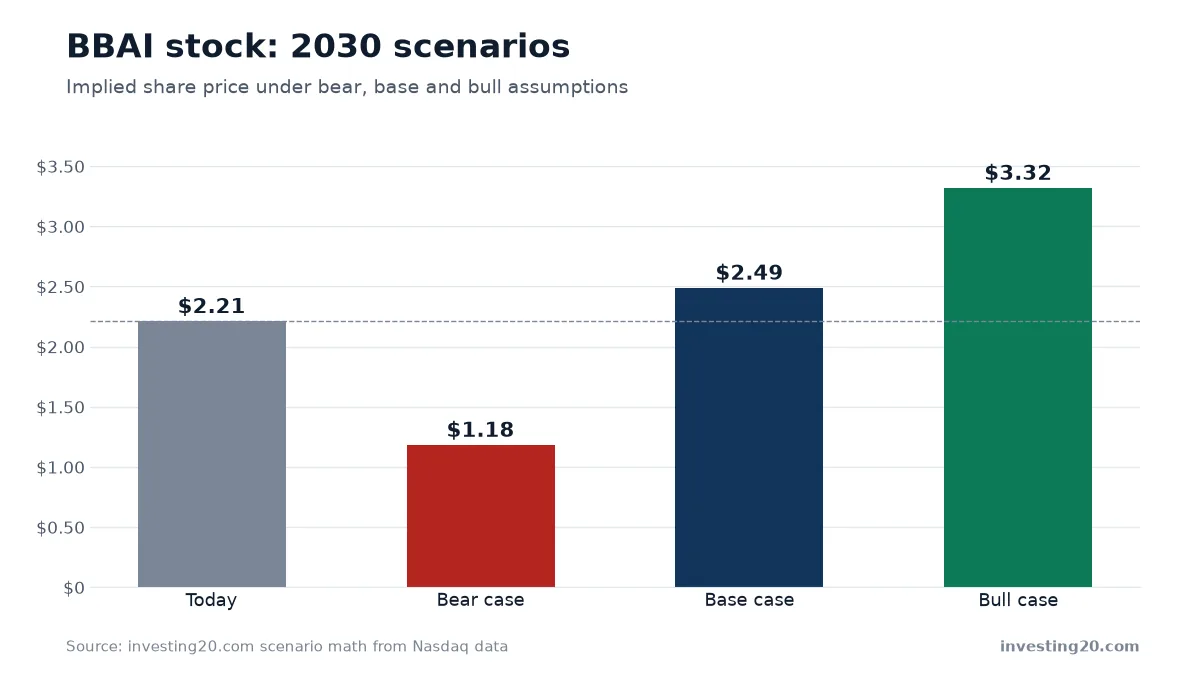
To project a long-term bbai stock prediction for 2030, we model three operating scenarios based on trailing revenue of $142.1 million. The methodology grows revenue at steady annual rates, applies realistic price-to-sales multiples reflecting company maturity, and adjusts for potential share dilution over time.
Today, BigBear.ai trades at a price-to-sales multiple of roughly 8.3. In our scenario model, break-even math shows that at the base-case multiple of 8.3 and a diluted share count of 480 million, BigBear.ai needs about $142.1 million in annual revenue by 2030 just to justify today’s $2.45 share price. That tells you the current price already assumes the company will sustain its current sales baseline without suffering long-term structural declines.
| Scenario | Revenue growth per year | 2030 revenue | Price-to-sales | Shares | Implied share price |
|---|---|---|---|---|---|
| Bear | -1% | $136.5 million | 5.0× | 500 million | about $1.36 (-44%) |
| Base | 3% | $159.9 million | 8.3× | 480 million | about $2.76 (+13%) |
| Bull | 7% | $186.2 million | 9.1× | 461 million | about $3.68 (+50%) |
The bear case: prolonged headwinds
In the bear case, annual revenue declines by an average of 1% per year through 2030, dropping top-line sales to $136.5 million. This could happen if federal defense spending shifts toward other programs or enterprise software budgets tighten. Assuming the price-to-sales multiple contracts to 5.0 and share dilution lifts total shares to 500 million, the implied share price drops to about $1.36. That represents a 44% decline from current levels.
The base case: steady contract expansion
The base case assumes BigBear.ai achieves modest, steady top-line growth averaging 3% annually, reaching $159.9 million in revenue by 2030. At a price-to-sales ratio of 8.3 and an estimated 480 million shares, the resulting implied share price is $2.76, an increase of about 13% from today. This scenario assumes that steady procurement wins offset existing contract expirations.
The bull case: strong adoption in defense and border security
In the bull case, expanding national security needs and adoption across travel security programs lift revenue by 7% per year, bringing 2030 revenue to $186.2 million. With higher market enthusiasm, the price-to-sales multiple expands slightly to 9.1. Factoring in modest dilution to 461 million shares, the modeled share price reaches $3.68, offering a 50% gain from current prices.
The core takeaway from these scenarios is that BigBear.ai’s valuation upside depends on turning recent quarterly progress into sustained annual growth while keeping dilution under control.
Risks to weigh
Before making any investment decisions, consider the key risks facing the company:
- Customer concentration and contract lumpiness: A heavy focus on national security and federal programs means revenue depends heavily on government budgeting cycles and contract awards.
- Ongoing cash burn: With trailing net losses of $180.2 million, BigBear.ai remains unprofitable, which may require capital raises that dilute common shareholders.
- Historical volatility: The stock has traded as low as $1.70 and as high as $9.78 over the past two years, reflecting high sensitivity to speculative market swings.
- Valuation sensitivity: At a price-to-sales ratio of 8.3, the stock trades at an elevated valuation multiple relative to its negative 19.3% revenue growth rate in fiscal 2025.
What to watch next
If you are following BigBear.ai, the primary metric to watch over the coming quarters is whether sequential revenue gains can translate into full-year top-line growth. Pay close attention to operating margins and cash usage in upcoming earnings reports to see if losses continue to narrow toward the consensus EPS estimate of -$0.25 in 2027. Tracking federal contract announcements in defense and travel security will also provide early clues about whether the company is pacing toward our base or bull trajectory.
FAQ
What is the 12-month BBAI stock price target?
According to Nasdaq consensus data as of November 9, 2026, the average 12-month analyst target is $3.25, with a low of $3.00 and a high of $3.50. That implies roughly 32.7% upside from the current share price of $2.45.
What is the BBAI stock forecast for 2030?
Our long-term scenario model projects an implied share price between $1.36 and $3.68 by 2030. The base case points to $2.76, assuming annual revenue grows by 3% to $159.9 million with a price-to-sales multiple of 8.3.
Is BigBear.ai profitable?
No, BigBear.ai operates at a loss. Over the last four reported quarters, the company generated $142.1 million in revenue alongside a net loss of $180.2 million.
Market data: Nasdaq. Financials: Nasdaq. Scenario math: investing20.
This article is for information only and is not investment advice. Do your own research before investing.