Hut 8 Corp. (HUT) Stock Forecast 2026–2030
Hut 8 Corp. stock forecast for 2026 to 2030. Explore revenue trends, Wall Street analyst price targets, and long-term valuation scenarios.
On this page
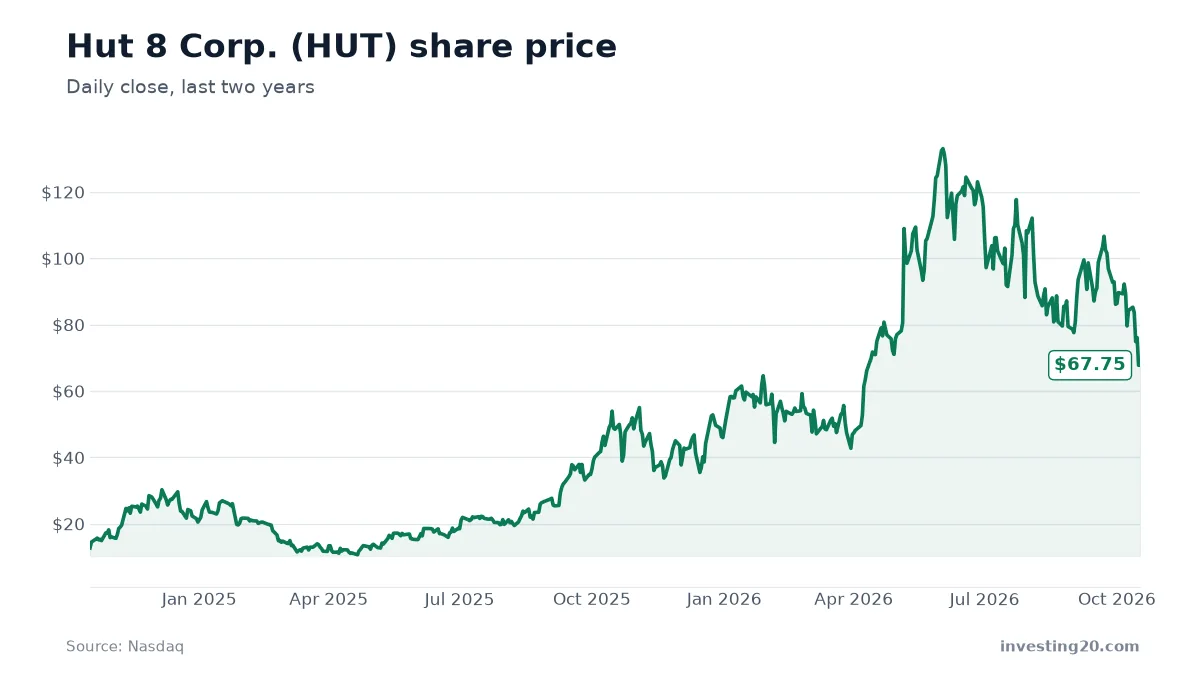
Hut 8 Corp. (HUT) trades around $45 per share as of November 5, 2026, down sharply from its 52-week high of $140.80. If you hold shares or are thinking about buying in, you want to know whether this energy and compute infrastructure company can turn its expanding scale into actual profits over the next few years.
This article breaks down where Hut 8 stands today, what Wall Street analysts expect over the next 12 months, and how three different long-term growth paths could shape the share price by 2030. Keep in mind that five-year stock forecasts are not promises or price predictions. They are valuation models designed to help you see what kind of growth today’s price already assumes.
| Share price | $45.32 (Nov 5, 2026 1:39 PM ET) |
| Market value | about $5.6 billion |
| 52-week range | $31.67 – $140.80 |
| Revenue, last 12 months | about $305.5 million |
| Revenue growth, last fiscal year | 45% |
| Net income, last 12 months | a loss of about $518.6 million |
| Price-to-sales | about 18.3× |
| Price-to-earnings | n/a (not profitable) |
| Analyst 12-month target | average $147.35 (range $92 – $275); 17 buy, 1 hold, 0 sell |
Market data from Nasdaq as of November 5, 2026. Check current figures before making any decision.
What changed since our last update
Since our last update on November 2, 2026, Hut 8’s share price dropped 17.7%, falling from $55.08 to $45.32. That drop came right around the company’s third-quarter earnings report on November 4, where reported loss per share came in wider than Wall Street expected.
Because the stock price fell, Wall Street’s average 12-month price target shifted slightly from $151.12 to $147.35. Our 2030 scenario prices moved down slightly as well to account for the updated valuation baseline, though the core long-term growth assumptions remain tied to how quickly Hut 8 builds out its energy and computing infrastructure.
What Hut 8 Corp. does
Hut 8 operates as an energy infrastructure platform that builds and manages large-scale power, digital infrastructure, and computing systems. The company focuses on hosting and running power-intensive technology workloads, including artificial intelligence applications, high-performance computing (HPC), and application-specific integrated circuit (ASIC) compute used in digital asset mining.
Instead of operating purely as a traditional data center provider, Hut 8 uses what it calls a power-first approach. It develops, commercializes, and manages industrial-scale energy assets to guarantee access to high-density electrical power. That power is then paired with specialized data center buildings and hardware designed to run continuous, heavy computing jobs.
The company earns revenue primarily by leasing out its infrastructure, offering compute capacity to technology clients, and running its own digital infrastructure operations. Its clients include businesses that need huge amounts of reliable power and specialized hardware to train AI models or execute intensive cryptographic calculations. Like other infrastructure providers benefiting from AI compute demand—a trend we also look at in our Super Micro Computer (SMCI) stock forecast—Hut 8 is betting that access to large-scale power will remain a scarce, valuable resource.
Where the business stands today
Hut 8 has grown its top-line revenue at a steady pace over the past three fiscal years. Revenue stood at $96.0 million for the year ending December 31, 2023, rose to $162.4 million in 2024, and reached $235.1 million in 2025. That represents a 44.8% growth rate in 2025. Over the last four reported quarters, total revenue reached $305.5 million.
Here is how quarterly revenue looked across the most recent periods:
- Quarter ending Dec 31, 2025: $88.49 million
- Quarter ending Mar 31, 2026: $71.02 million
- Quarter ending Jun 30, 2026: $74.93 million
- Quarter ending Sep 30, 2026: $71.07 million
While top-line sales have expanded, profitability remains a major challenge. Over the last four quarters combined, Hut 8 lost $518.6 million. In the fiscal year ending December 31, 2025, net losses were $226.1 million, compared to net income of $331.9 million in fiscal year 2024.
Earnings results over the past year have been volatile compared to Wall Street estimates:
- Quarter ending Dec 2025 (reported Feb 25, 2026): Reported EPS of $0.36 versus consensus estimates of $-0.12 (a positive surprise of 400.0%).
- Quarter ending Mar 2026 (reported May 6, 2026): Reported EPS of $-0.12 versus consensus estimates of $-0.28 (a positive surprise of 57.14%).
- Quarter ending Jun 2026 (reported Aug 4, 2026): Reported EPS of $-0.26 versus consensus estimates of $-0.50 (a positive surprise of 48.0%).
- Quarter ending Sep 2026 (reported Nov 4, 2026): Reported EPS of $-1.23 versus consensus estimates of $-1.06 (a 16.04% negative surprise).
Analyst consensus estimates collected by Nasdaq show expected annual losses per share of $-2.93 for fiscal year 2026, $-6.23 for 2027, and $-10.43 for 2028. The company is spending heavily to secure power and expand facilities, which boosts sales but keeps near-term bottom-line figures deep in the red.
What analysts expect over the next 12 months
Despite recent earnings losses, Wall Street analysts maintain a overwhelmingly positive stance on the stock. Among 18 analysts tracking the company on Nasdaq, 17 rate it a Buy, 1 rates it a Hold, and 0 rate it a Sell.
The average 12-month price target is $147.35, which implies an upside of 225.1% from the current price of $45.32. The lowest target among analysts sits at $92.00, while the highest target reaches $275.00.
For the stock to hit those targets over the next year, Hut 8 would need to prove that its high-performance compute and AI hosting partnerships can generate higher profit margins. Investors would also need to see evidence that capital expenditures on energy assets are slowing down relative to incoming cash flow. It’s important to remember that analyst targets cover a short 12-month period, whereas building high-density energy infrastructure often takes several years to deliver full returns. If you want to compare how Wall Street treats other high-growth tech stories, see our breakdown of SoundHound AI (SOUN) stock prospects.
HUT stock forecast for 2030: three scenarios
To look out to 2030, we use a clear valuation framework. We start with Hut 8’s last-four-quarter revenue of $305.5 million, project revenue growth out to 2030 under three different rates, apply a price-to-sales multiple, and divide by an adjusted share count that factors in potential dilution from capital raises.
Today, Hut 8 trades at a price-to-sales multiple of 18.3. As fast-growing infrastructure companies mature, their price-to-sales multiples typically compress. At today’s price of $45.32, our model shows that Hut 8 needs about $592.9 million in annual revenue by 2030 (under base-case multiple and share count assumptions) just to sustain its current valuation.
| Scenario | Revenue growth per year | 2030 revenue | Price-to-sales | Shares | Implied share price |
|---|---|---|---|---|---|
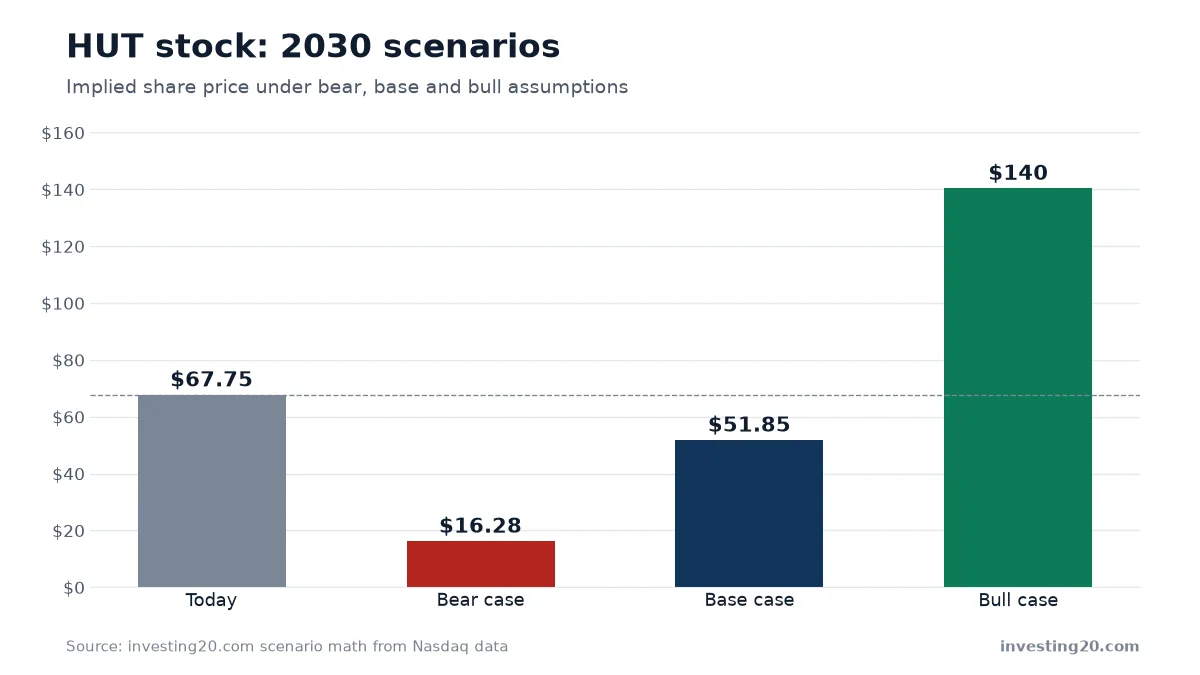
| Bear | 13% slowing to 5% | $434.0 million | 5.0× | 139 million | about $15.64 (-65%) |
| Base | 27% slowing to 15% | $651.8 million | 10.0× | 131 million | about $49.82 (+10%) |
| Bull | 40% slowing to 25% | $942.6 million | 18.0× | 126 million | about $134.93 (+198%) |
Bear case
In the bear case, annual revenue growth slows quickly from 13% down to 5% per year (averaging about 9% annually). By 2030, revenue reaches $434.0 million. If power demand for high-performance compute cools off or construction delays stall facility rollouts, the market might value the company at a mature price-to-sales multiple of 5.0×. Assuming dilution pushes the share count to 139 million, the implied share price would be about $15.64, representing a 65% drop from today’s price.
Base case
In the base case, revenue growth starts at 27% and slows to 15% per year (averaging roughly 21% annually), bringing total revenue to $651.8 million by 2030. If Hut 8 steadily expands its energy contracts and secures hosting customers, the stock might trade at a price-to-sales multiple of 10.0×. With a share count of 131 million, the implied share price comes out to $49.82, a 10% gain over today’s $45.32.
Bull case
In the bull case, AI compute demand remains strong, allowing Hut 8 to grow revenue at 40% initially before settling at 25% annually (averaging about 33% per year). Under this path, 2030 revenue reaches $942.6 million. If the market continues to pay a premium valuation of 18.0× price-to-sales and the share count is limited to 126 million, the implied share price reaches $134.93, a 198% return from current levels.
Key takeaway
The main takeaway from these scenarios is that today’s valuation of $45.32 already prices in substantial future expansion. For long-term investors to see strong gains, Hut 8 must not only deliver steady top-line growth but also prove it can convert energy capacity into profitable, long-term contracts.
Risks to weigh
Before adding HUT to a portfolio, consider the main operational and market risks:
- Heavy net losses: Hut 8 lost $518.6 million over the past four reported quarters, and analyst consensus points toward continuing net losses through 2028.
- Dilution risk: Building industrial-scale energy and compute facilities requires heavy capital. Issuing new equity to fund growth can dilute existing shareholders over time.
- High baseline multiple: Trading at 18.3 times sales, the stock has little room for error if quarterly revenue growth misses expectations.
- Volatility in target markets: Demand for ASIC compute and high-performance hosting can shift rapidly depending on broader technology trends and digital asset market conditions.
- Execution delays: Securing power grid interconnections and completing specialized data centers often involve regulatory delays and construction overruns.
What to watch next
The main number I’d watch over the next few quarters is quarterly revenue growth relative to operating losses. Look closely at whether Hut 8 can stabilize its net margins as new compute facilities come online.
Keep an eye out for official announcements regarding new power interconnect agreements or long-term high-performance compute contracts. Monitoring how management funds its upcoming capital expenses will tell you whether shareholder dilution remains a major factor heading into 2027.
FAQ
What is the 12-month target price for Hut 8 stock?
According to Nasdaq consensus analyst data as of November 5, 2026, the average 12-month price target for Hut 8 is $147.35, with a low target of $92.00 and a high of $275.00.
Is Hut 8 Corp. profitable right now?
No, Hut 8 is not currently profitable. Over the last four reported quarters ending September 30, 2026, the company generated a net loss of $518.6 million on $305.5 million in revenue.
What is Hut 8's revenue growth rate?
Hut 8 reported revenue of $235.1 million for the fiscal year ending December 31, 2025, which was up 44.8% from $162.4 million in 2024.
Market data and financials: Nasdaq. Scenario math: investing20.
This article is for information only and is not investment advice. Do your own research before investing.