IonQ (IONQ) Stock Forecast 2026–2030: Long-Term Outlook
IonQ stock forecast for 2026 to 2030. See Wall Street price targets, revenue growth scenarios, valuation multiples, and what must happen for shares to rise.
On this page
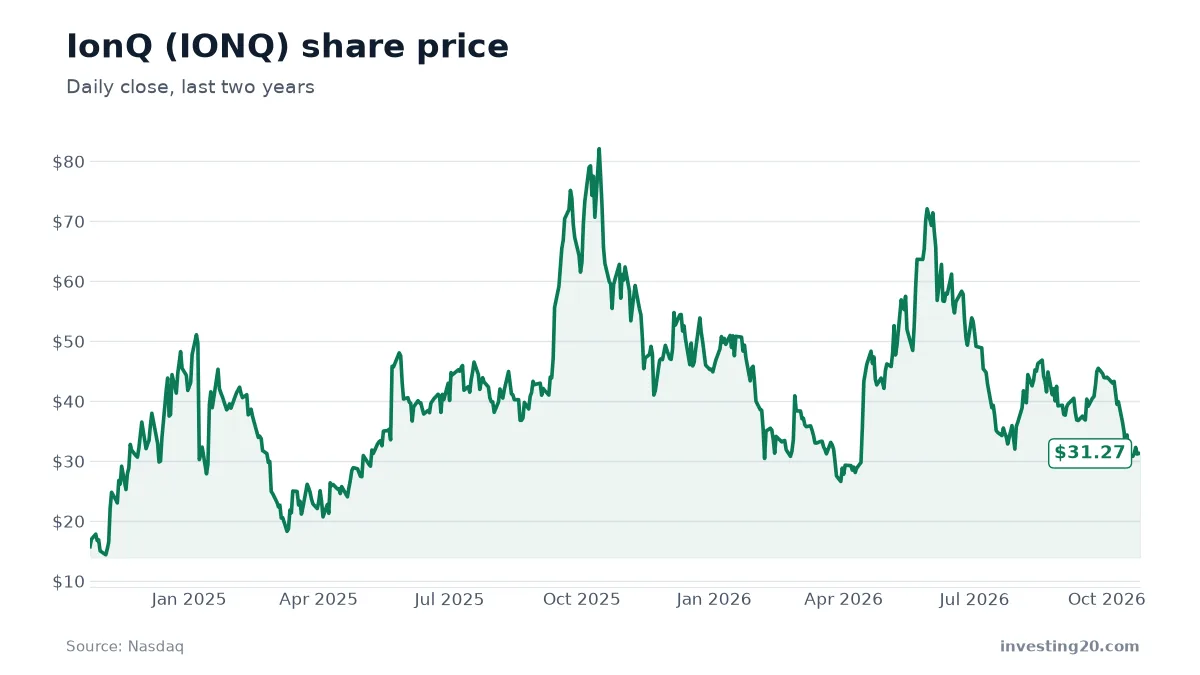
IonQ (IONQ) stock forecast articles tend to swing between breathless hype and outright dismissal. This one aims for the middle: a look at what the numbers say today, what analysts expect over the next year, and three plausible paths to 2030. Long-range forecasts are scenarios, not predictions. They show what has to happen for the stock to be worth more or less than today’s price.
The company builds trapped-ion quantum computers and sells access through cloud platforms. Revenue has grown fast but the stock has pulled back sharply from its 2025 high. Below are the key figures, what changed since our last update, and the cases for where IONQ could go.
| Share price | $24.52 (Nov 17, 2026 2:44 PM ET) |
| Market value | about $11.3 billion |
| 52-week range | $24.91 – $73.65 |
| Revenue, last 12 months | about $380.4 million |
| Revenue growth, last fiscal year | 202% |
| Net income, last 12 months | about $255.2 million |
| Price-to-sales | about 29.8× |
| Price-to-earnings | about 44× |
| Analyst 12-month target | average $57.08 (range $40 – $70); 10 buy, 1 hold, 0 sell |
Market data from Nasdaq as of November 17, 2026. Check current figures before making any decision.
What changed since our last update
- Share price fell from $32.55 to $24.52, a 24.7% drop since November 7, 2026.
- The bear-case implied price moved from $10.55 to $9.32, the base case from $49.61 to $43.82, and the bull case from $235.02 to $207.62.
- The average analyst 12-month target stayed at $57.08.
- The moves reflect the lower starting price and slightly different revenue and share-count inputs; the scenario logic hasn’t changed.
What IonQ does
IonQ builds quantum computers that use trapped ytterbium ions as qubits. The company calls its newest system Superion. It doesn’t sell the hardware outright to most customers. Instead, it runs the machines in its own data centers and sells compute time through Amazon Web Services, Microsoft Azure, and Google Cloud. It also builds dedicated systems for a handful of partners.
Customers include AstraZeneca for drug discovery, NVIDIA for quantum simulation, and various defense and financial firms. Revenue comes from cloud access fees, custom system contracts, and professional services. The company description from Nasdaq says its earlier systems helped customers achieve a 20x performance increase over previous quantum solutions. In 2025, IonQ reported 99.99% two-qubit gate fidelity, a world record for this metric.
Where the business stands
Revenue has accelerated each quarter through 2026. The quarter ending September 30, 2026 brought $173.83 million, up from $80.05 million in June and $64.67 million in March. The December 2025 quarter was $61.89 million. For the full fiscal year 2025, revenue reached $130.0 million versus $43.1 million in 2024 and $22.0 million in 2023. That’s 202% year-over-year growth.
The trailing twelve-month revenue is $380.4 million. Net income over the same period shows $255.2 million, but that figure includes a large one-time gain. The underlying business lost $510.4 million in fiscal 2025 and $331.6 million in 2024. The price-to-sales ratio is 29.8 based on trailing revenue. The price-to-earnings ratio of 44.5 uses the GAAP net income number, which is distorted by that one-time item.
Recent earnings surprises have been mixed. The September 2026 quarter beat estimates by 15% (EPS -$0.67 vs -$0.79 consensus). The June quarter missed by 22% and the March quarter missed by 33%. The December 2025 quarter showed a massive positive surprise of 502%, driven by the one-time gain. Consensus EPS forecasts call for losses of $2.87 in 2026, $2.66 in 2027, and $3.08 in 2028.
IONQ stock forecast for the next 12 months
Eleven analysts cover the stock. Ten rate it a buy, one a hold, zero sells. The average 12-month price target is $57.08, with a range of $40 to $70. That average sits 132.8% above the current $24.52.
For the stock to reach the average target, a few things need to happen. Revenue must keep growing at a triple-digit pace. The market must stay willing to pay a high multiple for quantum exposure. And the share count must not balloon from stock-based compensation or capital raises. The current price-to-sales of 29.8 already prices in a lot of success. If growth slows or sentiment shifts, the multiple could compress fast.
Analyst targets are for 12 months. Our 2030 scenarios use a different method: project revenue forward, apply a mature-company multiple, and divide by a diluted share count. Don’t compare the two as if they were the same horizon.
IONQ stock forecast for 2030: three scenarios
The model starts from trailing revenue of $380.4 million, grows it at a yearly rate that slows over time, applies a price-to-sales multiple that falls toward mature-company levels, and divides by a share count that accounts for dilution. Today’s multiple is 29.8. The bear case uses 5.0, base 10.0, bull 18.0. Break-even at the base-case multiple and share count requires about $1.2 billion of 2030 revenue for the stock to be worth today’s $24.52.
| Scenario | Revenue growth per year | 2030 revenue | Price-to-sales | Shares | Implied share price |
|---|---|---|---|---|---|
| Bear | 50% slowing to 5% | $970.7 million | 5.0× | 521 million | about $9.32 (-62%) |
| Base | 100% slowing to 15% | $2.2 billion | 10.0× | 491 million | about $43.82 (+79%) |
| Bull | 182% slowing to 25% | $5.4 billion | 18.0× | 472 million | about $207.62 (+747%) |
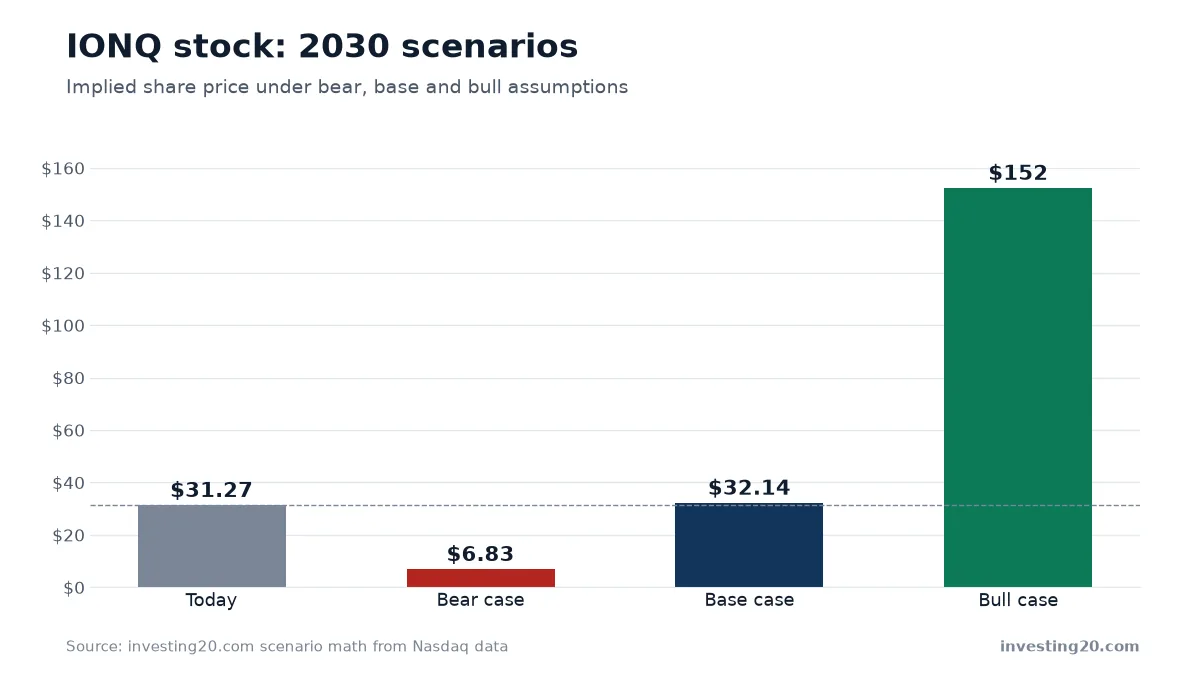
Bear case: Revenue grows 50% next year, slowing to 5% by 2030, averaging 26% annually. That gets to $970.7 million in 2030. At 5.0 times sales and 521 million shares, the implied price is about $9.32, down 62% from today. This assumes quantum stays niche, competition erodes IonQ’s position, and the market re-rates the stock like a hardware vendor with slowing growth.
Base case: Revenue grows 100% next year, slowing to 15% by 2030, averaging 54% annually. That reaches $2.2 billion in 2030. At 10.0 times sales and 491 million shares, the implied price is about $43.82, up 79%. This assumes IonQ keeps a technology lead, cloud demand scales steadily, and the market values it like a high-growth enterprise software company.
Bull case: Revenue grows 182% next year, slowing to 25% by 2030, averaging 95% annually. That hits $5.4 billion in 2030. At 18.0 times sales and 472 million shares, the implied price is about $207.62, up 747%. This assumes quantum computing breaks into broad commercial use, IonQ captures a large share, and the market keeps a premium multiple.
The main takeaway: today’s price sits between the bear and base cases. You’re paying for a high probability of base-case outcomes or better. If you think quantum computing is the next compute platform, the base and bull cases are plausible. If you think it stays a research tool, the bear case is more likely.
Risks to weigh
- Quantum computing may remain in the research and pilot phase for years longer than bulls expect
- Well-funded competitors include IBM, Google, Microsoft, and startups like Rigetti and Quantinuum
- IonQ has never posted an annual operating profit; the path to profitability is unclear
- Stock-based compensation and potential capital raises could dilute shareholders beyond the model’s assumptions
- The trapped-ion approach has scaling challenges; other modalities (superconducting, photonic, neutral atom) could win
- Government funding shifts could affect defense and research revenue
- High short interest and volatile trading can disconnect the stock from fundamentals for long periods
What to watch next
- Quarterly revenue growth rate: is the triple-digit pace holding or decelerating?
- Gross margins on cloud access vs. custom systems: shows the long-term profit potential
- Customer announcements: new names and expanded deals signal demand traction
- Fidelity and qubit count roadmap: technical milestones that validate the trapped-ion approach
- Analyst estimate revisions: the consensus EPS forecasts are only from one or two analysts, so they can move sharply
- Share count changes: watch the quarterly 10-Q for dilution from equity grants
For more on how we build these scenarios, see our Rocket Lab (RKLB) Stock Forecast 2026–2030: Long-Term Outlook and NIO Stock Forecast and Price Prediction 2026–2030: Bull, Base and Bear Cases.
FAQ
What is the IonQ stock forecast for 2026?
Analysts' average 12-month price target is $57.08, which is 132.8% above the November 17, 2026 price of $24.52. The consensus EPS forecast for fiscal 2026 is a loss of $2.87 per share.
What is the IonQ price target for 2030?
Our three scenarios for 2030 imply share prices of about $9.32 (bear), $43.82 (base) and $207.62 (bull). These are model outputs based on revenue growth and valuation assumptions, not predictions.
Is IonQ stock a good long-term investment?
IonQ revenue grew 202% in the last fiscal year to $380.4 million over the trailing four quarters. The stock trades at 29.8 times sales. Whether it's a good investment depends on whether quantum computing reaches commercial scale and IonQ keeps its technology lead.
What are the main risks for IonQ stock?
Key risks include: quantum computing may stay in research phase longer than expected; competition from IBM, Google, and startups; continued net losses with no clear path to profitability; and share dilution from stock-based compensation and capital raises.
How does IonQ make money?
IonQ sells access to its quantum computers through cloud platforms like Amazon Web Services and Microsoft Azure, and builds custom systems for customers in drug discovery, materials science, financial modeling, logistics, cybersecurity, and defense.
Market data: Nasdaq. Financials: Nasdaq. Scenario math: investing20.
This article is for information only and is not investment advice. Do your own research before investing.