Gran Tierra Energy (GTE) Stock Forecast: 2026–2030 Scenarios
An honest look at Gran Tierra Energy (GTE) stock forecast through 2030. Explore analyst price targets, revenue trends, and realistic bull, base, and bear models.
On this page
Gran Tierra Energy Inc. (AMEX: GTE) is executing a major corporate transition, moving from its traditional South American producing footprint toward assets in Canada and Azerbaijan. If you own the stock or are tracking international oil and gas producers, you want to know how that geographic shift and recent quarterly losses affect the company’s valuation through the end of the decade.
This forecast outlines Gran Tierra’s operational footing, recent financial results, and realistic 2026 to 2030 valuation pathways. Long-range forecasts are not concrete predictions or guaranteed share prices; they are mathematical scenarios that show what has to go right with revenue, profit margins, and share counts to support a given stock price.
| Share price | $9.28 (Nov 6, 2026 2:45 PM ET) |
| Market value | about $328.3 million |
| 52-week range | $3.73 – $11.94 |
| Revenue, last 12 months | about $638.4 million |
| Revenue growth, last fiscal year | -4% |
| Net income, last 12 months | a loss of about $255.4 million |
| Price-to-sales | about 0.5× |
| Price-to-earnings | n/a (not profitable) |
| Analyst 12-month target | average $12.96 (range $12 – $14); 2 buy, 1 hold, 0 sell |
Market data from Nasdaq as of November 6, 2026. Check current figures before making any decision.
What changed since our last update
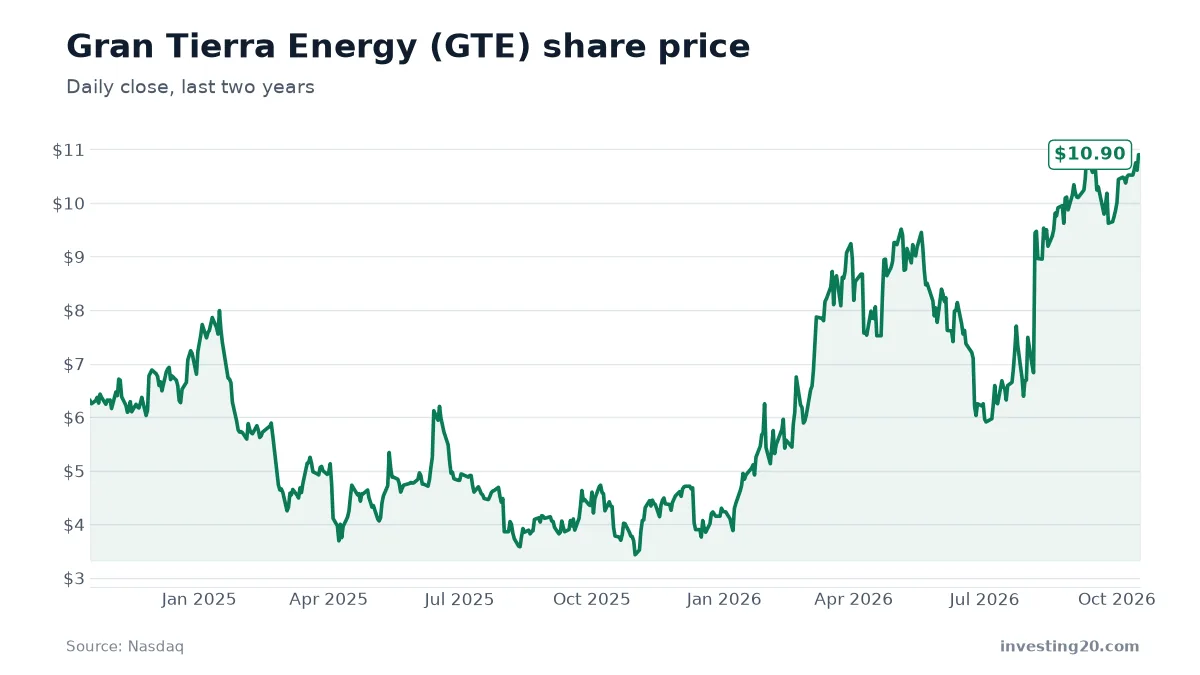
Gran Tierra shares dropped 14.9% from $10.90 on October 17, 2026, to $9.28 on November 6, 2026. This decline followed a third-quarter earnings report that missed consensus expectations.
Because of the lower starting valuation and recent performance, our 2030 model scenario prices adjusted downward from our previous update: the bear case shifted from $8.05 to $6.85, the base case from $12.27 to $10.44, and the bull case from $16.36 to $13.93. Meanwhile, Wall Street’s 12-month average price target held steady, inching up slightly from $12.95 to $12.96.
What Gran Tierra Energy does
Gran Tierra Energy is an independent international exploration and production company. It generates revenue by extracting crude oil and natural gas and selling those commodities on global and regional markets.
Historically, the bulk of its reserves and day-to-day production came from South America, specifically Colombia and Ecuador. It also maintains producing interests in Canada and holds a 65% working interest as the operator in an onshore exploration, development, and production sharing agreement in Azerbaijan.
The business model is undergoing a structural overhaul. Gran Tierra previously announced the sale of its Colombian and Ecuadorian business units. Once that sale closes, the company intends to concentrate its operations primarily on Canada and Azerbaijan while seeking new international growth assets.
Where the business stands today
Gran Tierra has experienced contracting top-line revenue alongside substantial bottom-line losses. Fiscal year revenue fell from $637.0 million in 2023 to $621.8 million in 2024, and dropped another 4.0% to $596.7 million in fiscal year 2025. Over the last four reported quarters, revenue totaled $638.4 million, supported by $187.18 million in the quarter ending June 30, 2026, and $172.06 million in the quarter ending March 31, 2026.
Profitability remains a core concern. The company generated a modest net income of $3.2 million in fiscal year 2024, but swung to a net loss of $193.1 million in 2025. Over the last four reported quarters, total net losses reached $255.4 million.
Earnings results throughout 2026 have been volatile compared to Wall Street estimates:
- Quarter ending September 2026 (reported November 5, 2026): Gran Tierra posted a loss of -$0.38 per share against an expected -$0.05, a negative surprise of 660.0%.
- Quarter ending June 2026 (reported August 5, 2026): EPS of $0.70 missed the consensus estimate of $1.19 by 41.18%.
- Quarter ending March 2026 (reported May 7, 2026): EPS came in at -$1.12, beating the expected -$2.66 consensus.
- Quarter ending December 2025 (reported March 3, 2026): Reported EPS of -$0.14 topped expectations of -$0.16.
For full-year results, single-analyst consensus estimates tracked by Nasdaq project continued per-share losses: -$0.80 for 2026, -$0.12 for 2027, and -$0.01 for 2028. The company trades at a price-to-sales ratio of roughly 0.5, reflecting market skepticism around its earnings turnaround and strategic portfolio sale.
What do analysts expect for GTE over the next 12 months?
Wall Street sentiment remains moderately constructive despite the third-quarter earnings miss. According to Nasdaq consensus figures, three analysts cover the stock, issuing two “Buy” ratings and one “Hold.”
The average 12-month price target stands at $12.96, which sits 39.7% above the November 6, 2026, trading price of $9.28. The low target among analysts is $12.12, while the high target is $13.55.
To reach that $12.96 target over the coming year, Gran Tierra would need to smoothly execute the divestiture of its Colombian and Ecuadorian assets without damaging operational cash flows. It would also need stabilizing commodity prices and clearer evidence that production in Canada and Azerbaijan can narrow the company’s net losses toward break-even levels.
GTE stock forecast for 2030: three scenarios
Looking past 12-month Wall Street targets requires modeling long-range fundamentals. Our 2030 scenarios start from Gran Tierra’s trailing 12-month revenue of $638.4 million and apply varying annual growth rates, price-to-sales multiples, and potential dilution to share counts.
Keep in mind what current prices imply: at our base-case valuation multiple (0.5× sales) and projected share count (35 million shares), Gran Tierra needs about $638.4 million in annual revenue by 2030 just to justify today’s $9.28 share price.
| Scenario | Revenue growth per year | 2030 revenue | Price-to-sales | Shares | Implied share price |
|---|---|---|---|---|---|
| Bear | -1% | $613.3 million | 0.4× | 37 million | about $6.85 (-26%) |
| Base | 3% | $718.5 million | 0.5× | 35 million | about $10.44 (+13%) |
| Bull | 7% | $836.8 million | 0.6× | 34 million | about $13.93 (+50%) |
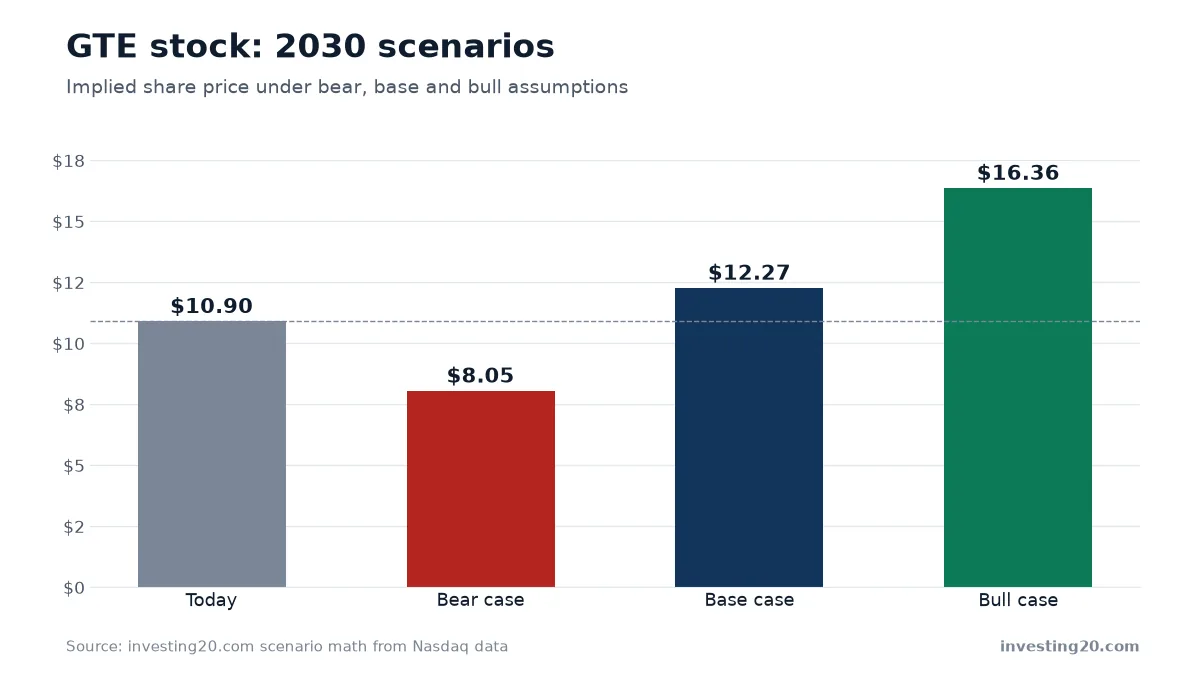
Bear case ($6.85)
In this case, revenue shrinks by an average of 1% each year, falling to $613.3 million by 2030. The loss of South American production is not fully replaced by Canadian and Azerbaijani projects, while ongoing exploration overhead keeps profits out of reach. Additional share issuance to fund capital expenditures expands the share count to 37 million. With the market awarding a conservative price-to-sales multiple of 0.4×, the stock would trade around $6.85, a 26% decline from current levels.
Base case ($10.44)
Here, Gran Tierra grows top-line revenue by an average of 3% annually, reaching $718.5 million in 2030. Stable production in Azerbaijan and incremental development in Canada successfully offset the divested South American assets. Net losses diminish as projected by analysts heading into 2028, and the share count rises modestly to 35 million. At a constant price-to-sales multiple of 0.5×, shares would sit near $10.44, up 13% from today.
Bull case ($13.93)
In the optimistic scenario, Azerbaijan development outperforms expectations and Canadian operations expand steadily, driving 7% average yearly revenue growth to $836.8 million by 2030. Gran Tierra shifts sustainably into positive net earnings, preventing significant equity dilution and keeping shares at 34 million. Improved market sentiment lifts the price-to-sales multiple slightly to 0.6×, leading to an implied price of about $13.93, a 50% gain.
The main takeaway across these scenarios is that GTE is not valued like high-multiple energy infrastructure operators such as MPLX LP Common Units (MPLX). Because it operates in upstream extraction with fluctuating profitability, valuation gains depend directly on operational execution in Azerbaijan and maintaining tight control over capital expenditures.
Risks to weigh
Before taking a position in Gran Tierra Energy, investors should weigh several operational and balance sheet risks:
- Asset portfolio transition: The planned sale of Colombian and Ecuadorian operations removes established producing basins. If closing conditions stall or proceeds fail to sufficiently fund new drilling in Canada and Azerbaijan, revenue could contract faster than expected.
- Persistent net losses: Gran Tierra lost $255.4 million over the last four reported quarters. Until the business reaches cash flow self-sufficiency, external financing or equity offerings remain a risk.
- Single-asset geopolitical risk: Holding a 65% working interest in Azerbaijan concentrates future growth in a region with distinct regulatory and geopolitical complexities.
- Commodity price volatility: Upstream producers are direct price-takers. A sustained drop in global crude benchmarks directly impairs operating cash flows and reserve valuations.
What to watch next
If you are tracking Gran Tierra, keep an eye on updates regarding the final closing terms of the Colombian and Ecuadorian asset sale. Watch whether the proceeds are used to retire debt or reinvest in Canadian drilling programs.
On the operational side, follow drilling milestones and production reports out of the onshore Azerbaijan contract area, as well as the company’s full-year 2026 earnings report to see if per-share losses narrow toward consensus estimates. Investors looking at capital allocation across cyclical sectors can also review how broader market swings impact equities like Robinhood Markets (HOOD) or long-range growth models for Rocket Lab (RKLB).
FAQ
What is the 12-month price target for Gran Tierra Energy (GTE)?
According to Nasdaq consensus data as of November 6, 2026, the average 12-month analyst price target for GTE is $12.96, with a low estimate of $12.12 and a high of $13.55.
Is Gran Tierra Energy currently profitable?
No. Over the last four reported quarters ending in 2026, Gran Tierra posted a net loss of $255.4 million, following a net loss of $193.1 million in fiscal year 2025.
Where does Gran Tierra Energy operate?
Historically focused on Colombia, Ecuador, and Canada, the company also operates an onshore exploration and production agreement in Azerbaijan with a 65% working interest. It has announced the sale of its Colombian and Ecuadorian assets to focus on Canada and Azerbaijan.
Market data: Nasdaq. Financials: Nasdaq. Scenario math: investing20.
This article is for information only and is not investment advice. Do your own research before investing.