MPLX LP Common Units (MPLX) Stock Forecast 2026–2030
MPLX LP stock forecast for 2026 to 2030. Explore midstream revenue trends, earnings, Wall Street targets, and three long-term valuation scenarios.
On this page
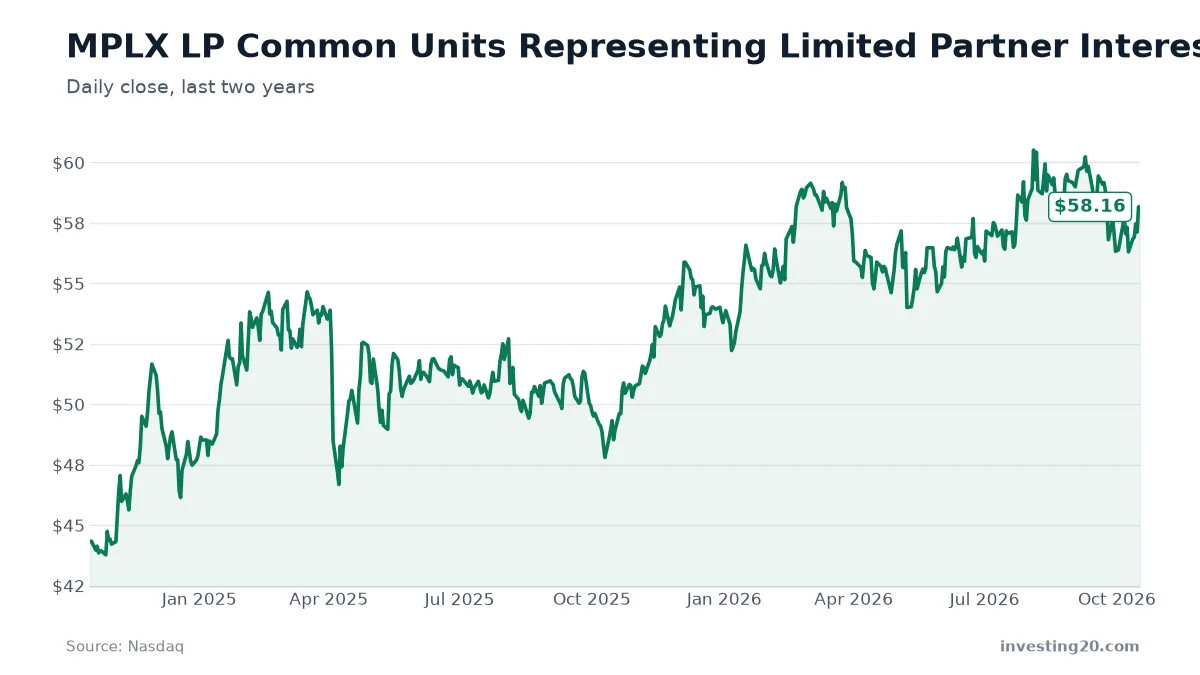
MPLX LP Common Units Representing Limited Partner Interests (NYSE: MPLX) trades around $58.16, backed by a massive footprint of pipelines, storage facilities, and processing plants. If you hold energy infrastructure or master limited partnerships (MLPs) in your portfolio, you are likely looking at MPLX for steady cash flow and reliable distributions rather than wild tech-style expansion.
This forecast examines where MPLX stands today, reviews what Wall Street expects over the next 12 months, and models three specific scenarios through 2030. Keep in mind that multi-year projections are not concrete predictions. They are mathematical frameworks designed to help you see what kind of business performance is already baked into the current unit price.
| Share price | $58.16 (Oct 15, 2026) |
| Market value | about $59.0 billion |
| 52-week range | $48.29 – $60.95 |
| Revenue, last 12 months | about $13.2 billion |
| Revenue growth, last fiscal year | 9% |
| Net income, last 12 months | about $4.7 billion |
| Price-to-sales | about 4.5× |
| Price-to-earnings | about 12× |
| Analyst 12-month target | average $64.63 (range $62 – $73); 5 buy, 4 hold, 0 sell |
Market data from Nasdaq as of October 17, 2026. Check current figures before making any decision.
The table above summarizes the core valuation metrics for MPLX as of October 17, 2026. The partnership carries a market value of $59.0 billion, trades at roughly 12.5 times its trailing earnings, and commands a price-to-sales ratio of 4.5.
What MPLX LP does
MPLX is a diversified, large-cap master limited partnership that owns and operates midstream energy infrastructure and logistics assets, alongside fuels distribution services. Rather than drilling for oil or speculating on raw energy prices, midstream businesses collect fees for moving, storing, and processing hydrocarbons across North America.
The asset base includes a network of crude oil and refined product pipelines, an inland marine transport business, light-product terminals, and underground storage caverns. It also operates refinery tanks, docks, loading racks, and marine terminals for both crude and refined fuels. On the natural gas side, MPLX owns gathering systems, pipelines, and processing and fractionation facilities for natural gas and natural gas liquids (NGLs) across major supply basins in the United States.
Because MPLX acts as a toll road for fuels, volume throughput drives its performance. Long-term commercial agreements and fee structures protect the partnership from sudden shifts in daily commodity prices.
Where the business stands
The partnership has delivered consistent top-line expansion over the past three fiscal years. Revenue rose from $11.3 billion in 2023 to $11.9 billion in 2024, reaching $13.0 billion for the fiscal year ending December 31, 2025. That marked 8.9% revenue growth in 2025. Over the trailing four quarters ending June 30, 2026, total revenue reached $13.2 billion.
Looking at individual quarters, performance has stayed resilient:
- Quarter ending September 30, 2025: $3.62 billion in revenue
- Quarter ending December 31, 2025: $3.25 billion in revenue
- Quarter ending March 31, 2026: $3.04 billion in revenue
- Quarter ending June 30, 2026: $3.31 billion in revenue
Net income reached $4.3 billion in fiscal 2024, climbed to $4.9 billion in 2025, and sits at $4.7 billion over the last four reported quarters. That healthy profitability produces dependable cash generation.
Quarterly earnings per unit have shown some volatility against consensus estimates. In the quarter ending September 2025, MPLX reported earnings per share (EPS) of $1.52, beating the $1.07 consensus by 42.06%. The December 2025 quarter also delivered a beat, reporting $1.17 against a $1.08 estimate. The March 2026 quarter stumbled, posting $0.90 per share against an expected $1.05 (a 14.29% negative surprise), before rebounding in the June 2026 quarter with $1.06 versus the $1.04 forecast.
Wall Street projects ongoing earnings stability. The consensus forecast from seven analysts projects full-year EPS of $4.26 for 2026. Looking further out, consensus calls for $4.69 per share in 2027 and $5.06 per share across six analysts in 2028. You can compare this trajectory with earlier projections in our MPLX stock forecast for 2023, 2025, 2030 and 2050.
What do analysts expect over the next 12 months?
Wall Street sentiment on MPLX is moderately positive, without a single sell rating. Among nine analysts tracked by Nasdaq, five rate the units as a buy and four rate them as a hold.
The average 12-month price target is $64.63, representing an 11.1% gain from the recent trade of $58.16. Targets range from a low of $62.00 to a high of $73.00.
To hit that average target of $64.63, MPLX needs to maintain steady pipeline throughput, avoid operational bottlenecks in its gathering systems, and keep capital expenditures disciplined. Because the low target of $62.00 sits above the current trading price, analysts broadly believe the current unit valuation provides a solid floor, supported by strong fee revenue and cash flow. For a perspective on how capital-intensive businesses handle long-term target projections, see our review of the Rocket Lab (RKLB) Stock Forecast 2026–2030.
MPLX stock forecast for 2030: three scenarios
To model where MPLX units could stand by 2030, we start with trailing four-quarter revenue of $13.2 billion. We project top-line sales using different compound growth rates, apply a price-to-sales multiple reflecting market maturity, and divide by the expected unit count.
Today’s price-to-sales ratio is 4.5. In our model, mature energy firms typically see multiples compress or hold near historical levels rather than expand aggressively. Break-even analysis shows that at the base-case multiple (4.5) and share count (1.01 billion), MPLX needs about $13.2 billion of annual revenue in 2030 to justify today’s $58.16 unit price. In short, today’s price already assumes MPLX maintains its current revenue baseline through 2030.
| Scenario | Revenue growth per year | 2030 revenue | Price-to-sales | Shares | Implied share price |
|---|---|---|---|---|---|
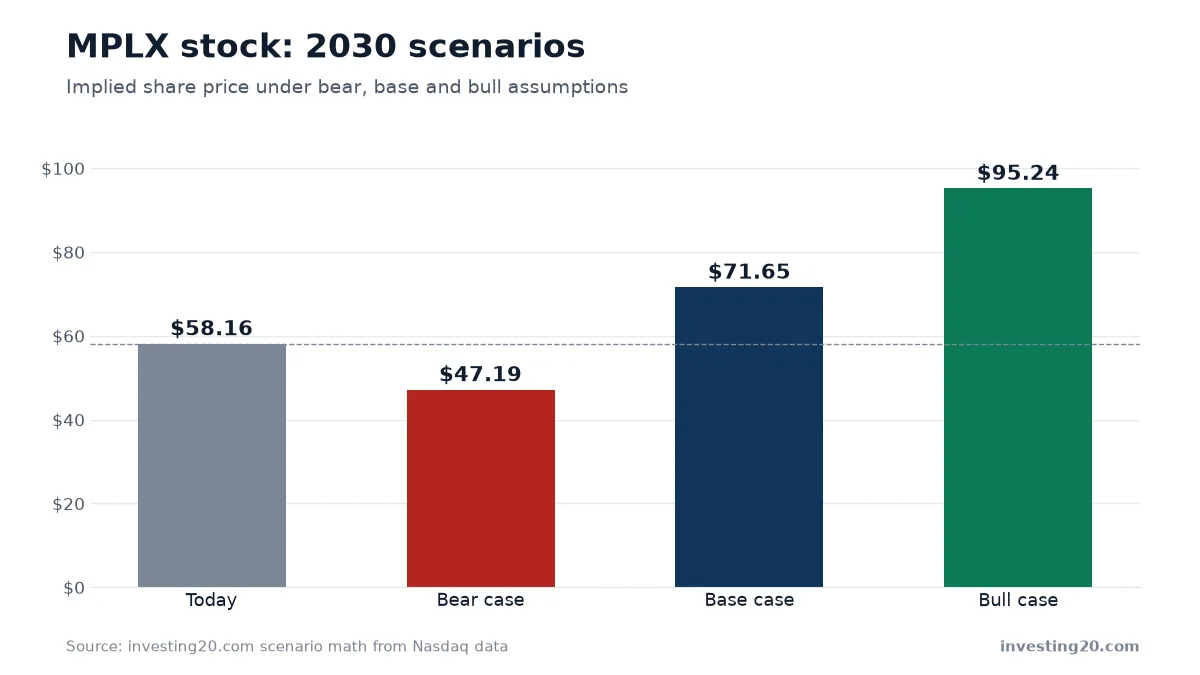
| Bear | 1% | $14.0 billion | 3.6× | 1.06 billion | about $47.19 (-19%) |
| Base | 5% | $16.3 billion | 4.5× | 1.01 billion | about $71.65 (+23%) |
| Bull | 9% | $18.9 billion | 4.9× | 974 million | about $95.24 (+64%) |
The bear case: 1% annual growth
In this scenario, energy transition pressures, regulatory delays, or regional drilling cutbacks reduce throughput growth across key basins. Revenue grows at an average pace of just 1% per year, reaching $14.0 billion by 2030. Slower momentum causes the price-to-sales multiple to drift down to 3.6. With the unit count creeping up to 1.06 billion, the implied unit price is $47.19. That represents a 19% drop from current levels, though cash distributions over those years would help cushion the total return.
The base case: 5% annual growth
The base case assumes steady U.S. natural gas demand, reliable crude exports, and incremental expansion projects across processing and fractionation facilities. Top-line revenue grows at an average of 5% each year, rising to $16.3 billion by 2030. The price-to-sales ratio holds steady at 4.5. Across a unit count of 1.01 billion, the implied price reaches $71.65, a 23% gain from today’s price. For investors holding midstream units for yield, capital gains of this size alongside steady payouts represent a solid outcome.
The bull case: 9% annual growth
In the bull scenario, high global demand for liquefied natural gas and U.S. crude products keeps gathering and transport pipelines running near capacity. Revenue expands by 9% annually, matching the fiscal 2025 growth rate, and reaches $18.9 billion by 2030. A modest multiple expansion to 4.9 price-to-sales, paired with unit repurchases that lower the unit count to 974 million, yields an implied unit price of $95.24. That would deliver a 64% gain from current prices.
Looking at alternative high-growth sectors, our SoFi Technologies (SOFI) Stock Forecast 2026–2030 illustrates how multiple expansion affects valuations differently in consumer finance compared to pipeline MLPs.
The main takeaway from these scenarios is clear: MPLX does not need explosive revenue growth to maintain its valuation. Because the baseline business already supports the current unit price, midstream performance will hinge on operational efficiency and volume retention rather than rapid expansion.
Risks to weigh
Before adding MPLX to your holdings, consider these structural and operational risks:
- Basin drilling activity: MPLX relies on oil and gas producers to feed its gathering lines. If drilling activity slows in key supply basins, volume throughput drops.
- Refined product demand: Shifting consumer fuel consumption patterns can reduce terminal throughput and pipeline demand over time.
- Tax complexity: As a master limited partnership, MPLX issues Schedule K-1 tax forms rather than standard 1099s. This can create extra reporting steps for taxable accounts.
- Capital allocation discipline: Funding large expansion projects while sustaining distributions requires careful balance sheets. Higher borrowing costs can raise the expense of refinancing debt.
- Environmental regulations: Permitting pipelines and marine terminals faces continuous regulatory scrutiny, which can stall planned infrastructure work.
What to watch next
Keep an eye on quarterly throughput volumes in the natural gas gathering and processing segment. That metric reveals whether upstream producers are increasing activity or pulling back.
Watch the upcoming full-year earnings release to see if MPLX meets the consensus 2026 EPS estimate of $4.26. Monitor management comments regarding unit buybacks and distribution increases. In midstream investing, steady volume growth and disciplined capital spending matter far more than speculative market swings.
FAQ
What is the 12-month analyst target for MPLX?
Wall Street analysts tracked by Nasdaq have an average 12-month price target of $64.63, with estimates spanning from $62.00 to $73.00 across 5 buy and 4 hold ratings.
How does MPLX make money?
MPLX operates midstream energy logistics, earning fee-based income from crude and refined product pipelines, inland marine shipping, storage terminals, and natural gas gathering and processing plants.
What is the 2030 stock forecast for MPLX?
Investing 2.0 scenario modeling projects 2030 outcomes ranging from $47.19 in a 1% annual growth bear case to $71.65 in a 5% base case and $95.24 in a 9% bull case.
Market data and financials: Nasdaq. Scenario math: investing20.
This article is for information only and is not investment advice. Do your own research before investing.