PayPal (PYPL) Stock Forecast 2026–2030: Long-Term Outlook
Looking at PayPal (PYPL) stock forecast for 2026 to 2030. See Wall Street price targets, earnings trends, valuation multiples, and three distinct 2030 scenarios.
On this page
PayPal Holdings, Inc. (PYPL) remains one of the most widely recognized brands in digital payments, but its stock has struggled over the past two years. This long-range analysis breaks down the business model, current earnings trends, Wall Street price targets, and three distinct valuation scenarios through 2030.
Long-term stock forecasts are not guarantees or precise price predictions. They are analytical frameworks designed to help you understand what level of business performance is required to support different stock valuations over time.
| Share price | $56.02 (Oct 28, 2026 1:05 PM ET) |
| Market value | about $47.9 billion |
| 52-week range | $38.46 – $79.22 |
| Revenue, last 12 months | about $34.1 billion |
| Revenue growth, last fiscal year | 4% |
| Net income, last 12 months | about $4.9 billion |
| Price-to-sales | about 1.4× |
| Price-to-earnings | about 10× |
| Analyst 12-month target | average $57.60 (range $45 – $70); 3 buy, 23 hold, 3 sell |
Market data from Nasdaq as of October 28, 2026. Check current figures before making any decision.
What changed since our last update
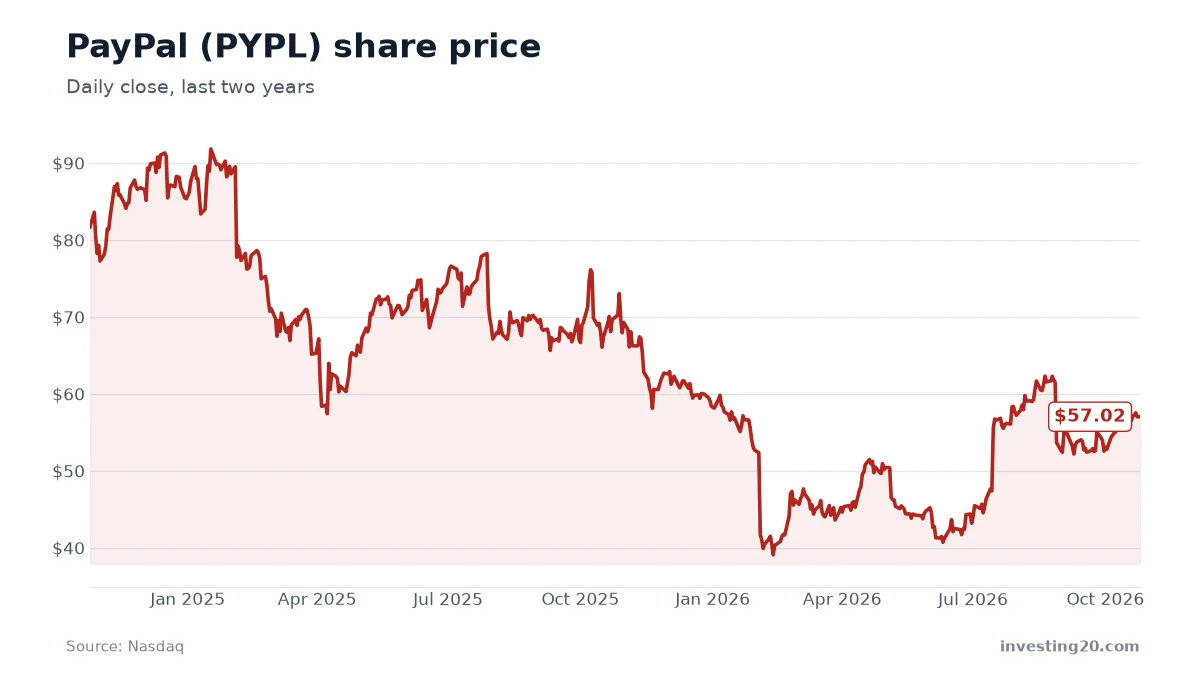
In our previous update on October 25, 2026, PayPal shares traded at $57.02. The stock has drifted down slightly to $56.02 following the third-quarter earnings report on October 27, 2026.
Because the share price dropped 1.8%, the implied upside in our 2030 scenarios moved marginally higher, while Wall Street’s average 12-month price target nudged down from $58.25 to $57.60. Overall valuation metrics remain near multi-year lows, reflecting ongoing debate about the company’s long-term top-line expansion.
How PayPal makes money and serves customers
PayPal operates a global digital payments platform connecting consumers and merchants across roughly 200 markets. For over 25 years, the company has built tools that allow individuals and businesses to transfer funds, complete online checkouts, and process debit or credit card payments securely.
The business earns revenue primarily by taking a small transaction fee every time money moves across its network. It processes payments for online store checkouts, peer-to-peer money transfers, and merchant services. In recent years, PayPal has expanded into unbranded card processing, buy-now-pay-later financing, and digital wallet features to capture broader consumer checkout volume.
Where the business stands today
PayPal generated $34.1 billion in revenue over the last four reported quarters, up from $33.2 billion in full-year 2025 and $31.8 billion in 2024. Top-line revenue growth in fiscal 2025 stood at 4.3%, reflecting steady but slowing expansion compared to historical norms.
Despite top-line moderation, PayPal stays solidly profitable, bringing in $4.9 billion in net income over the past 12 months. The business trades at a price-to-earnings ratio of 9.8 and a price-to-sales ratio of 1.4, which are lower than many consumer finance peers. The company also offers a modest 1.00% dividend yield.
In its latest quarter ending September 30, 2026, PayPal reported adjusted earnings per share (EPS) of $1.45, beating consensus estimates of $1.31 by 10.69%. This followed positive earnings surprises of 7.81% in June 2026 ($1.38 vs. $1.28) and 5.51% in March 2026 ($1.34 vs. $1.27). Wall Street consensus forecasts call for full-year EPS of $5.61 in 2026, rising to $5.84 in 2027 and $6.22 in 2028.
While earnings execution has consistently beaten quarterly estimates, the stock remains well off its peaks. PYPL traded at $83.59 on October 28, 2024, representing a 33.0% decline over the past two years. The shares have fluctuated between $38.46 and $79.22 over the past 52 weeks.
For investors exploring broader payment and fintech opportunities, comparing established platforms with emerging models in our Robinhood stock forecast or modern banking alternatives in our SoFi stock forecast can provide helpful sector context.
PYPL stock price forecast for the next 12 months
Wall Street analysts hold a cautious short-term outlook on PayPal. According to Nasdaq consensus data, 29 analysts track the stock, issuing 3 buy ratings, 23 hold ratings, and 3 sell ratings.
The average 12-month PYPL price target is $57.60, representing a modest 2.8% gain from the current price of $56.02. Individual 12-month targets span a wide gap:
- High target: $70.00 (+25.0%)
- Average target: $57.60 (+2.8%)
- Low target: $45.00 (-19.7%)
For PayPal to reach the higher end of analyst targets over the next year, the company would likely need to demonstrate accelerating transaction volume in its core branded wallet, maintain expanding operating margins, or report stronger international uptake. Conversely, reaching the lower analyst targets would stem from ongoing competitive pressures or shrinking profit margins.
PayPal stock price prediction for 2030: three scenarios
Looking out to 2030 requires evaluating long-term business performance rather than short-term price noise. Our 2030 scenarios start with trailing 12-month revenue of $34.1 billion, project annual sales growth rates, apply realistic price-to-sales multiples, and factor in expected changes to total share counts.
To maintain today’s share price of $56.02 in 2030 at a base-case price-to-sales multiple of 1.4, PayPal needs to achieve roughly $34.1 billion in revenue—meaning the current market price already assumes virtually zero net growth from today’s top line.
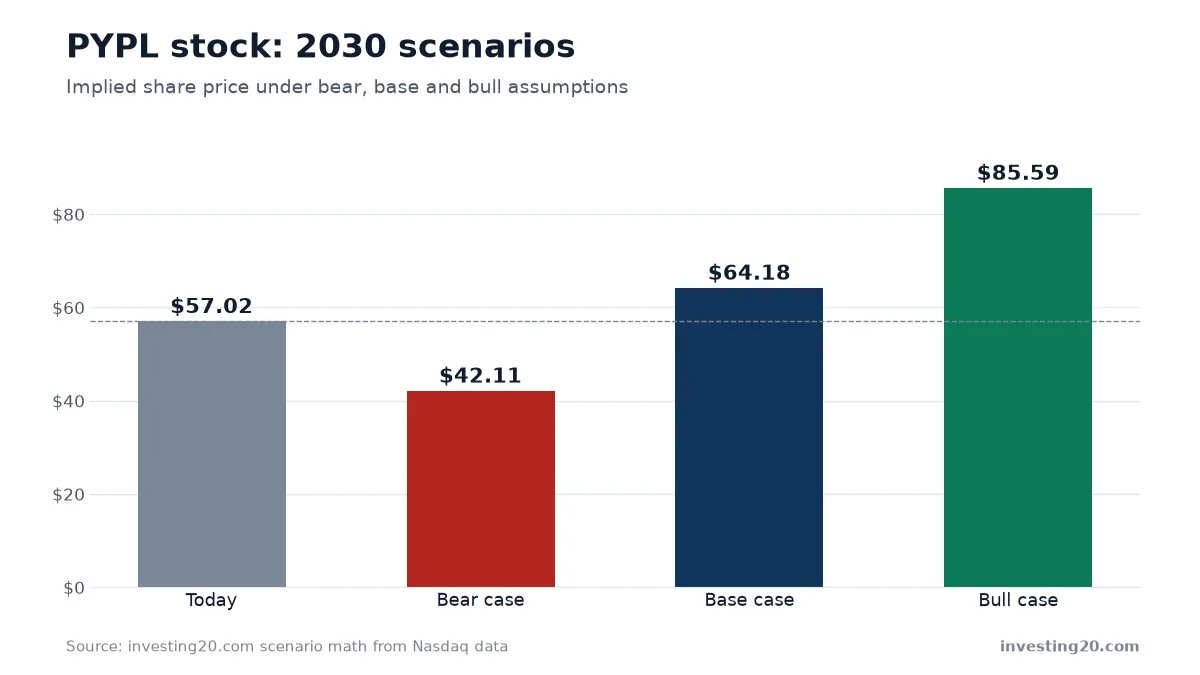
| Scenario | Revenue growth per year | 2030 revenue | Price-to-sales | Shares | Implied share price |
|---|---|---|---|---|---|
| Bear | -1% | $32.8 billion | 1.1× | 890 million | about $41.37 (-26%) |
| Base | 3% | $38.4 billion | 1.4× | 855 million | about $63.05 (+13%) |
| Bull | 7% | $44.7 billion | 1.5× | 822 million | about $84.08 (+50%) |
Bear case
The bear case models a slight decline in core payment volume, with revenue shrinking by 1% annually to $32.8 billion by 2030. Reduced market power compresses the price-to-sales ratio to 1.1x. Assuming minor share dilution to 890 million shares, the implied stock price lands at $41.37, representing a 26% decline from current levels.
Base case
The base case assumes modest execution with revenue growing at 3% per year to $38.4 billion in 2030. The price-to-sales multiple remains steady at 1.4x, while share buybacks reduce the diluted share count to 855 million. Under these conditions, the implied stock price reaches $63.05, offering a 13% gain from today’s price.
Bull case
The bull case projects a successful turnaround in branded wallet adoption, with revenue growing 7% per year to $44.7 billion by 2030. Higher growth boosts the valuation multiple slightly to 1.5x price-to-sales, and active share repurchases lower the share count to 822 million. This yields an implied price of $84.08, a 50% potential increase.
Investors building diversified portfolios across different sectors may also want to read our long-term coverage on industrial leaders, such as our Rocket Lab stock forecast.
Risks to weigh before investing
- Competition in checkout: Apple Pay, Shop Pay, and direct bank rails continue to vie for market share at online checkout points.
- Margin pressures: Growth in unbranded transaction processing often carries lower gross profit margins than PayPal’s traditional branded checkout button.
- Economic sensitivities: Broader slowdowns in consumer spending directly reduce transaction volumes and processing fees across the network.
- Slower top-line expansion: Revenue growth was 4.3% in fiscal 2025; failing to re-accelerate growth could keep valuation multiples compressed.
What to watch next
If you are tracking PayPal stock, keep an eye on upcoming quarterly earnings reports for updates on transaction margin dollar growth. Watch whether management can sustain positive EPS surprises above consensus estimates. It is also worth tracking share count reductions from buybacks, which remain a primary lever for growing earnings per share even during periods of slow revenue growth.
FAQ
What is the 12-month PYPL price target?
According to Nasdaq consensus data as of October 28, 2026, the average 12-month price target for PayPal is $57.60. Individual analyst targets range from a low of $45.00 to a high of $70.00.
What is the PayPal stock price prediction for 2030?
Based on investing20.com scenario modeling, PayPal stock could trade around $63.05 by 2030 in a base case assuming 3% annual revenue growth. The bull case estimates $84.08, while a bear case projects $41.37.
Is PayPal stock expected to grow its revenue?
PayPal generated $33.2 billion in revenue in fiscal year 2025, representing 4.3% growth over 2024. Long-term projections evaluate revenue growth trajectories between -1% and 7% annually through 2030.
Market data and financials: Nasdaq. Scenario math: investing20.
This article is for information only and is not investment advice. Do your own research before investing.