Pfizer (PFE) Stock Forecast 2026–2030: Long-Term Outlook
Examine the Pfizer (PFE) stock forecast through 2030. We analyze recent earnings, Wall Street targets, and long-term revenue scenarios for PFE stock.
On this page
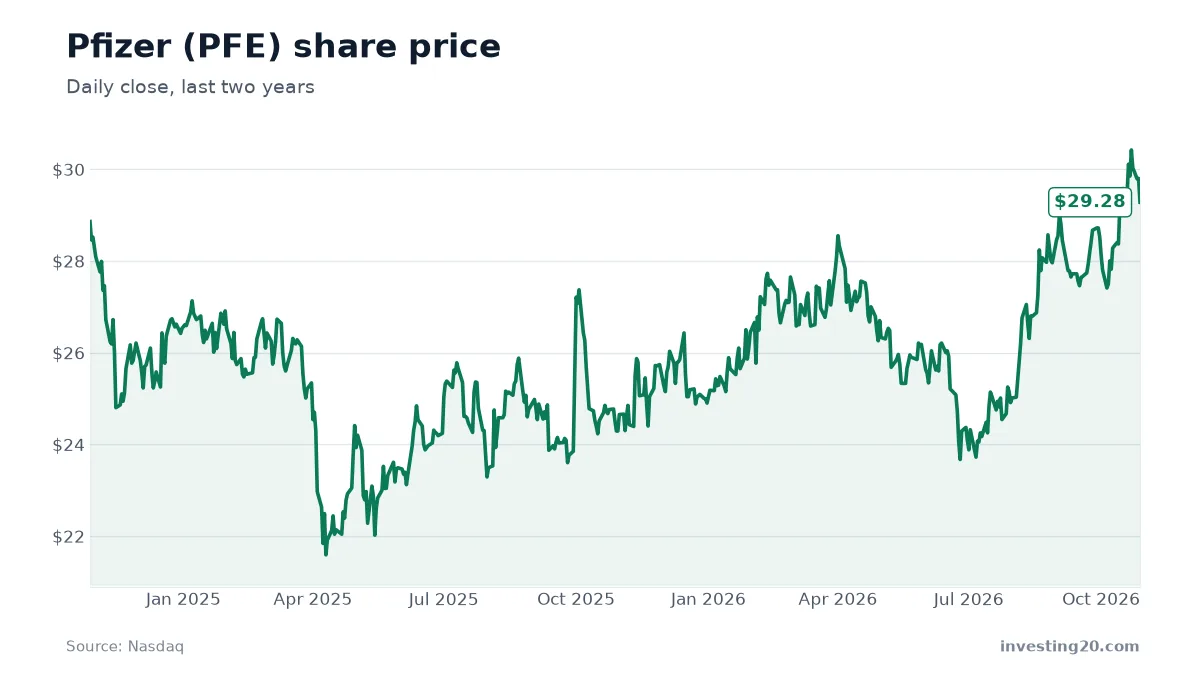
Pfizer stock traded at $29.28 on October 28, 2026, sitting right near its average Wall Street price target of $29.62. If you hold Pfizer or are thinking about adding it to your portfolio, you are likely wondering how the business will perform over the next several years as it moves past its post-pandemic revenue reset.
This article breaks down Pfizer’s recent financial results, short-term Wall Street consensus, and potential valuation outcomes through 2030. Long-range stock forecasts are not absolute predictions or guaranteed price targets. Instead, they are structured scenarios that show what kind of business performance and market multiples would be required to yield specific returns.
| Share price | $29.28 (Oct 28, 2026 3:02 PM ET) |
| Market value | about $166.9 billion |
| 52-week range | $23.62 – $30.44 |
| Revenue, last 12 months | about $63.7 billion |
| Revenue growth, last fiscal year | -2% |
| Net income, last 12 months | about $4.4 billion |
| Price-to-sales | about 2.6× |
| Price-to-earnings | about 38× |
| Analyst 12-month target | average $29.62 (range $25 – $36); 8 buy, 13 hold, 1 sell |
Market data from Nasdaq as of October 28, 2026. Check current figures before making any decision.
How Pfizer makes its money
Pfizer is a global pharmaceutical company founded more than 175 years ago. The business focuses on developing, manufacturing, and distributing healthcare products, including innovative prescription medicines and vaccines across developed and emerging international markets.
Its portfolio spans therapies for oncology, immunology, cardiology, rare diseases, and infectious diseases. Revenue comes directly from sales to drug wholesalers, retail pharmacies, hospital networks, and government health agencies. Pfizer collaborates with healthcare providers and local governments to maintain distribution networks worldwide.
Because prescription drugs carry high initial research costs but modest production costs once approved, top-line sales volume and patent protections dictate long-term profit margins.
Where the business stands today
Pfizer generated $63.7 billion in revenue over the last four reported quarters, ending June 28, 2026. Top-line revenue reached $15.03 billion in the quarter ending June 2026, up from $14.45 billion in the quarter ending March 2026. For the fiscal year ending December 31, 2025, Pfizer recorded $62.6 billion in revenue, representing a slight drop of 1.6% from $63.6 billion in fiscal year 2024.
Despite flat revenue growth, Pfizer has steadily beat Wall Street’s quarterly earnings expectations. In the quarter ending June 2026, Pfizer reported adjusted earnings per share (EPS) of $0.77 compared to a consensus estimate of $0.68, a 13.24% beat. That followed positive EPS surprises of 5.63% in March 2026 ($0.75 reported versus $0.71 expected), 15.79% in December 2025 ($0.66 reported versus $0.57 expected), and 31.82% in September 2025 ($0.87 reported versus $0.66 expected).
Over the last four quarters, Pfizer produced $4.4 billion in net income. For the full fiscal year 2025, net income stood at $7.8 billion, down slightly from $8.1 billion in 2024. Today, the stock trades at a price-to-sales multiple of roughly 2.6 and a price-to-earnings ratio of 38.2.
The stock price has remained largely flat over a two-year period. On October 28, 2024, Pfizer shares traded at $28.86. Two years later, at $29.28, the stock is up just 1.5%. Over the past 52 weeks, shares have moved between a low of $23.62 and a high of $30.44. Evaluating mature blue-chip companies with stable revenues requires a similar analytical approach to studying dividend-paying entities like MPLX LP Common Units (MPLX) Stock Forecast 2026–2030.
PFE stock forecast for the next 12 months
Wall Street analysts hold a neutral to slightly positive short-term view on Pfizer. Out of 22 analysts tracked by Nasdaq, 8 rate the stock a buy, 13 recommend a hold, and 1 assigns a sell rating.
The average 12-month analyst price target sits at $29.62, which implies a modest 1.2% upside from the current price of $29.28. The low target among analysts is $25.00 (a 14.6% decline), while the high target is $36.00 (a 22.9% gain).
For Wall Street consensus:
- Consensus EPS for fiscal year ending December 2026 is $2.94, based on 9 analysts.
- Consensus EPS for fiscal year ending December 2027 is $2.95, based on 9 analysts.
- Consensus EPS for fiscal year ending December 2028 drops to $2.41, based on 4 analysts.
To push toward the upper end of analyst targets ($36.00), Pfizer would need to demonstrate durable top-line revenue growth across its core non-COVID commercial portfolio and expand its operating margins. Conversely, falling toward the lower target ($25.00) would likely stem from revenue contraction or pipeline setbacks. Evaluating these short-term targets differs from examining fast-growing technology companies like those analyzed in the IonQ (IONQ) Stock Forecast 2026–2030: Long-Term Outlook, where valuation ratios tend to be much more volatile.
PFE stock forecast for 2030: three scenarios
To build a reasonable PFE outlook through 2030, we evaluate three revenue and valuation scenarios. Starting from trailing twelve-month revenue of $63.7 billion, each model projects sales growth out to 2030, applies a realistic price-to-sales valuation multiple, and calculates the resulting share price after adjusting for expected share counts.
At today’s share count and current price-to-sales multiple of 2.6, Pfizer needs to generate roughly $63.7 billion in revenue in 2030 to justify its current $29.28 share price. This indicates that current stock prices already build in zero growth expectations over the coming four years.
| Scenario | Revenue growth per year | 2030 revenue | Price-to-sales | Shares | Implied share price |
|---|---|---|---|---|---|
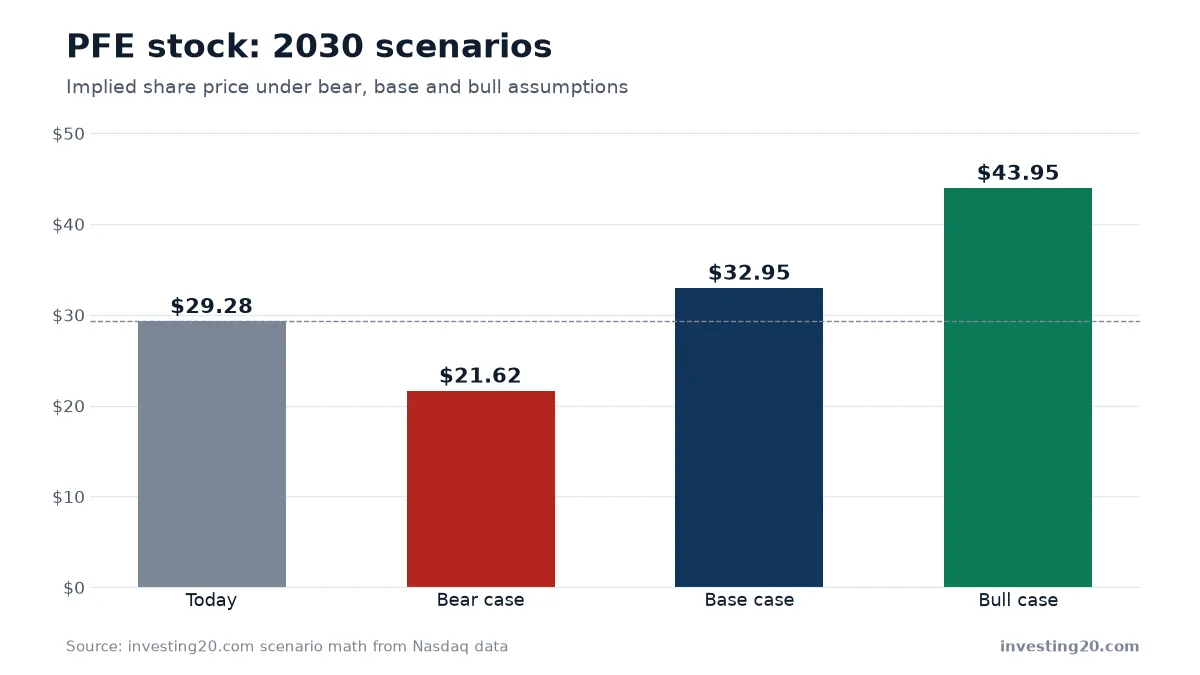
| Bear | -1% | $61.2 billion | 2.1× | 5.93 billion | about $21.62 (-26%) |
| Base | 3% | $71.7 billion | 2.6× | 5.70 billion | about $32.95 (+13%) |
| Bull | 7% | $83.5 billion | 2.9× | 5.48 billion | about $43.95 (+50%) |
Bear case
In the bear case, Pfizer’s revenue declines by an average of 1% per year through 2030, reducing total sales to $61.2 billion. This outcome reflects generic competition eating into existing commercial drugs faster than new pipeline products reach the market. Assuming the price-to-sales ratio shrinks to 2.1 and share dilution brings total shares to 5.93 billion, the implied share price drops to $21.62. That represents a 26% loss from today’s price.
Base case
The base case assumes modest corporate execution, with revenue growing by an average of 3% per year to reach $71.7 billion in 2030. Under this scenario, new drug launches offset patent expirations on older medicines. Keeping the price-to-sales multiple flat at 2.6 and assuming slight share buybacks reduce the count to 5.70 billion shares, the implied 2030 share price reaches $32.95. That equals a 13% gain from the current price, excluding dividend payments.
Bull case
In the bull case, Pfizer achieves 7% annual revenue growth, expanding top-line revenue to $83.5 billion by 2030. This path requires clinical success across its pharmaceutical pipeline and strong adoption of newly approved therapies. With expanded sales, the price-to-sales multiple rises slightly to 2.9, while active share repurchases lower the total count to 5.48 billion shares. The resulting share price calculation yields $43.95, representing a 50% total gain from current levels. Investors comparing long-term scenario models across different industries can review similar structured cases in the Tesla (TSLA) Stock Forecast 2026–2030: Long-Term Outlook.
The primary takeaway from these 2030 scenarios is that Pfizer is priced as a slow-growth legacy asset. Because current valuations do not require massive top-line expansion just to preserve capital, even modest operational execution yields a positive long-term return path.
Risks to weigh
Before making an investment decision regarding Pfizer, consider the core risks facing large-cap pharmaceutical businesses:
- Patent cliffs: Loss of exclusivity on major commercial drugs allows low-cost generic manufacturers to quickly take market share.
- Pipeline uncertainty: Clinical trials carry high failure rates. Experimental drugs can fail in late-stage trials after years of research spending.
- Regulatory scrutiny: Government drug pricing policies and reimbursement negotiations can limit profit margins on core products.
- Capital allocation: Pfizer relies on acquisitions to acquire early-stage biotech assets. Poorly timed or overpriced deals can hurt shareholder returns.
What to watch next
If you are tracking Pfizer stock over the coming quarters, monitor three key areas:
- Quarterly revenue trends: Watch whether non-COVID commercial revenues increase steadily above the baseline $15 billion quarterly rate.
- Pipeline readouts: Pay close attention to Phase 3 trial results and FDA decision dates for flagship pipeline candidates.
- Margin evolution: Track net profit performance relative to consensus estimates to ensure operating expenses remain controlled as top-line revenue stabilizes.
FAQ
What is the 12-month pfe stock forecast?
Wall Street analysts tracked by Nasdaq set an average 12-month price target of $29.62 for Pfizer, with targets ranging from $25.00 to $36.00. That average suggests a modest 1.2% upside from the October 2026 price of $29.28.
What is the long-term pfe outlook through 2030?
Long-term scenario modeling suggests Pfizer could reach $32.95 by 2030 in a base case assuming 3% annual revenue growth. A bull case with 7% annual growth implies $43.95, while a bear case with -1% annual sales contraction points to $21.62.
Is Pfizer stock expected to grow its revenue?
Pfizer reported $63.7 billion in revenue over the last four quarters, though revenue fell 1.6% in its latest full fiscal year. Analyst estimates point to steady adjusted earnings per share around $2.94 in 2026 and $2.95 in 2027.
Market data and financials: Nasdaq. Scenario math: investing20.
This article is for information only and is not investment advice. Do your own research before investing.