Riot Platforms (RIOT) Stock Forecast: 2026–2030 Long-Term Scenarios
Riot Platforms stock forecast for 2026 to 2030. Explore analyst price targets, revenue trends, and long-term valuation scenarios for RIOT shares.
On this page
If you hold shares in Riot Platforms (RIOT) or are looking to add exposure to digital infrastructure and crypto mining to your portfolio, long-term projections can help put the company’s wild price swings into context. This article breaks down where the business stands today and outlines potential outcomes for the stock through 2030 using three distinct scenarios.
Long-range stock forecasts are not accurate predictions of the future. Instead, think of them as structured possibilities built on specific assumptions about revenue growth, share dilution, and market valuation multiples. They help you evaluate what needs to happen for the current share price to make sense over the next five years.
| Share price | $16.80 (Nov 6, 2026 2:45 PM ET) |
| Market value | about $6.3 billion |
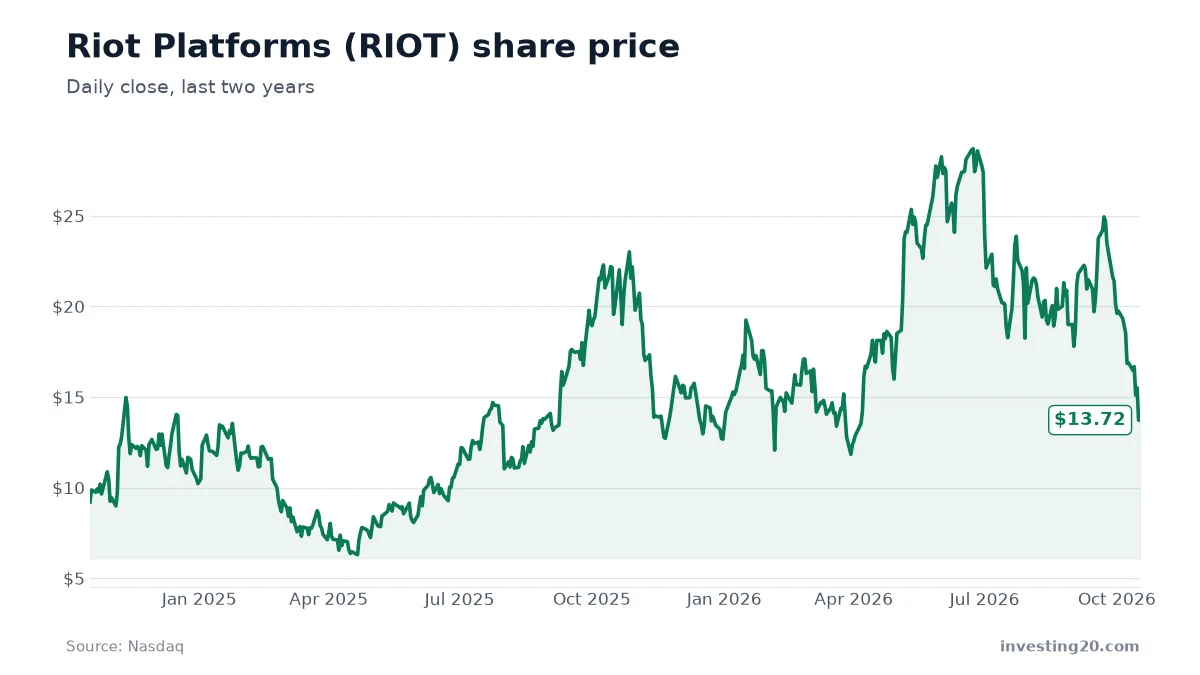
| 52-week range | $11.50 – $30.32 |
| Revenue, last 12 months | about $675.7 million |
| Revenue growth, last fiscal year | 72% |
| Net income, last 12 months | a loss of about $1.4 billion |
| Price-to-sales | about 9.3× |
| Price-to-earnings | n/a (not profitable) |
| Analyst 12-month target | average $32.11 (range $19 – $50); 15 buy, 0 hold, 0 sell |
Market data from Nasdaq as of November 6, 2026. Check current figures before making any decision.
What changed since our last update
Since our previous update on October 17, 2026, RIOT’s share price rose 22.4% from $13.72 to $16.80. The rally was driven in part by stronger earnings for the quarter ending September 30, 2026, where the company beat analyst expectations with a positive EPS of $0.01 against an expected loss of $0.34 per share.
Because the share price moved up, our modeled returns across all three 2030 scenarios look slightly lower on a percentage basis today, even though our implied target prices rose due to updating our base trailing revenue figures. Wall Street analyst targets remained steady, shifting slightly from an average of $32.54 down to $32.11 as 15 analysts maintain a unanimous buy rating.
What Riot Platforms does
Riot Platforms is a digital infrastructure company focused primarily on large-scale Bitcoin mining operations and data centers. The company builds and operates power-intensive digital infrastructure facilities located in central Texas and Kentucky.
In addition to mining Bitcoin for its own balance sheet, Riot operates engineering and electrical fabrication facilities in Denver and Houston. These engineering units design and manufacture power distribution equipment and custom electrical infrastructure, serving both internal expansion projects and external industrial customers.
The primary engine of Riot’s top-line revenue is its Bitcoin mining segment, which generates revenue by earning Bitcoin rewards and transaction fees on the network. Consequently, the company’s financial top line is tightly connected to Bitcoin market prices and broad network mining difficulty.
Where the business stands
Riot’s top-line sales have expanded substantially over recent years. Revenue grew 71.9% in the fiscal year ending December 31, 2025, reaching $647.4 million, up from $376.7 million in 2024 and $280.7 million in 2023. Over the last four reported quarters, revenue totaled $675.7 million. Quarterly revenue has shown a steady upward trend, progressing from $152.83 million in late 2025 to $181.43 million in the quarter ending September 30, 2026.
Despite steady top-line growth, profitability remains volatile due to power cost fluctuations, depreciation, and shifts in digital asset valuations. Over the last four quarters, Riot logged a net loss of $1.4 billion, following a net loss of $663.2 million in fiscal year 2025.
Earnings surprises have swung dramatically over recent quarters. On November 4, 2026, Riot reported third-quarter EPS of $0.01, beating consensus estimates of a $0.34 loss per share. However, the three prior quarters saw heavy bottom-line misses, including a loss of $2.03 per share reported in March 2026 versus a consensus estimate of a $0.22 loss. Wall Street consensus estimates project continued annual net losses through 2028, with EPS forecasts of -$2.66 for 2026, -$1.14 for 2027, and -$1.43 for 2028.
For comparison on how high-growth tech and infrastructure plays handle choppy industry shifts, you can read our Rocket Lab (RKLB) Stock Forecast or review our Super Micro Computer (SMCI) Stock Forecast.
RIOT stock forecast for the next 12 months
Wall Street analysts are overwhelmingly bullish on RIOT stock over the coming 12 months. According to Nasdaq consensus data gathered from 15 covering analysts, all 15 rate the stock a Buy, with zero Hold or Sell ratings.
The average 12-month target price sits at $32.11, which implies a 91.1% upside from the current share price of $16.80. The lowest analyst target is $19.00, which is still above today’s price, while the high target stretches to $50.00.
For RIOT to reach that consensus average over the next year, two key things need to fall into place. First, Bitcoin market prices would need to remain strong or trend higher, preserving profit margins on Riot’s newly mined coins. Second, the market would need to reward Riot’s ongoing expansion of operational hash rate and hosting capacity, proving that its physical power assets in Texas and Kentucky can consistently generate operational cash flow despite ongoing net accounting losses.
If you are curious about how other volatile tech sectors are evaluated by Wall Street, take a look at our SoundHound AI (SOUN) Stock Forecast.
RIOT stock forecast for 2030: three scenarios
To model where RIOT stock might trade in 2030, we start with trailing four-quarter revenue of $675.7 million and run three growth paths. Because rapid top-line growth naturally moderates as companies scale, our scenarios assume annual revenue growth slows gradually over time.
The model also applies reduced price-to-sales multiples relative to today’s ratio of 9.3, acknowledging that fast-growing infrastructure companies often command lower multiples as they mature. At our base-case valuation multiple and share count, Riot needs to achieve roughly $796.9 million in annual revenue by 2030 to justify today’s $16.80 price tag.
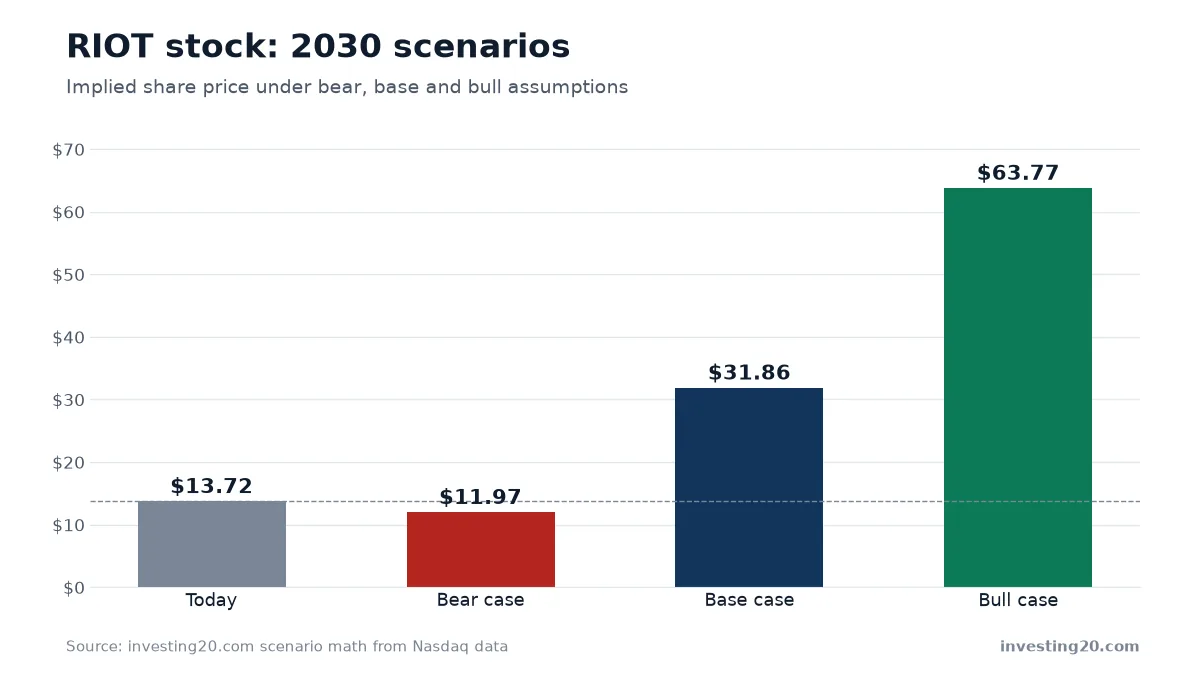
| Scenario | Revenue growth per year | 2030 revenue | Price-to-sales | Shares | Implied share price |
|---|---|---|---|---|---|
| Bear | 22% slowing to 5% | $1.1 billion | 5.0× | 422 million | about $13.10 (-22%) |
| Base | 43% slowing to 15% | $1.9 billion | 8.4× | 398 million | about $39.01 (+132%) |
| Bull | 65% slowing to 25% | $2.9 billion | 10.3× | 383 million | about $78.09 (+365%) |
Bear case
In the bear case, digital asset momentum slows, and network mining difficulty squeezes profit margins. Revenue growth drops from 22% down to 5% per year (averaging about 13% annually), taking top-line sales to $1.1 billion by 2030. Assuming share dilution increases the share count to 422 million and the price-to-sales multiple compresses to 5.0, the share price drops to about $13.10. That represents a 22% decline from today’s price.
Base case
In the base case, Riot scales its operational power capacity cleanly and benefits from stable demand for high-density computing infrastructure. Revenue growth slows from 43% down to 15% annually (averaging about 29% per year), reaching $1.9 billion in 2030. With a price-to-sales multiple of 8.4 and a share count of 398 million, the stock price moves to about $39.01, delivering a 132% gain.
Bull case
The bull case assumes aggressive growth in both Bitcoin infrastructure demand and commercial host engineering services. Top-line expansion starts at 65% and slows to 25% per year (an annual average rate around 44%), lifting 2030 revenue to $2.9 billion. If the market rewards this expansion with a price-to-sales multiple of 10.3 and share count stays tighter at 383 million, the stock reaches about $78.09, representing a 365% return.
If you want to compare how other specialized sectors trade in our multi-scenario models, see our long-term projections for Hut 8 Corp. (HUT) or Robinhood Markets (HOOD).
Key risks to weigh
- Digital asset price volatility: Riot’s financial metrics depend heavily on the price of Bitcoin. A prolonged downturn in crypto market valuations directly depresses mining margins and asset valuations.
- Network difficulty and halving dynamics: Increases in total network computing power decrease the amount of Bitcoin earned per unit of electricity, requiring continuous capital spending just to maintain market share.
- Persistent net losses: The company has racked up $1.4 billion in net losses over the past four quarters. Continued structural losses may lead to cash burn or operational stress.
- Shareholder dilution: Capital expenditures for data center expansion and custom hardware are often funded through equity offerings, which increases total share count and reduces per-share value.
- Power supply and regional concentration: A major portion of Riot’s operations is concentrated in Texas. Grid disruptions, changes in local power tariffs, or regulatory shifts regarding high-density data centers pose direct operational risks.
What to watch next
If you own or are following RIOT stock, keep an eye out for full-year 2026 financial results, which are expected in early 2027. Watch whether bottom-line earnings continue to show stability following the positive third-quarter surprise, and monitor management updates on deployed operational capacity across central Texas and Kentucky.
FAQ
What is the 12-month analyst target for RIOT stock?
According to Nasdaq consensus data as of November 6, 2026, the average 12-month price target for Riot Platforms is $32.11, with a high target of $50.00 and a low of $19.00.
Is Riot Platforms currently profitable?
No. Riot Platforms reported a net loss of $1.4 billion over the last four reported quarters, though it posted a small positive earnings surprise of $0.01 per share in the quarter ending September 30, 2026.
What is the 2030 base-case target for RIOT?
Our base-case model estimates an implied 2030 stock price of about $39.01, assuming revenue reaches $1.9 billion on an average annual growth rate of roughly 29%.
Market data: Nasdaq. Financials: Nasdaq. Scenario math: investing20.
This article is for information only and is not investment advice. Do your own research before investing.