NVIDIA (NVDA) Stock Forecast: 2026 to 2030 Outlook
NVIDIA stock forecast from 2026 to 2030 with revenue scenarios, valuation targets, analyst consensus ratings, and risks for long-term investors.
On this page
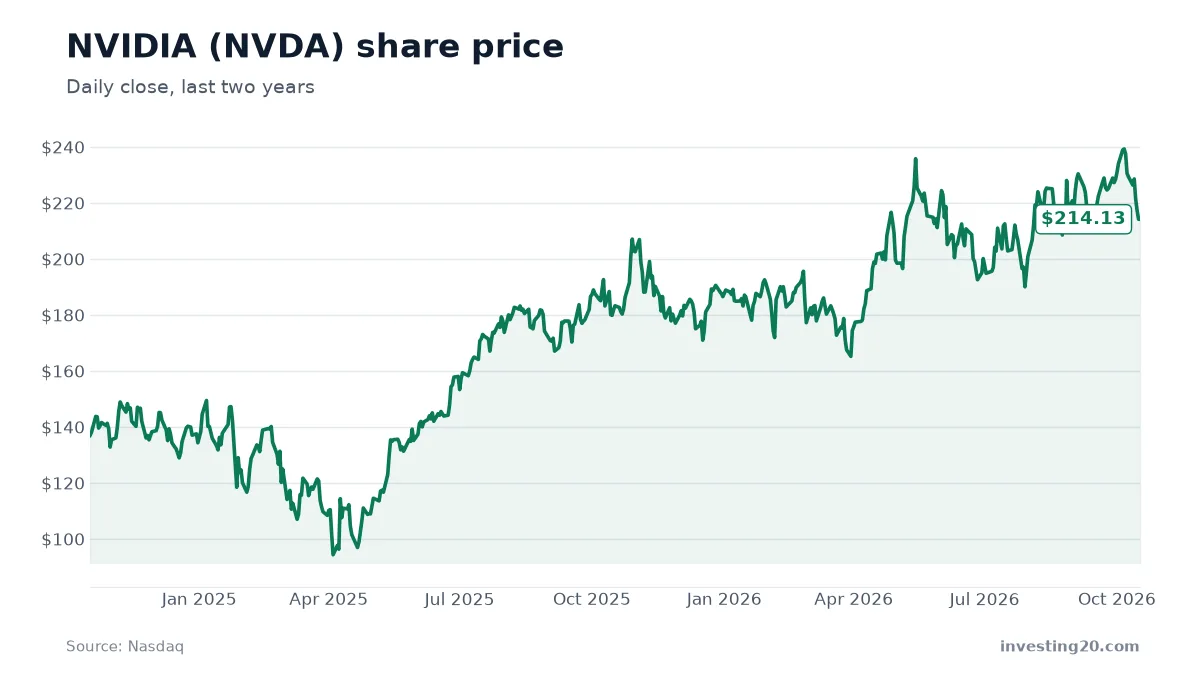
NVIDIA sits at the center of the modern compute buildout, trading at $214.13 with a market capitalization of $5.2 trillion as of October 2026. This article breaks down where the business stands today and maps out realistic revenue scenarios through 2030 so you can gauge whether the stock still offers value.
Long-range forecasts should never be treated as ironclad predictions. Instead, five-year models are scenario tools that show what kind of sales growth and valuation multiples are required to generate a positive return from today’s starting price.
| Share price | $214.13 (Oct 15, 2026) |
| Market value | about $5.2 trillion |
| 52-week range | $164.27 – $243.37 |
| Revenue, last 12 months | about $303.0 billion |
| Revenue growth, last fiscal year | 65% |
| Net income, last 12 months | about $192.9 billion |
| Price-to-sales | about 17.0× |
| Price-to-earnings | about 27× |
| Analyst 12-month target | average $324.20 (range $275 – $465); 33 buy, 0 hold, 0 sell |
Market data from Nasdaq as of October 17, 2026. Check current figures before making any decision.
The figures above capture a company running at extraordinary operational scale. NVIDIA generated $303.0 billion in sales over the last four reported quarters, converting nearly two-thirds of that into bottom-line net income.
What NVIDIA does and how it makes money
NVIDIA is the global leader in accelerated computing and artificial intelligence hardware and software. The company designs high-performance graphics processing units (GPUs), networking platforms, and computing architectures that power enterprise data centers, cloud infrastructure, and advanced computing clusters.
Instead of operating its own chip fabrication plants, NVIDIA focuses on architecture, chip design, and integrated systems. Its revenue primarily comes from selling compute platforms directly to cloud service providers, large tech enterprises, sovereign entities, and server manufacturers.
Beyond core silicon, NVIDIA packages its chips with proprietary networking hardware and software frameworks like CUDA. This ecosystem creates customer lock-in: once engineers develop software optimized for NVIDIA’s compute stack, switching to alternative hardware requires substantial software rework and operational cost.
Where the business stands: sales, margins, and earnings
NVIDIA’s financial trajectory over the past three fiscal years shows rapid expansion. Fiscal year revenue rose from $60.9 billion in the year ending January 2024 to $130.5 billion in January 2025, reaching $215.9 billion in the fiscal year ending January 2026. That represented 65.5% annual growth in the latest full fiscal year.
Quarterly momentum has continued through 2026:
- Quarter ending October 26, 2025: $57.01 billion
- Quarter ending January 25, 2026: $68.13 billion
- Quarter ending April 26, 2026: $81.61 billion
- Quarter ending July 26, 2026: $96.22 billion
Net income over the last four quarters reached $192.9 billion, up from $120.1 billion in fiscal 2026 and $72.9 billion in fiscal 2025. This puts NVIDIA’s trailing price-to-earnings ratio at 26.8, alongside a price-to-sales multiple of 17.0 and a dividend yield of 0.46%.
The company has consistently outperformed Wall Street estimates over the past four quarters. In the quarter ending July 2026, NVIDIA reported earnings per share (EPS) of $2.22 against a consensus expectation of $2.09, delivering a 6.22% positive surprise. That followed surprises of 10.0% in April 2026 (EPS of $1.87 versus $1.70 expected), 8.28% in January 2026 (EPS of $1.57 versus $1.45 expected), and 5.08% in October 2025 (EPS of $1.24 versus $1.18 expected).
Consensus EPS projections compiled by Nasdaq call for $9.27 per share for the fiscal year ending January 2027, $15.75 for fiscal 2028, and $21.85 for fiscal 2029.
What do analysts expect for NVDA stock over the next 12 months?
Wall Street sentiment remains unified. All 33 analysts tracked by Nasdaq maintain a buy rating on NVIDIA stock, with zero hold and zero sell recommendations.
The consensus 12-month price target stands at $324.20, which sits 51.4% above the current share price of $214.13. Even the most conservative analyst target of $275.00 implies an upside of roughly 28%, while the highest target reaches $465.00.
To achieve that average target of $324.20 over the next year, NVIDIA would need to continue beating quarterly expectations while demonstrating that customer capital expenditure plans remain durable. Investors tracking tech megacaps often evaluate similar long-range trajectories across hardware leaders, as explored in our Tesla stock forecast and Rocket Lab stock forecast.
NVDA stock forecast for 2030: three long-term scenarios
Looking out to 2030 requires modeling different rates of revenue deceleration alongside valuation multiple compression. Because growth rates naturally moderate as absolute numbers climb, our model steps growth downward over time and trims the price-to-sales multiple toward historical norms for mature tech businesses.
| Scenario | Revenue growth per year | 2030 revenue | Price-to-sales | Shares | Implied share price |
|---|---|---|---|---|---|
| Bear | 20% slowing to 5% | $479.9 billion | 5.0× | 27.12 billion | about $88.47 (-59%) |
| Base | 39% slowing to 15% | $783.7 billion | 10.0× | 25.58 billion | about $306.38 (+43%) |
| Bull | 59% slowing to 25% | $1.2 trillion | 18.0× | 24.59 billion | about $886.66 (+314%) |
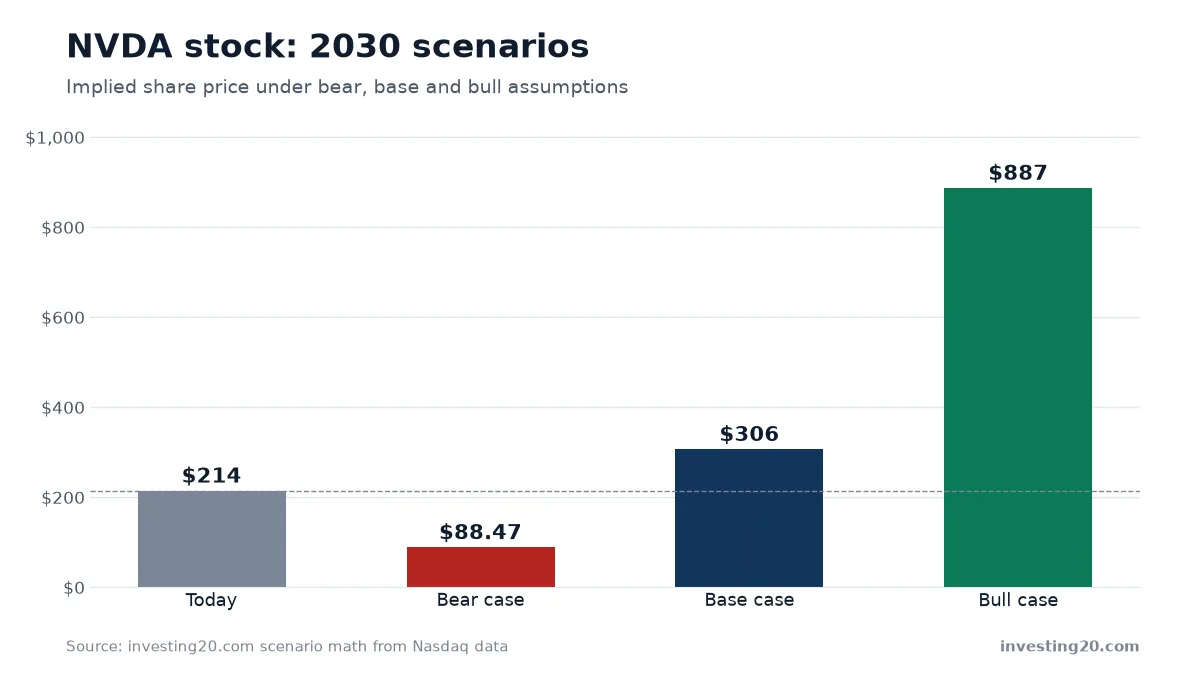
To understand what today’s price implies, look at the break-even math. At a base-case valuation multiple of 10.0 times sales and a diluted share count of 25.58 billion, NVIDIA must generate approximately $547.7 billion in revenue in 2030 just to trade at today’s $214.13. Any return beyond that depends on the company surpassing that revenue mark or sustaining a higher multiple.
In the bear case, customer hardware spending cools significantly. Revenue growth slows from 20% down to 5% per year, averaging about 12% annually and delivering $479.9 billion in 2030 revenue. If the market prices NVIDIA at a mature multiple of 5.0 times sales across 27.12 billion shares, the stock would trade near $88.47, representing a 59% drop from current levels.
The base case assumes strong demand persists but moderates from breakneck rates. Sales expand at 39% and glide down to 15% annually (averaging roughly 27% per year), reaching $783.7 billion in 2030. At a price-to-sales multiple of 10.0 and 25.58 billion shares, the implied price reaches $306.38, delivering a 43% gain.
The bull case models an extended compute cycle where enterprise and government adoption stays elevated. Sales grow at 59% down to 25% (about 41% annually on average), lifting 2030 revenue to $1.2 trillion. If investors continue paying a premium valuation of 18.0 times sales on 24.59 billion shares, the price reaches $886.66, up 314%.
The big takeaway from this scenario analysis is that valuation compression is the primary hurdle. Even if NVIDIA grows sales by more than 50% over the next four years to $479.9 billion, a drop in the price-to-sales multiple to 5.0 would result in negative investor returns. Continued revenue growth must outpace valuation contraction for the stock to advance.
For further perspective on how long-term projections work across high-growth sectors, review our earlier NVIDIA stock forecast coverage.
Risks to weigh
Before making any investment decision, consider the primary operational and market risks facing NVIDIA:
- Customer capital expenditure cycles: A handful of hyperscale cloud providers account for a large portion of data center demand; any pullback in their infrastructure spending would directly hit quarterly orders.
- Valuation sensitivity: At a price-to-sales multiple of 17.0, any slowdown in top-line growth could trigger sharp multiple contraction, even if earnings remain stable.
- Supply chain concentration: NVIDIA relies heavily on third-party foundries and advanced packaging facilities to manufacture its physical chips, leaving it exposed to fabrication bottlenecks.
- Competitive alternatives: Cloud customers and competing semiconductor designers continue developing custom in-house accelerators to reduce reliance on third-party GPUs.
What to watch next
The next milestone to monitor is NVIDIA’s upcoming quarterly earnings release for the period ending October 2026. Watch reported revenue against the prior quarter’s $96.22 billion run rate to see whether sequential quarterly growth remains intact.
Beyond headline revenue, keep an eye on net margin trends to verify that pricing power holds steady, and monitor full-year consensus revisions for fiscal 2027 (currently targeting $9.27 EPS) to gauge Wall Street’s confidence in spending momentum.
FAQ
What is the 12-month analyst target for NVIDIA stock?
According to Nasdaq consensus data as of October 2026, 33 analysts rate NVIDIA a buy with an average 12-month price target of $324.20, ranging from a low of $275.00 to a high of $465.00.
What revenue does NVIDIA need by 2030 to support its current price?
Under a base-case valuation multiple of 10 times sales and 25.58 billion diluted shares, NVIDIA would need about $547.7 billion in annual revenue by 2030 simply to justify its current price of $214.13.
How profitable is NVIDIA right now?
Over the four quarters leading up to July 2026, NVIDIA generated $192.9 billion in net income on $303.0 billion in total revenue, trading at a price-to-earnings ratio of 26.8.
Market data and financials: Nasdaq. Scenario math: investing20.
This article is for information only and is not investment advice. Do your own research before investing.