Jumia (JMIA) Stock Forecast and Price Prediction 2026–2030
JMIA stock forecast and price prediction for 2026 to 2030: Jumia’s latest results, analyst targets, and bear, base and bull 2030 scenarios with the math shown.
On this page
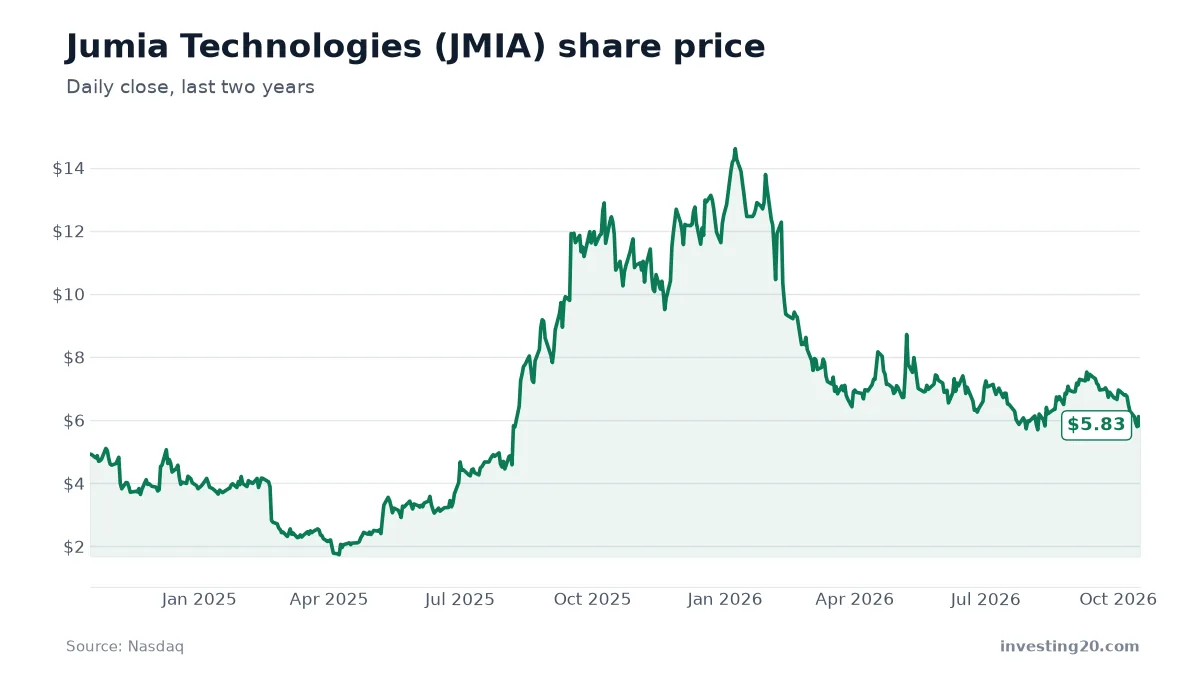
Updated October 17, 2026. This is the JMIA stock forecast for Jumia Technologies, the African e-commerce company listed on the New York Stock Exchange. It covers where the business stands today, what analysts expect for 2026 and 2027, and a JMIA stock price prediction for every year to 2030 under three scenarios.
The short answer: using Jumia’s own revenue and simple valuation math, JMIA lands near $2 in a bear case, $8 in a base case and $22 in a bull case by 2030, against $5.83 today. Analysts’ 12-month targets average about $12. Everything depends on Jumia breaking even in the fourth quarter of 2026 as promised.
Nothing here is a prediction you should trade on. Long-range stock forecasts are guesses, so this article shows its assumptions and lets you change them.
Key numbers at a glance
| Share price | $5.83 (close on October 16, 2026) |
| Market value | about $780 million |
| 52-week range | $5.59 – $14.72 |
| Revenue, last 12 months | about $210 million |
| Net loss, last 12 months | about $58 million |
| Analyst 12-month targets | $11 – $18 (average about $12) |
| Next earnings report | mid-November 2026 (date not yet confirmed) |
Price and valuation data are from Nasdaq, StockAnalysis and MarketBeat. Check them for current figures before you make any decision.
What is Jumia Technologies (JMIA)?
Jumia is an online marketplace that connects sellers with shoppers across Africa. It was founded in 2012, has its headquarters in Berlin, and listed on the New York Stock Exchange in April 2019 at $14.50 per share. Alongside the marketplace it runs its own logistics network and a payments service, JumiaPay.
The company is smaller and more focused than it was a few years ago. Francis Dufay took over as chief executive in late 2022 and cut costs hard. Jumia left South Africa and Tunisia in 2024 and Algeria in February 2026, and now concentrates on markets including Nigeria, Egypt, Kenya, Morocco, Ivory Coast and Ghana. Nigeria is the largest.

Image Credit: Jumia.com
Where the business stands in 2026
Growth has picked up and losses are shrinking, but Jumia still loses money.
Full year 2025:
- Revenue of $188.9 million, up 13% from 2024
- Gross merchandise value (GMV, the value of goods sold on the platform) of $818.6 million, up 14%
- Adjusted EBITDA loss of $50.5 million, about the same as 2024
- Loss before income tax of $60.1 million, down 38%
Second quarter 2026 (reported August 12, 2026):
- Revenue of $52.0 million, up 14% year over year
- GMV of $216.3 million, up 20%
- Physical goods orders up 28% and quarterly active customers up 24%, to 2.6 million
- Adjusted EBITDA loss of $8.7 million, down 36%
- Liquidity of $48.3 million at the end of the quarter
With that report Jumia also announced a $50 million capital raise, anchored by a $25 million investment from the International Finance Corporation, at $5.52 per share. The raise gives the company more room to reach breakeven, and it also means more shares outstanding.
Management’s targets are specific. It expects GMV to grow 20% to 30% in 2026, an adjusted EBITDA loss of $25 million to $30 million for the year, breakeven on adjusted EBITDA and positive cash flow in the fourth quarter of 2026, and a full profitable year on that basis in 2027.
JMIA stock forecast for 2026 and 2027
The near-term forecast comes down to one question: does Jumia hit breakeven on schedule?
Five brokerages cover the stock. Four rate it a buy and one a sell. After the August results, RBC set a target of $13, Craig-Hallum $12 and Cantor Fitzgerald $11; New Street Research has the highest at $18. The average is about $12 to $14 depending on the data provider, roughly double the current price.
Two things are worth knowing about those targets:
- They are conditional. They assume the fourth-quarter breakeven happens. A miss, or another capital raise, would likely pull them down.
- Several were lowered in August. RBC and Cantor Fitzgerald both cut their targets after the second-quarter report.
The stock has drifted lower since the August report and set a new 52-week low of $5.59 in October, so the market is not giving Jumia much credit for the plan yet. If it reports a breakeven fourth quarter in early 2027, the shares have room to move toward the analyst range. If breakeven slips, that low is the level to watch.
JMIA stock forecast for 2030: three scenarios
No one can forecast a share price four years out. What you can do is pick assumptions and see what they imply. The table below starts from 2025 revenue of $188.9 million and applies a yearly growth rate through 2030, a price-to-sales multiple, and a share count that allows for some dilution.
| Scenario | Revenue growth per year | 2030 revenue | Price-to-sales | Shares | Implied share price |
|---|---|---|---|---|---|
| Bear | 5% | $241 million | 1× | 140 million | about $2 |
| Base | 15% | $380 million | 3× | 135 million | about $8 |
| Bull | 25% | $577 million | 5× | 130 million | about $22 |
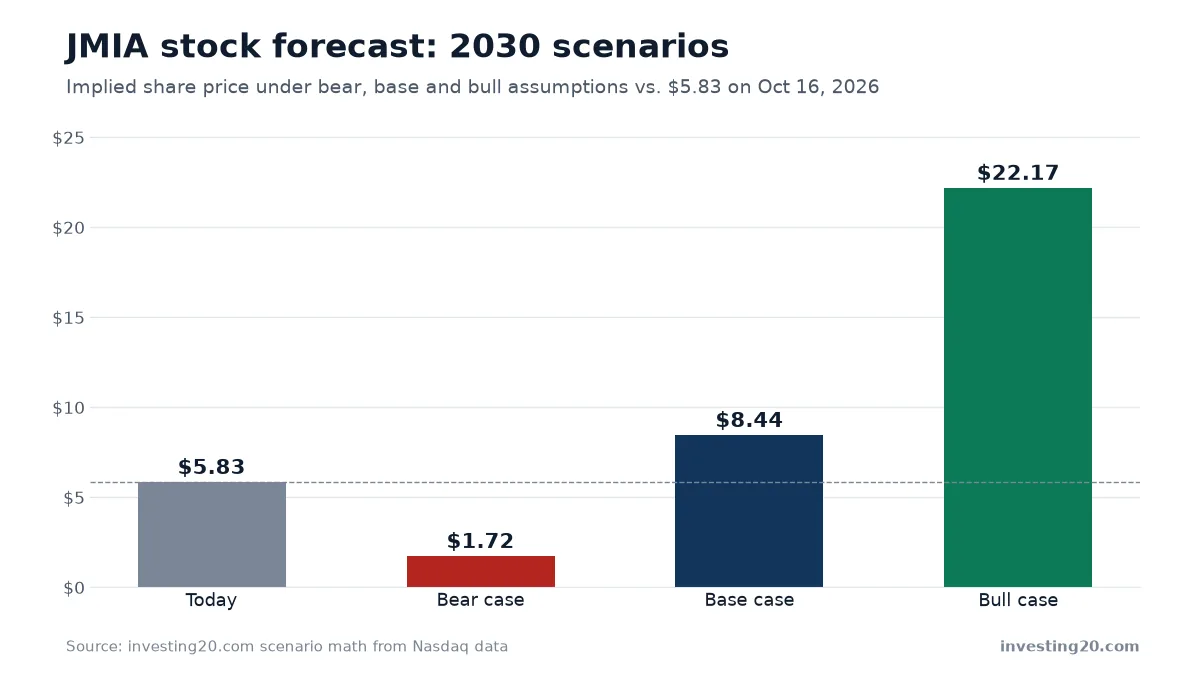
How to read it:
- Bear case. Competition from Temu and Shein and weak local currencies hold growth to low single digits, profits stay out of reach, and the market values Jumia at about one times sales, below the roughly 1.5 times it traded at in late 2022.
- Base case. Revenue keeps growing at about the 2025 pace, Jumia turns modestly profitable, and the valuation settles a little below today’s roughly four times sales. The result is a share price close to where it is now.
- Bull case. Growth accelerates toward the top of management’s GMV guidance, margins expand, and investors pay a growth multiple.
JMIA stock price prediction by year
The same three scenarios, year by year. Each year applies that scenario’s revenue growth and moves the valuation and share count in even steps from today’s levels (about 3.7 times sales and 134 million shares) to the 2030 assumptions.
| Year-end | Bear | Base | Bull |
|---|---|---|---|
| 2026 | $4.66 | $5.79 | $7.05 |
| 2027 | $4.02 | $6.38 | $9.44 |
| 2028 | $3.32 | $7.02 | $12.59 |
| 2029 | $2.55 | $7.71 | $16.73 |
| 2030 | $1.72 | $8.44 | $22.17 |
These are outputs of the stated assumptions, not forecasts of where the stock will trade in any given year. Real prices will swing far more than a smooth path suggests.
The base case landing near today’s price is the main takeaway. The current valuation already assumes several years of steady growth, so the upside depends on Jumia doing better than that.
What about 2040 and 2050?
The earlier version of this article gave price ranges for 2040 and 2050. Those were not defensible and they have been removed. Over 15 to 25 years the outcome depends on things no model captures: how fast online shopping grows in Africa, whether Jumia stays independent, and how many new shares it issues along the way.
What would have to be true for the stock to be much higher in the long run:
- Jumia becomes consistently profitable and funds its own growth
- Online retail takes a far larger share of spending in Nigeria, Egypt and its other markets
- It holds its position against Chinese cross-border platforms and local rivals
- Currency devaluations stop erasing its growth when results are reported in dollars
How the earlier forecast held up
The 2023 version of this article projected $5.73 to $11.60 for 2023 and $12 to $15.60 for 2025. The stock trades at $5.83 in October 2026, well below the low end of that 2025 range. That miss is the reason this update uses scenarios with stated assumptions instead of single price targets.
Risks to weigh
- Cash and dilution. Jumia had $48.3 million of liquidity before the August 2026 raise and has repeatedly issued new shares.
- Competition. Temu and Shein are expanding across African markets with very low prices.
- Currency. Jumia earns in naira, Egyptian pounds and other local currencies and reports in dollars.
- Concentration. After three country exits, results depend heavily on a few markets, Nigeria above all.
- Volatility. The share price ranged from $5.69 to $14.72 in the past year.
FAQ
What is the JMIA stock forecast for 2026 and 2027?
Analysts covering Jumia have 12-month price targets between $11 and $18, with an average of about $12 to $14, against a share price of $5.83 on October 16, 2026. Those targets assume Jumia hits its goal of breaking even on adjusted EBITDA in the fourth quarter of 2026 and staying profitable on that basis in 2027.
What is the JMIA stock prediction for 2030?
Nobody can know. Using simple revenue-and-valuation math, a bear case lands near $2, a base case near $8 and a bull case near $22 per share by 2030. The spread is wide because the outcome depends on whether Jumia becomes consistently profitable.
Is Jumia profitable?
Not yet. Jumia reported an adjusted EBITDA loss of $50.5 million for 2025 and $8.7 million for the second quarter of 2026. Management is targeting adjusted EBITDA breakeven and positive cash flow in the fourth quarter of 2026, and a full profitable year on that basis in 2027.
Is Jumia stock a buy, sell or hold?
Most of the handful of brokerages that cover Jumia rate it a buy; Nasdaq’s October 2026 consensus shows three buy ratings and no holds or sells, while MarketBeat also lists one sell. That is a small group of analysts, the stock is volatile, and this article is not investment advice.
Can JMIA stock reach $20?
Only in an optimistic case. In the bull scenario below, with 25% yearly revenue growth and a valuation of five times sales, the math lands near $22 by 2030. The base case is closer to $8.
When does Jumia report earnings next?
Jumia’s third-quarter 2026 results are expected in mid-November 2026. Data providers list dates between November 11 and November 18; check Jumia’s investor relations site for the confirmed date.
Can Jumia be the next Amazon?
It is unlikely to match Amazon’s scale. Jumia sells into far smaller consumer markets, it has left several countries to cut losses, and Chinese platforms such as Temu and Shein now compete for the same shoppers. A realistic win for Jumia is a profitable, growing marketplace in its core African markets.
Final thoughts
Jumia is in better shape than it was when this article was first written. Losses are down, growth has returned and management has put a date on breakeven. The stock is still a high-risk bet on that date being met, and the scenario math shows the current price already assumes steady progress.
Related forecasts: Palantir (PLTR), NIO stock forecast 2026–2030, can NIO stock reach $1,000?, Amazon and SoFi.
Disclaimer: This article is for information only and is not investment advice. The scenarios are illustrations based on stated assumptions, not predictions. Do your own research before investing.