Monthly Income From REITs: US and TSX Monthly Dividend REITs, and the Math (2026)
How to earn monthly income from REITs: US and high-yield TSX REITs that pay monthly, their 2026 yields, and how much you need to invest to make $500 a month.
On this page
Updated October 17, 2026. This article explains how REITs can produce a monthly income, which REITs pay every month in the US and on the Toronto Stock Exchange (TSX), and how much you would need to invest to collect $500 a month. US yields and prices are as of October 2, 2026; Canadian ones as of October 16, 2026.
What are REITs?
A REIT, or real estate investment trust, is a company that owns and operates property: apartments, warehouses, shopping centers, hospitals, hotels and more. Some REITs own mortgages instead of buildings.
A REIT works like a fund for real estate. You buy shares, the company collects rent, and it passes most of the income on to you. By law a REIT must pay out at least 90% of its taxable income to shareholders, which is why REIT yields are higher than those of most stocks.
Why invest in REITs?
Liquidity. You get exposure to real estate without owning a building. REIT shares trade like any stock, so you can sell in seconds. Selling a property takes months.
Income. Because of the 90% payout rule, REITs pay steady dividends. A handful pay every month instead of every quarter, which suits anyone who wants income that lines up with monthly bills.
A low starting amount. One share of the REITs below costs between about $9 and $57. A rental property needs a down payment in the tens of thousands.
Four REITs that pay monthly dividends
| REIT | What it owns | Share price | Monthly dividend | Yield |
|---|---|---|---|---|
| Realty Income (O) | Single-tenant retail and commercial property | $54.13 | $0.2715 | 6.0% |
| EPR Properties (EPR) | Theaters, attractions, recreation | $56.45 | $0.31 | 6.6% |
| LTC Properties (LTC) | Senior housing and health care | $43.00 | $0.19 | 5.3% |
| AGNC Investment (AGNC) | Mortgage-backed securities | $8.79 | $0.12 | 16.4% |
Figures are from StockAnalysis dividend pages as of October 2, 2026. Check current numbers before you buy.
1. Realty Income (O)

Realty Income calls itself “The Monthly Dividend Company.” It is an S&P 500 company that owns thousands of single-tenant properties leased to retailers and other businesses on long-term leases. It has a long record of raising its dividend, and it is the usual starting point for a monthly income portfolio.
More information: realtyincome.com/investors
2. EPR Properties (EPR)
EPR is a specialty REIT that owns “experience” properties: movie theaters, ski resorts, attractions and fitness centers. The yield is higher than Realty Income’s because the tenants are more exposed to consumer spending. EPR suspended its dividend during the pandemic in 2020 and brought it back in 2021, which shows the risk.
More information: investors.eprkc.com
3. LTC Properties (LTC)
LTC invests in senior housing and health care properties through leases, mortgage loans and other structures. Demand for senior housing grows with an aging population. The monthly dividend has been steady at $0.19 per share for years, so expect income here more than growth.
More information: ltcreit.com
4. AGNC Investment (AGNC)
AGNC is a mortgage REIT. It owns residential mortgage-backed securities guaranteed by US government agencies and funds them largely with borrowed money. That leverage produces the 16% yield and also the risk: AGNC has cut its dividend several times, and its share price has fallen over the long run. Treat it as a small, high-risk slice of a portfolio, if at all.
More information: ir.agnc.com
What happened to STAG Industrial?
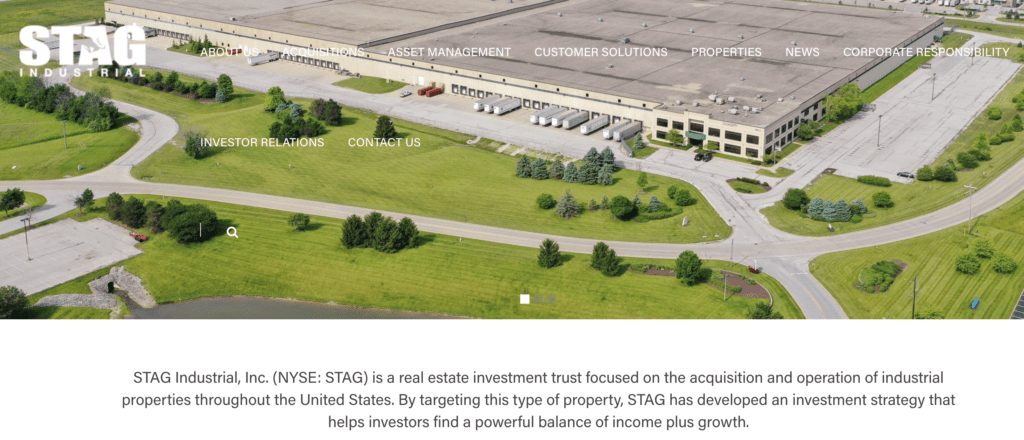
STAG Industrial, which owns single-tenant warehouses and industrial buildings, was on the original version of this list. At the start of 2026 it switched from monthly to quarterly dividends. It now pays $0.3875 per share each quarter, a yield of about 4.3% at $36.05. It is still a solid industrial REIT, but it no longer fits a monthly income plan.
High-yield monthly paying REITs on the TSX
Monthly payments are the norm in Canada. Most large Canadian REITs listed on the Toronto Stock Exchange pay their distributions every month, so a Canadian investor, or anyone with access to the TSX, has more monthly options than the US list above. Canadian REITs are trusts, so you buy units rather than shares, and the tickers end in “.UN”.
| REIT (TSX ticker) and what it owns | Yield | Monthly payout | Unit price |
|---|---|---|---|
| SmartCentres (SRU.UN): shopping centres, many anchored by Walmart | 6.9% | C$0.1542 | C$26.76 |
| CT REIT (CRT.UN): Canadian Tire stores | 5.6% | C$0.0818 | C$17.53 |
| RioCan (REI.UN): city retail and mixed-use | 5.5% | C$0.0965 | C$20.98 |
| Choice Properties (CHP.UN): grocery-anchored retail, Loblaw the main tenant | 5.1% | C$0.065 | C$15.25 |
| CAPREIT (CAR.UN): apartments | 4.9% | C$0.1292 | C$31.52 |
| Granite (GRT.UN): warehouses and logistics | 4.1% | C$0.2958 | C$86.19 |
Prices are closes on October 16, 2026, from StockAnalysis; yields are the monthly distribution times twelve, divided by the price.
A few things stand out:
- SmartCentres has the highest yield, and its distribution has been flat at about C$0.154 a month since early 2025. A high yield with no growth is the market’s way of pricing in some risk, so treat it as income rather than growth.
- CT REIT and Choice Properties keep raising. CT REIT increased its monthly distribution in June 2026 and Choice Properties in March 2026. Both have a single large, well-known tenant (Canadian Tire and Loblaw), which makes the rent steadier and also concentrates the risk.
- Granite and CAPREIT yield less but own warehouses and apartments, two property types with steadier long-term demand. Granite raised its distribution in December 2025.
If you would rather not pick, two TSX-listed ETFs hold a basket of Canadian REITs and also pay monthly: the iShares S&P/TSX Capped REIT Index ETF (XRE), at C$15.71 with a yield of about 4.6%, and the BMO Equal Weight REITs Index ETF (ZRE), at C$22.32 and about 4.7%. Both yields are based on the past year’s distributions.
For Canadians, holding these in a TFSA keeps the distributions tax-free. If you live outside Canada, Canadian withholding tax usually applies to the distributions, and how much depends on your country and account type, so check with your broker before you buy.
How much do you need for $500 a month?
$500 a month is $6,000 a year. Divide that by the yield to get the amount to invest.
| Yield | Amount needed for $500 a month |
|---|---|
| 4% | $150,000 |
| 5% | $120,000 |
| 6% | $100,000 |
| 8% | $75,000 |
A portfolio split equally between Realty Income, EPR and LTC yields about 6.0% today, so it would take roughly $100,000 to produce $500 a month.
Adding AGNC lowers the amount needed, because its yield is so high. That is the trade-off: you are replacing income from rents with income that depends on borrowing costs and has been cut before. The earlier version of this article reached $500 a month with $65,000 by leaning on AGNC. That number was achievable on paper and riskier than it looked.
The same math works in Canadian dollars: a TSX portfolio yielding 5.5% needs about C$109,000 for C$500 a month.
You do not need the full amount on day one. Reinvesting the dividends and adding money each month gets you there over time, and the same math works for smaller goals: $50 a month needs about $10,000 at 6%.
Risks to know
- Interest rates. When rates rise, REIT prices usually fall, and borrowing costs go up.
- Dividend cuts. A dividend is not guaranteed. EPR suspended its payout in 2020 and AGNC has cut its several times.
- Concentration. Each REIT specializes. A problem in theaters, senior housing or mortgages hits one holding hard, so spread your money across several or use a REIT fund.
- Taxes. Most REIT dividends are taxed as ordinary income. Holding REITs in an IRA or 401(k) avoids the yearly tax bill.
FAQ
How much do REITs pay out?
REITs must distribute at least 90% of their taxable income to shareholders. In October 2026 the monthly-paying REITs in this article yield between about 5.3% and 6.6% a year, and the mortgage REIT AGNC yields about 16% with much higher risk.
How much do I need to invest in REITs to make $500 a month?
$500 a month is $6,000 a year. At a 6% yield that takes about $100,000. At 5% it takes $120,000, and at 8% it takes $75,000. Higher yields need less money but carry more risk of a dividend cut.
Which REITs pay monthly dividends?
In the US, Realty Income (O), EPR Properties (EPR), LTC Properties (LTC) and AGNC Investment (AGNC) all pay monthly as of October 2026. Most large Canadian REITs on the TSX also pay monthly, including SmartCentres, CT REIT, RioCan, Choice Properties, CAPREIT and Granite. STAG Industrial switched from monthly to quarterly payments at the start of 2026.
Which high-yield TSX REITs pay monthly?
As of October 16, 2026, SmartCentres REIT (SRU.UN) yields about 6.9%, CT REIT (CRT.UN) 5.6%, RioCan (REI.UN) 5.5% and Choice Properties (CHP.UN) 5.1%, all paid monthly. The iShares XRE and BMO ZRE REIT ETFs also pay monthly, at about 4.6% to 4.7%.
Can you lose money on a REIT?
Yes. REIT share prices fall when interest rates rise or when tenants struggle, and dividends can be cut. AGNC, for example, has reduced its dividend several times. A long dividend record lowers the risk but does not remove it.
How are REIT dividends taxed?
Most REIT dividends are taxed as ordinary income in a taxable account. The 20% Section 199A deduction for REIT dividends was made permanent in 2025, which brings the top federal rate on them from 37% to 29.6%, plus the 3.8% net investment income tax for high earners. This is general information, not tax advice.
How do I buy REITs?
Publicly traded REITs are bought and sold like any other stock, through any brokerage account. You can also own them through a REIT index fund or ETF.
This article is for information only and is not investment or tax advice. For questions, use the contact form or email [email protected].